Learning the World — Ken MacLeod

Cover of Learning the World


Learning the World
Ken MacLeod
398 pages
published in 2005

It only occurred to me after I finished this novel, that this was in fact Ken MacLeod’s version of Vernor Vinge’s A Deepness in the Sky. Like that, Learning the World is a novel of first contact between a planetbound alien civilisation and a human interstellar trading expedition. That realisation only dawned so late because despite the simular premise, the novels do not resemble each other all that much. MacLeod’s version is much more straightforward than Vinge’s book was.

Nevertheless, if you read these novels back to back MacLeod’s novel does start to look like a cheap knockoff, especially in synopsis. Both have a species of planetbound aliens, operating at a more or less early twentieth century level of technology, divided into several nations in a political situation that resembles that of pre-World War I Europe. For both the arrival of the humans represent both an opportunity and a threat, with their presence accelerating the political tension already present. In both the humans are also divided amongst themselves about how to handle first contact.
Read more…

Engine City — Ken MacLeod

Cover of Engine City


Engine City
Ken MacLeod
271 pages
published in 2002

This is the third and last book in the Engines of Light series, the previous two being Cosmonaut Keep and Dark Light. As the capstone of the series, Engine City was a disappointment.

From the start this series was supposed to be a traditional science fiction trilogy, unlike MacLeod’s previous Fall Revolution series in which the individual novels were only thematically related. This worked well in the first two books, with Cosmonaut Keep setting up the plot and Dark Light continuing the plotlines while setting up some new ones of its own, all of which should then be resolved in Engine City, which they were, but in a far too abrupt manner. On the whole it seemed as if MacLeod had grown bored with the series and crammed everything that needed to be resolved in one slim book, instead of taking it at the same pace as the first two.

Read more…

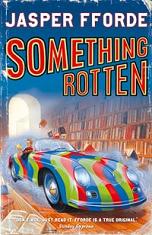
Something Rotten — Jasper Fforde

Cover of Something Rotten


Something Rotten
Jasper Fforde
393 pages
published in 2004

Something Rotten is the fourth novel in Jasper Fforde’s Thursday Next series, which concludes the story and ties up all the remaining plot points from the previous three books. There may be some spoilers here if you haven’t read the previous novels, The Eyre Affair, Lost in a Good Book and The Well of Lost Plots. Like the previous books this was entertaining, funny in places but slight. Nevertheless, this was an improvement on the previous book, which I thought to be the weakest in the series.

In Something Rotten Thursday Next comes out from her hiding place in the realm of unfinished stories back into the real world, to take on her old enemy the Goliath Corporation and force them to uneradicate her husband, Landen Park-Laine. This may turn out to be more easier than she hough, as the corporation has seemingly turned over a new leaf and is in the process of setting right all of their previous misdeeds in return for their victims forgiveness. Landen may therefore be much more easily restored to her than Thursday thought possible.

Read more…

Cell – Stephen King

Cover of Cell


Cell
Stephen King
350 pages
published in 2006

I’m not a big horror fan, nor a big Stephen King fan either. The only books of his I liked was his Dark Tower series and even that I haven’t kept up with. Yet when I idly started to skim through Cell, I couldn’t put it down until I had finished it. Sandra, who is a Stephen King fan, says that this is what King does best: grip you by the throat and carry you along until the story’s over. He certainly managed to do that here, dragging you bodily to the finish despite the absurdities on the way.

Because, let’s be honest, Cell is not so much a good novel, as it is an exciting novel, one for which the inevitable movie treatment has already been written. Googling, it seems this was written as a homage to zombie horror movies, as well as novels like Richard Matheson’s I am Legend; Cell is in fact dedicated to George Romero and him. In that context it works about as well as the recent remake of Dawn of the Dead: it’s a fast paced but shallow adrenaline rush.

Read more…

Souls in the Great Machine — Sean McMullen

Cover of Souls in the Great Machine


Souls in the Great Machine
Sean McMullen
448 pages
published in 1999

Sean McMullen is an Australian science fiction writer, whose first books were only published there, with Souls in the Great Machine being the first one available in the rest of the world. Apparantely it’s a rewrite of two earlier McMullen novels, Voices In The Light and Mirrorsun Rising, which were of course only available in Australia. In any event, Souls in the Great Machine is the first novel (or indeed anything) I’ve read of McMullen, after the local science fiction bookstore had it and its sequel, The Miocene Arrow available cheap. Because of good reviews in Locus and elsewhere I thought I’d take a gamble.

On the whole I think Souls in the Great Machine was worth the gamble, though I had some caveats. The writing isn’t always as smooth as you would like and the overall plot is a bit …episodic shall we say, which may of course be a result of it having started as two separate books. The most bothersome aspect of McMullen’s writing however is his sudden and rather frequent switch of viewpoints. Usually even with authors who like to jump from character to character you still get a good sense of who the heroes of their stories are, but with this book there are several perspective shifs which abandon the character you thought was the protagonist for someone else entirely. This feels a bit sloppy, but is more than made up for by the inventiveness McMullen displays in his depiction of the world of Souls in the Great Machine.

Read more…