Despite the oodles of spare time allegedly freed up by being forced to work from home thanks to Covid, I haven’t actually managed to read all that much this past year. Whether it’s lack of interest, lack of energy or something else I don’t know, but I’m lucky if I managed to get into the double digits this year of books read. To be honest, it has been a bit of a trend for me the last few years. Having kept a booklog since 2001 and having been deeply involved in science fiction and fandom in 2010-2015 just caught up with me. As I got into anime I spent less time reading; when covid hit I thought it would give me time to read again, but so far it hasn’t. Until yesterday, when I felt the need to read something comforting, something I hadn’t read in a long time and my eye fell on Richard Fortey’s Trilobite.
Richard Fortey is a writer I got to know thanks to Sandra, who was a huge fan of his. One of the advantages of being in a relationship with somebody who’s as big a reader as you are. Whereas I was always interested in history, science fiction and the like, she was more into the natural sciences, sociology and detective fiction. Our tastes overlapped in places — after all we first met in a Terry Pratchett related IRC channel — and where they differed there was always an opportunity to get to know a new writer. Thanks to Sandra I read a hell of a lot more classic detective novels than I otherwise would’ve had, but also a lot more of pop science books like this one. She always had an eye for interesting, entertaining science books. Trilobite
I last read and reviewed in August of 2004, so high time to reread it. Below is the original review, warts and all:
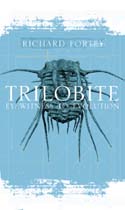
Trilobite!
Eyewitness to Evolution
Richard Fortey
269 pages, including index
published in 2000
I’ve always liked trilobites, but never as much as Richard Fortey liks them. He is genuinely enthusiastic about them, which comes through on every page of this book. For a subject which could easily be made dull, this is a good thing, though at times his enthusiasm is slightly wearing. Never mind though, if you have even the slightest interest in trilobites, he will suck you in. Fortey has a knack of describing the various species of trilobites with such clarity that even somebody like me, who didn’t know a pleura from a glabella was able to picture them in his mind and understand the differences.
Trilobite! is not just about trilobites however, as the subtitle, Eyewitness to Evolution indicates. Fortey uses trilobites to illustrate the larger story of evolution and the workings of science. His book not only tells of the evolutionary history of the trilobite, but also of the history of their discovery and the evolution of our understanding of them.
Popular science books, especially those written by non-scientists, often have a tendency to focus on those areas of science in which a dramatic story can be told, either because the subject matter itself is so dramatic, or because the story behind the science is. At first glance, trilobites offer neither. The animal itself is so common a fossil, existing in so many variations as to have been dubbed “the beetle of the Paleozoic”. Fascinating in its anatomy to be sure, but without the vicarious thrill of the dinosaurs. Furthermore, the history of trilobite research, as detailed by Fortey, is one of gradual discovery and steady progress. There are no heroic tales of young, brilliant scientists with outlandish but correct theories fighting the hidebound establishment to get them accepted here.
Since that is not the way most science works anyway, that is probably a good thing. Anything the subject might lack in conspicuous drama, it more than makes up for in the enthusiasm Fortey brings to his trilobites. The history of both trilobites itself as well as the history of our understanding of them comes alive through it.
Take for example how Fortey starts Trilobite!. The first chapter mixes personal reminiscences with a short overview of where trilobites come from and what the book is about and manages to refer Thomas Hardy, who used a trilobite to great effect in his novel A Pair of Blue Eyes. It is at once both interesting and warm, an appealing jumble that’s neither pedantic nor pretentious. Most of the rest of the book is the same way, somewhat less structured than others may have thought wise, but none the less interesting for it.
Halfway through the book, Fortey partially abandons his trilobites to examine how the abundant presence of trilobite fossils has helped our understanding of evolution. Since trilobites fossils are so common and trilobites existed for such a long time, they make it easy to trace evolutionary processes.
One part of this diversion has Fortey butt in to the ongoing arguments about the socalled “Cambrian explosion”, that time when life, according to Stephen Jay Gould and others, exploded into an incredibly array of forms and designs, most never seen again afterwards. (Gould’s version of this event is explored in Wonderful Life.) Fortey himself is somewhat skeptical of this notion and shows how this theory has changed since the publication of Wonderful Life.
After this diversion, Fortey goes back to his trilobites, with a general description of the lifes and times of trilobites. He ends it with an impassionate crusade for scientific curiosity and its importance, even if it doesn’t bring anything of immediate applied value.
In all, Trilobite! is everything a good popular science book should be: interesting, enlightening and humane. Recommended.