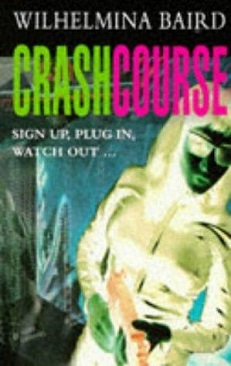
Crashcourse — Wilhelmina Baird

Cover of Crashcourse


Crashcourse
Wilhelmina Baird
277 pages
published in 1993

Wilhelmina Baird is an interesting writer: wrote some short science fiction at the dawn of the New Wave (as Kathleen James), then returned in 1993 with this, a cyberpunk inspired novel with overtones of the sort of fifties satirical sf Pohl and Kornbluth wrote. She wrote three more novels, two sequels to this, then disappeared. She’s obscure enough not to even have a Wikipedia entry, so it’s unclear if she stopped writing or just couldn’t get published anymore. I vaguely remember that her second novel, Clipjoint, was hailed as a minor classic when it came out, but that’s all I knew of her writing when I first got this.

In the world of Crashcourse the population is divided in a small ruling class of Aris, slightly more Techs and Arts to serve and entertain them, with the vast mass of people being unemployed umps. Cass, Moke and Dosh are three of them, trying to earn enough (illicit) money to get off Earth, Cass as thief, Moke as artist and Dosh as whore. Caught up in a love triangle, with Cass loving Dosh who loves Moke who loves Cass, only wanting to leave if all three of them can leave together. That is, until Dosh is roughed up once too many by one of his clients and temptation comes calling in the form of an Aris with a film proposal.

As Cass is all too well aware, such a film is little more than a legalised snuff movie, where some hapless umps are enticed to sign their lives away in return for a shot at the kind of money that can get them off Earth and into the good life. Meanwhile the audience doesn’t just see them get killed, but actually feels the emotions of the leading actor or actress in a movie. It used to be that the film company didn’t inform their stars that they were on camera, but that had been outlawed — not that this made the films necessarily safer.

Cass — short for Cassandra, as what else could it be — warns against taking the contract, but Dosh is obsessed by becoming a proper actor and sees this as his real break, while Moke is happy enough to go along if only to stop all three of them from staying stuck in their old routines, with no real hope of making it off Earth. Once they have signed the contract, things move fast. Cass and Dosh are caught in a runaway funfair ride, while Moke gets an invitation from a serious art collector to talk about his sculptures and to top it all off, they rescue a young teenage girl from a gang rape.

To be honest, the plot flowed in a familiar pattern from there on out, where of course the “rescue” is all part of the film and the art collector, who the protagonists all dismiss as too obvious a put-on, turns out be genuine. Just as predictable, Cass and her friends, with a little bit of help from the local gangster in love with her, plot to turn the tables on the film company and succeed, but at the cost of the life of one of them.

The plot is therefore slightly pedestrian, while the background is, as said, clearly influenced by cyberpunk, but with a fifties sheen to it. It’s not quite over the top enough to rank with something like The Space Merchants, but it has some of the same elements. A world rigidly divided in haves and have nots, where the vast mass of people have nothing to do but engage in mindless entertainment and crime, while their rulers in turn amuse themselves with them. There’s some use of the usual computer hocus pocus you’d expect in cyberpunk, but it’s marginal; this story could’ve easily been told without it.

Crashcourse, even if predictable, kept me entertained, in large part due to the way Wilhelmina Baird writes Cass, as a self aware, sometimes funny, tough but vulnerable woman, somebody who goes along with a harebrained scheme against her better instincts, out of love. The love triangle between Cass, Dosh and Moke is only sketched, but comes across as warm and real, a far cry from some of the more regretable cyberpunk cliches.
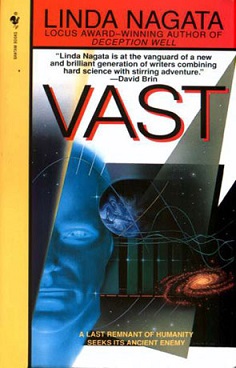

Vast — Linda Nagata

Cover of Vast


Vast
Linda Nagata
403 pages
published in 1998

Space opera used to be terrible, reactionary stories of brawny male heroes with safe anglosaxon names making the galaxy safe for terran manifest destiny by cheerfully genociding any alien races looking at them funny. Long derided as the lowest of the low, though with the occasional saving grace in the form of that elusive “sense of wonder” all science fiction strives to achieve, it was sort of rehabilitated in the seventies by a generation of fans and writers who’d grown up reading the stuff. In the eighties and nineties this led to the socalled New Space Opera, which took that sense of wonder and removed the xenophobia and human supremacy from it. Though in this New Space Opera the universe was far more indifferent to human pretensions than the old stuff, it could still be upbeat, as in e.g. Iain M. Banks’ Culture novels, where hundreds of various human races live happily ever after in an AI controlled utopia.

But not always. In Linda Nagata’s Vast the universe is not just indifferent, but actively hostile to human life. A millions years old alien war has left still active, automated warships behind, warships capable of blowing up suns. As humanity moved out of the Solar System and established colonies around other stars, these Chenzeme ships started to attack. One such attack has left only four survivors, fleeing the attack aboard the Null Boundary, a slower than light spaceship, who have decided to go look for the source of the Chenzeme coursers, somewhere in the swan direction of the Orion arm of the galaxy, all the while being chased by a Chenzeme courser themselves.

Vast is therefore one long chase scene, taking places over centuries of travel time as the Null Boundary moves further into the Orion Arm. It reminded me somewhat of Alastair Reynolds Revelation Space and sequels, which also partially took place onboard vast, ancient slower than light ships moving between star systems. There’s the same feeling of claustrophobia and isolation, though Nagata’s characters are much more strange than Reynolds’.

There’s Lot, infected by the alien Cult virus, which basically makes him want to infect everybody he meets to let them join in a brotherhood of cosmic love. Unfortunately for him, everybody on the ship is immune to him, which means he has no outlets for his urge to infect. It’s unclear where the virus came from, whether it’s related to the Chenzeme or, as some of the characters speculate, their hypothetical enemy.

Then there’s Nikko, the owner of the Null Boundary who most of the time remains within the ship’s systems, only occasionally downloading himself into a meat body and who, during the long centuries that nothing happens, tends to wipe his own memories every ninety seconds, living in minute and a half loops unless something interesting happens.

The two remaining passengers on the Null Boundary are Urban and Clemantine, the most normal and human looking, but like Nikko, each of them can upload and save their memories to the ship’s systems, redownloading in new bodies when needed. Thanks to the cult virus, Lot can’t and is therefore condemned to spending a lot of time in cold sleep. He and Clemantine used to be lovers, but when she was still vulnerable, he infected her with the virus, which put a bit of a strain on their relationship. Now she’s cured but none of the other three trust Lot all that much, suspicious of his virus induced pacifistic leanings.

Vast is a psychological drama, where the questions of where the Chenzeme came from or what their goals were, are never quite answered, but the focus is in how Lot and all deal with their long voyage towards an answer, change and evolve during their journey. It’s not entirely successful, as other than Lot, the characters remain largely two dimensional, not quite convincing. Nikko and Urban especially come across more as a collection of tics and responses than as real people.

Vast is an excellent example of the new hard space opera, playing “fair” with the laws of physics in limiting its space ships to slower than light, while still using miracle technology in the form of nanotech, computer uploads, semi-intelligent alien viruses, not to mention functioning robot warships millions of years old. It attempts to show something of the vastness of space by emphasising how long a journey even between relatively close star systems would be, again something that isn’t entirely succesful. In the end Vast provides a sort of monochrome sense of wonder, much more sober than the old, gaudy space opera of the pulps.

The Normans — Marjorie Chibnall

Cover of The Normans


The Normans
Marjorie Chibnall
191 pages including index
published in 2000

So the Normans eh? Bunch of Vikings who plundered the English and French coasts for a while, before the king of France made an offer they couldn’t refuse and they settled in what became Normandy, named after them, to defend France against, well, other Vikings. Traditionally this is supposed to have happened in 911 CE. unlike other Scandinavian invaders attempting to set up stock in the countries they raided, these Vikings not only survived but thrived, creating essential a new people, the Normans and a new country, Normandy, in the process. Not only did Normandy become a powerful duchy, more or less indepdent from the kingdom of France, from there on William the Conqueror went on to take over England and Wales and invade Ireland, while other Normans went on to the Mediterranean and found kingdoms in Sicily and Antioch.

What the Normans managed to do looks a whole lot like what earlier “barbarian” invaders like the Goths did to the Roman empire, grabbing a piece of it and settle there in return for protection against other “barbarians”. But, as Marjorie Chibnall explains in her book, the Normans were “a product, not of blood, but of history”, not so much a people on the move as in the “classic” — and quite likely never to have happened in that form — people movements of Late Antiquity. Instead, it was a tightly knit group of warriors loyal to a specific ruler which took over and created Normandy, mixing with and ruling over the original populations. It was similar ties between ruler and noblemen that would later enable William the Conqueror to win the English kingdom.

A slight digression. I’ve been attempting to play a computer game called Crusader Kings II, which starts at roughly the conquest of England. At first glance this looks a standard grand strategy game, where you take control of a medieval country or duchy and attempt to conquer Europe from it, but which instead turns out all to be about building up your family and feudal ties and making your family the most prominent and powerful in Europe. It was hard to get into the mindset, but The Normans helped me a lot with this.

Because as said, if you trace the history of the Norman conquests after they’d been established in Normandy, it’s not a people or even a country going out to conquest, but instead smaller and larger groups of noblemen and knights, often younger sons left out of an inheritance, looking for adventure and spoils outside Normandy. The invasion of England was a highly organised state run enterprise; the establishments of Norman kingdoms in southern Italy/Sicily and Antioch were almost accidents, opportunities grabbed by clever, strong leaders.

Especially in their later conquests the Norman rulers were never more than a tiny minority, ruling over often already fairly mixed populations. For the most part they turned out to be tolerant of their subjects and their faiths, though not hesitant to sponsor and promote their own brand of Catholicism, including providing new monastries for their favourite orders.But because the Normans were always a minority at best, always intermixing with the populations of the countries they conquered, it’s hard to point to specifics about Norman culture and the chapters dealing with this are the weakest.

Overall though The Normans is a good, concise overview of Norman history, a good foundation to explore the Norman world from.

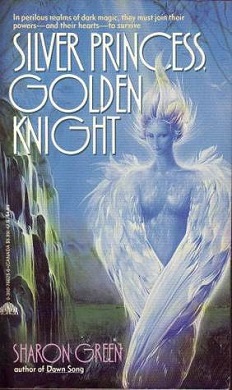
Silver Princess, Golden Knight — Sharon Green

Cover of Silver Princess, Golden Knight


Silver Princess, Golden Knight
Sharon Green
342 pages
published in 1993

When I saw Silver Princess, Golden Knight in a second hand bookshop, it looked like a fun fantasy adventure romp, spiced up with a bit of romance to make it interesting. A quick scan of the first few pages seemed to confirm that impression. I’d never heard of Sharon Green, but it was on the strenght of this that I decided to buy this novel. It was only after I started reading it in earnest that I discovered what a piece of sexist crap it was. I can’t think of any other novel I’ve ever read which spends so much time undermining its own heroine, all but calling her a bitch at times for being so unreasonable as wanting to decide how to live her own life.

Princess Alexia (Alex for friends) has always been a disappointment to her parents. Strongwilled and disdainful of traditional womanly virtues, she instead has spent most of years out on the streets, having been taught how to fight by her father’s royal guard. After one ill thought out attempt to help those less fortunate than her, has landed herself in prison for horse theft, her exasperated father decides enough is enough and decides that she needs a man to keep her on the straight and narrow. What she thinks about this is immaterial, there’s going to be a contest for all unmarried individuals in the kingdom and she is going the prize for the winner. Alex however discovers a loophole in the competition rules and enters herself, to make sure she remains a free womam. Now had Sharon Green chosen to tell the story of how Alex out fought and out smarted her would be suitors that would’ve been awesome. But this isn’t that story.

Instead this is a far more conventional “romance” story, where the heroine has to be forced into the love of a strong man, to realise afterwards that this was what she needed all along. The man chosen for that role is one Tiran d’Iste, a big, black haired, green eyed mercenary from another world, who is the only man who could defeat Alex on her own terms as like her, he’s a full range shape shifter. He wants her from the first moment he sees her, but like everybody else in the story gets frustrated and aggressive by her refusal to realise this is what she needs as well. Though he’s just sensitive enough to realise that somebody like Alex will never like being given away as a prize, this is not enough to stop him from entering the competition; it just worries him that he could win her, but not win her over.

To be honest, from the start Tiran comes across as a douchebag; otherwise he woldn’t have joined this contest. He’s also a bit rapey. When Alex invites him to sleep with her as a lark, then has second thoughts, for a while it looks as if he wants to keep her to her earlier promise. There’s also his internal monologue, in which he’s often angry at Alex, when she doesn’t do what he wants her to do. In this he’s not alone, her father is also angry a lot with her, talking about wanting to kill her, or later lamenting she’s too old to spank. It doesn’t do wonders for Alex’s agency, when every other character wants to hit her for doing things they dislike.

The contest starts, but somebody’s been tampering with it and of course Alex and Rapey macRapeson have to team up to survive the suddenly quite deadly challenges. This would be exciting if the challenges were actually, well, challenging. Instead everything they encounter is fairly easily defeated. At the end Alex disqualified due to a technicallity, the big bad behind the tampering gets revealed and is distinctly unimpressive and Alex and Tiran get to hear the real reason behind the contest and why Alex never had a chance. Turns out that there’s an ancient prophecy that if you have a feisty, independent daughter she needs to get an equally strong willed husband to roam the multiverse righting wrongs yadda yadda. Everybody lives happily ever after, bar the reader.

So yeah, not a good book, mostly because its sexism undermines what could’ve been a fun story. This was never going to be more than light entertainment, but the sexism made it something to hurl away with great force.

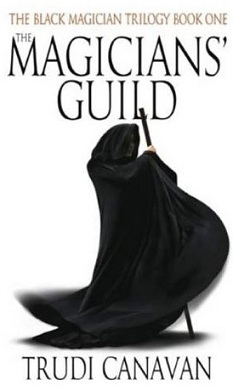
The Magician’s Guild — Trudi Canavan

Cover of The Magician's Guild


The Magician’s Guild
Trudi Canavan
465 pages
published in 2001

Trudi Canavan is an Austrialian fantasy writer who has been mostly writing epic fantasy trilogies and has become rather popular as a result. According to Wikipedia, her first series, The Black Magician Trilogy was ” the most successful debut fantasy series of the last 10 years”. The Magician’s Guildin the first book in that series as well as her debut novel, which I didn’t know when I picked it from the library to read. It was just that this was the only of her novels available that wasn’t part two or three of a trilogy when I decided to try and see if I would like her writing.

What also made me pick up this book in particular when skipping past seemingly similar fantasy books by other writers was the backcover blurb, which made it sounds like it was something more than the usual fantasy cliches in the usual medievaloid setting:

Each year the magicians of Imardin gather to purge the city streets of vagrants, urchins and miscreants. Masters of the disciplines of magic, they know nobody can oppose them. But their protective shield is not as impenetrable as they believe.

That sounds remarkably like The Magician’s Guild has a bit of class consciousness built into its story. That maybe the plucky street girl who discovers she can break the magicians’ shields could oppose the old order and win freedom and respect for the people from the slums, from outside the walls. And to be honest, the first dozen or pages or so, seen from Sonea’s point of view, did seem to confirm this impression. We’re told about how she and her aunt and uncle, along with hundreds of others were kicked out of the rented rooms they had won for themselves through hard work, on orders of the king, we’re shown an example of how the rich burghers of the city look down upon the slum dwellers, how dangerous the city guards are and finally, how the magicians cleanse the streets each year, sweeping all the unwanted people out of the city beyond the walls, with hundreds of people hurt, wounded or killed in the process. It all sets the stage nicely for a bit of agitprop. Sadly, this setup is soon abandoned.

Instead we get a much more traditional story of the young outsider who discovers they can do magic, who has to be convinced both of her own powers and the need to safely learn to use them under the tutilage of the magician’s guild. Untrained magicians burn out, can’t control their powers, so it’s for her own interest that they try to hunt Sonea down. Two of the magicians leading the search, Lords Dannyl and Rothen, have her best interests at heart; the third, Lord Fergun — the one she actually hit with her rock — hasn’t. The broader conflict inherent in the city’s class structures, the fact that there’s a whole class of people, dwells, barely tolerated for their labour in Imardin, but expelled as soon as they’re deemed to be trouble, is ignored in favour of a much simpler story about good and bad magicians.

To be fair, late in the plot some reference is made to the unfairness of Imardin’s social situation, with the idea that having a dwell like Sonea in the magicians’ guild would be a good thing, that Sonea becoming a magician means she would have the power to change her people’s lot, but we know how well that always works out in real life… Meanwhile it doesn’t help that Sonea is a fairly passive character, first spending much of the book depending on others to hide her from the magicians, then going through the inevitable introduction to the magician school. At first she’s hostile to the idea of becoming a mage, but in the end she of course finds a reason to stay, setting things up for the sequel. Once the story sets into this familiar pattern, there are few surprises.

This doesn’t mean that The Magician’s Guild is necessarily badly written. The plot is predictable and the social structures of Cananavan’s world in the end are as conservative and resistant to change as the most cliche of medievaloid extruded fantasy product, but Cananavan is a pleasant enough writer and the story itself flows along nicely. And though the gender relations are as conservative as the class relations, there is remarkable little open sexism. If you’re just looking for light entertainment, this fits the bill, but sadly it’s nothing more than that.