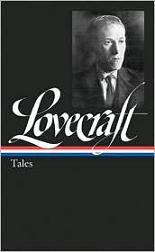
Tales — H. P. Lovecraft

Cover of Tales


Tales
H. P. Lovecraft
838 pages
published in 2005

This deceptively slim volume, much slimmer than the similarly titled 1997 Jocye Carol Oates edited collection of Lovecraft stories, turned out to be printed on the kind of paper they use to print those teeny tiny complete bibles with. So what I thought would be a week’s worth of reading actually needed two long train journeys to finish, by the time I was somewhat bored with Lovecraft’s eldritch obsessions. After a while all the lurking horrors and dwellers in the darkness start to blur into each other and the descriptions turn from atmospheric into mildly ridiculous. Lovecraft is not a writer you should over indulge in; it’s better to read him sparingly story by story.

As a collection this is an impressive book, part of the prestigious Library of America series set up to safeguard America’s literary heritage. That H. P. Lovecraft, as first science fiction, horror or fantasy writer is allowed in these hallowed pages as a genre writer, not ust an established literary figure dabbling in these genres, is a good sign of how far these genres have penetrated literary consciousness. You may quibble about Lovecraft as a first choice, but he has slowly evolved from a cult writer into one appreciated as much for his literary qualities as his ability to scare his readers so he’s certainly not an undefensible choice.

As I’ve said before, what I like about Lovecraft is how he took all the developments in science that the Golden Age science fiction writers were so enthusiastic about slightly later and turned them into horror. Instead of seeing a vast canvas for adventure, he saw humanity driven mad when it understood its proper place in the universe. In that context Lovecraft is a much more representative of his period than his more optimistic colleagues in the sf pulps. He takes all the horror and despair of the Great War and turns it into something sublime, yet still horrific. For this reason alone Lovecraft deserves inclusion in the Library of America.

Another reason is his incredible sense of place. He’s as much if not more so a New England writer as somebody like Nathaniel Hawthorne is. He manages not just to put the look of all these crumbling seatowns, small villages and dark forest on paper, but much more importantly, their atmosphere.

This Library of America volume is very well prepared. The stories are arranged in chronological order and taken as much as possible from Lovecraft’s original manuscripts, rather than from the publised version. The editor is S. T. Joshi, well known as a Lovecraft critic and biographer, with Peter Straub as the selector of the stories. I won’t bother to review the individual stories, as I’ve largely done this in the review of the Joyce Carol Oates collection already.

  • The Statement of Randolph Carter [Randolph Carter] · ss The Vagrant May ’20; Weird Tales Feb ’25
  • The Outsider · ss Weird Tales Apr ’26
  • The Music of Erich Zann · ss The National Amateur Mar ’22; Weird Tales Nov ’34
  • Herbert West–Reanimator [“Grewsome Tales”] · gp Home Brew Feb-Jul ’22; From the Dark, ss Weird Tales Mar ’42; The Plague Demon, ss Weird Tales
    Jul ’42; Six Shots by Moonlight, ss Weird Tales Sep ’42; The Scream of the Dead, ss Weird Tales Nov ’42; The Horror from the Shadows, ss Weird Tales Sep ’43;
    The Tomb-Legions, ss Weird Tales Nov ’43
  • The Lurking Fear · nv Home Brew Jan ’23 (+3); Weird Tales Jun ’28
  • The Rats in the Walls · ss Weird Tales Mar ’24
  • The Shunned House · nv Weird Tales Oct ’37
  • The Horror at Red Hook · nv Weird Tales Jan ’27
  • He · ss Weird Tales Sep ’26
  • Cool Air · ss Tales of Magic and Mystery Mar ’28; Weird Tales Jul ’27
  • The Call of Cthulhu [Inspector Legrasse] · nv Weird Tales Feb ’28
  • Pickman’s Model · ss Weird Tales Oct ’27
  • The Case of Charles Dexter Ward · na Weird Tales May ’41
  • The Colour Out of Space · nv Amazing Sep ’27
  • The Dunwich Horror · nv Weird Tales Apr ’29
  • The Whisperer in Darkness · na Weird Tales Aug ’31
  • At the Mountains of Madness · n. Astounding Feb ’36
  • The Shadow Over Innsmouth · na Visionary Press: Everett, PA, 1936; Weird Tales Jan ’42
  • The Dreams in the Witch-House · nv Weird Tales Jul ’33
  • The Thing on the Doorstep · nv Weird Tales Jan ’37
  • The Shadow Out of Time · na Astounding Jun ’36
  • The Haunter of the Dark · nv Weird Tales Dec ’36
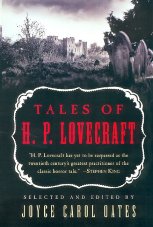
Tales of H. P. Lovecraft — H. P. Lovecraft

Cover of Well of Lost Plots


Tales of H. P. Lovecraft
H. P. Lovecraft
Joyce Carol Oates, editor
328 pages
published in 1997

It’s almost embarrassing to say this, but apart from the occasional short story in an anthology here or there, this is the first I’ve read of H. P. Lovecraft. Just as well then that this is an excellent introduction to Lovecraft, featuring many of his most famous works. The stories have been selected by Joyce Carol Oates, an not entirely unknown writer herself. What I like about Tales of H. P. Lovecraft is that she has managed to create a well balanced collection without any weak stories. It starts off slow, with several more conventional horror stories, the stories increasing both in length and sophistication, slowly immersing you in Lovecraft’s world.

Despite having only sampled Lovecraft in the past, I pretty much knew what to expect, since his influence is so pervasive in science fiction and fantasy literature. Even if you’ve never read any of his stories, you’ll probably have encountered some pastiche, homage or reference to him in other writers’ work, even discounting those authors like Derleth who imitated him outright.

I am not a big fan of horror on its own. I just don’t read scary stories for the sake of being scared; I don’t even watch that many “straight” horror movies. For the most part, horror bores me unless there is more to it than just being scared. With Lovecraft, there is, as this collection shows. In his best works, many of which are in this collection, Lovecraft espoused a coherent worldview and philosophy, best summed up in the following quote from Call of Cthulhu:

The most merciful thing in the world, I think, is the inability of the human mind to correlate all its contents. We live on a placid island of ignorance in the midst of black seas of infinity, and it was not meant that we should voyage far. The sciences, each straining in its own direction, have hitherto harmed us little; but some day the piecing together of dissociated knowledge will open up such terrifying vistas of reality, and of our frightful position therein, that we shall either go mad from the revelation or flee from the deadly light into the peace and safety of a new dark age.

At first this might sound like the same backwards “philosophy” espoused in the Frankenstein and other monster movies of that period: “that there are some things Man should not know”; but Lovecraft’s vision was not as simplistic as that. Lovecraft’s worldview stems from a deep awareness of the new horizons science had opened up in his lifetime; many of the stories in this volume speak of this awareness. Lovecraft wrote at a time when the implications of both Einstein’s theories of relativity and quantum physics were just starting to sink into the popular consciousness, while simultaneously the scale of the universe was revealed for the first time. The idea of an universe both unimaginably old and unimaginably vast, in which even the very foundations of matter were no longer sacrosanct you can react to either with joy or horror; Lovecraft chose the latter.

  • The Outsider (1921)
    This is an almost generic O Henry type of story, with the surprise twist at the end telegraphed well in advance. Coupled with a prose that is not so much purple as ultraviolet, this is the worst story in the collection, with little of the interest of the others.
  • The Music of Erich Zann (1921)
    Another very short story like The Outsider, but much improved. No twist ending here, but a slow building up of dread, climaxing in a crescendo of fear caused by the strange music of Erich Zann.
  • The Rats in the Walls (1923)
    The American descendant of an ancient line of English aristocrats returns to his family’s home seat to restore it to its former glory, ignoring the local superstitions. Until he starts hearing the sounds of rats in the walls that is. Well done although. the name of the protagonist’s black tomcat is a bit unfortunate.
  • The Shunned House (1924)
    In Providence stood an old house, filled with a peculiar kind of horror owned to its history as a place of unhappiness. Something unspeakably ancient and evil is slumbering there, something that sucks the life out of those unfortunate enough to life in it. The narrator has learned of the house history and the larger part of the story is his recounting of this history — Lovecraft does this a lot, interrupting his story by letting the hero tell everything he learned about the horror he has faced or is going to face.
  • The Call of Cthulhu (1926)
    This is the key text for the whole Cthulhu mythos.; I believe this is the first story to feature Cthulhu and the only story Lovecraft wrote which actually showed it. The story is written in two parts, with the narrator being the only one who knows the connection between the two separate tales. The first story tells of a raid on a Louisiana cult of Cthulhu worshippers, the second is the log book of a Norwegian sailor who actually encounter the newly risen city of R’lyeh, where Cthulhu lives.
  • The Colour out of Space (1927)
    A meteorite crash landing on a New England farm turns out to be some unknowable alien presence, damning the farm by its existence.
  • The Dunwich Horror (1928)
    This is the only story in the entire collection in which the protagonists confront the horror head on and not only survive, but succeed in driving it from our world.
  • At the Mountains of Madness (1931)
    The most science fictional of the stories in this volume, with the horror de-emphasised. An expedition to Antarctica finds a hideous, ancient city inhabitated by the very same evil that caused the collapse of this civilisation that aroused countless aeons before humanity. Lovecraft manages to evoke a sense of wonder comparable to that found in some of the best science fiction stories, through the vast vista of history revealed in the course of it.
  • The Shadow over Innsmouth (1931)
    Another Cthulhu Mythos story, this is a very creepy story, not least because of some unfortunate undercurrents embedded in it. The basic horror in the story is the idea of miscegenation between humans and the socalled Deep Ones, gill people living in the sea off Innsmouth. The narrator, at first curious about the truth behind the “Innsmouth look”, then revulsed when discovering what lies behind it and finally accepts his own fate, when he finds out what’s hidden in his own family tree….
  • The Shadow out of Time (1935)
    Nathaniel Wingate Peaslee was the subject of a curious amnesia: for five years his body was taken over by a secondary personality. He could remember nothing of these years, but through dilligent investigation and the slow recovery of his memories he managed to discover his mind had been taken over by an alien intelligence,living on Earth many millions of years before the ascent of man… The horror in this story lies not in the evil intentions of the aliens, whose motives if not benign are certainly not evil, but in the knowledge of their existence and all it entails. Far from being the master of the universe, man is just a mere upstart, with no knowledge of the immense powers that exist elsewhere.