Today it’s exactly 100 years ago Hugo Gernsback published the first science fiction, sorry scientifiction magazine.
Hugo Gernsback (August 16, 1884 – August 19, 1967) was a Luxembourgian immigrant to the United States, who became involved with the hottest technology of the 1910s and 20s: radio. He had his own radio station, was involved with some of the first television broadcasts in America (in 1928) and before that he helped establish amateur radio broadcasting, setting up the world’s first electronics magazine in 1909. As an inventor, entrepreneur and endless tech boaster he had an optimistic view of the coming age of high tech could save the world and to promote that vision he started writing stories set in that future. His serial Ralph 124C 41+ (One To Foresee For One) is dreadful but it has that manic energy of the true tech freak.
Tempting as it is to call him the Raoring Twenties’ version of Elon Musk that wouldn’t do him justice, Unlike Musk he did actually invent and create the things he took credit for. (But like Musk, he wasn’t particularly keen on paying his employees if he didn’t have to…)
The one problem is, without him we might not have had Elon Musk either. Because that strain of perverted techno utopianism that Musk deals in got its start with Gernsback.
Because Gernsback noticed that the scientifiction he published in his radio and electronics magazines was quite popular, so he thought a new magazine wholly devoted to it might sell as well…
Launched on 10 March 1926, this hunch proved correct. Even when only offering reprints at first, Amazing Stories was a hit, creating a new pulp genre out of nothing. Obviously, there had been science fiction stories before: Wells, Verne, Poe, Shelley and a host of other 19th and early 20th writers had written some. There were also earlier pulp magazines like Argosy or Weird Tales that published stories of that nature.
But it was Gernsback who codified and named it. And it was his evangelism that would shape the genre into something that had loftier intentions than just providing its readers with fifteen minutes of a good time. Gernsback intended science fiction to be educational, to provide a guideline to the future that would be build by men like him. That strain of science fiction would for decades be the dominant strain of English language sf, further refined by John Campbell Jr at Astounding Science Fiction and his stable of writers (Heinlein, Asimov, van Vogt etc).
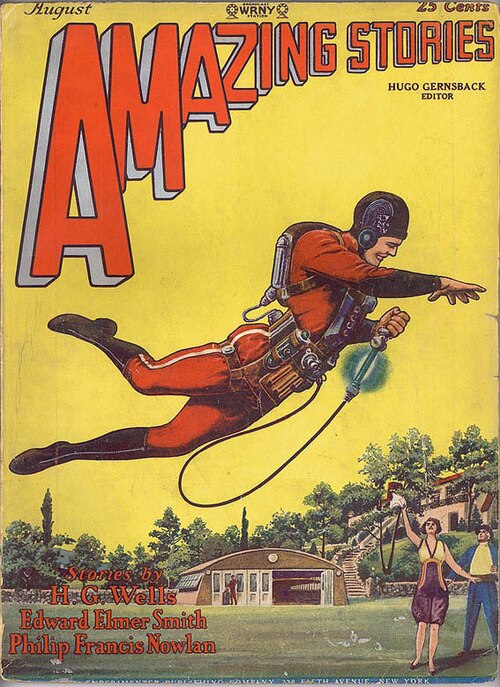
Wunded but not quite killed off by the New Wave in the sixties, it survived long enough through editors and writers like Jim Baen and Niven/Pournelle that it was still around to infect people like Musk, whose visions of self driving cars and colonies on Mars are straight out of Amazing. Also baked into Gernsback vision of science fiction : a nascent fascism and fondness for genocide as the answer to all problems. That nice cover to the left is the first appearance of E. E. “Doc” Smith’s Skylark of Space series, in which our heroes start by committing genocide against one alien race and end up blowing up entire galaxies. Great fun.
So three slightly muted cheers for the invention of science fiction. Too bad the worst people in the world took all the wrong lessons from it.
No Comments