Bernard Prince was the series that Hermann broke through with. Created in 1966 together with Greg, the hard working editor in chief and chief writer of Tintin magazine, one of the classics of the Belgian “Silver Age”.
Hermann only became a cartoonist by accident: his brother in law Philippe Vandooren, later an editor at Dupuis and Spirou needed a comic for a scouting magazine and volunteered him for it. This and a few other bits and pieces got him noticed by Greg, who suggested he came and work for him. He did his yeoman’s work drawing episodes of Histoires de l’oncle Paul, true history story as told by a pedantic uncle to his niece and nephew, before he and Greg went to work on Bernard Prince.
Bernard Prince follows the standard Tintin adventure series template. You got a square jawed, slightly boring hero in Prince himself, with two more comedic sidekicks. The red haired, Scottish, slightly seedy and fond of a drink Barney Jordan and a young Indian boy called Djinn. At first Prince is a police officer working for Interpol, but before long he becomes a freelance adventurer, sailing the seven seas in his yacht the Cormoran.
Hermann and Greg would create thirteen long stories together, from 1966 to 1978, roughly one a year, as well as a few incidental short stories. As I noted back in 2012, only one has ever been translated in English, in 1973 for Wonderworld as translated by Fred Patten, better known for his work in anime and manga fandom. Thanks to Hairy Green Eyeball scanning and uploading this story back in 2008 it’s still available 18 years later.
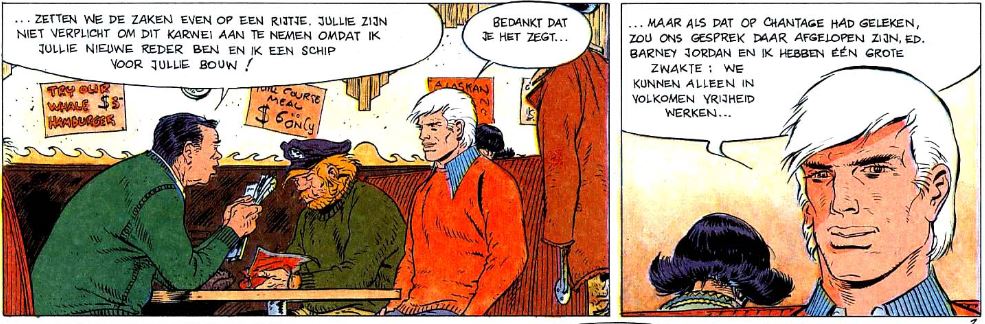
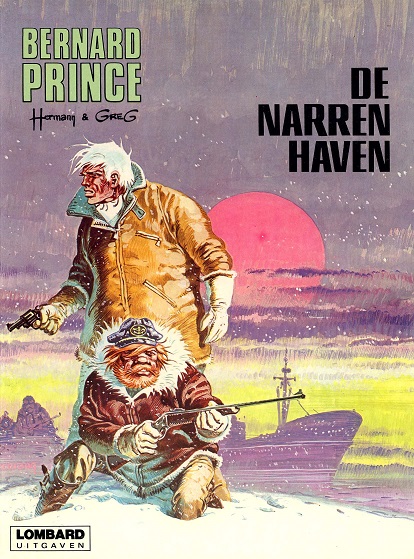
The cover above and the art throughout this post is from Hermann’s last entry in the series. When he started it his art style was still somewhat derivative of people like Eddy Paape, lacking some of the grit and realism he would develop later. Even in this particular album, though his art has improved dramatically from the first Bernard Prince story, still has a little bit of that flatness. You can see it in the first panel above, where Prince looks awkward next to the other two figures in the panel. His face in the second panel too is a bit stiff compared to what Hermann would draw a few years later. It’s as if he’s trapped by the need to adhere to Tintin‘s house style, such as it was and have Prince be a conventional, handsome hero.
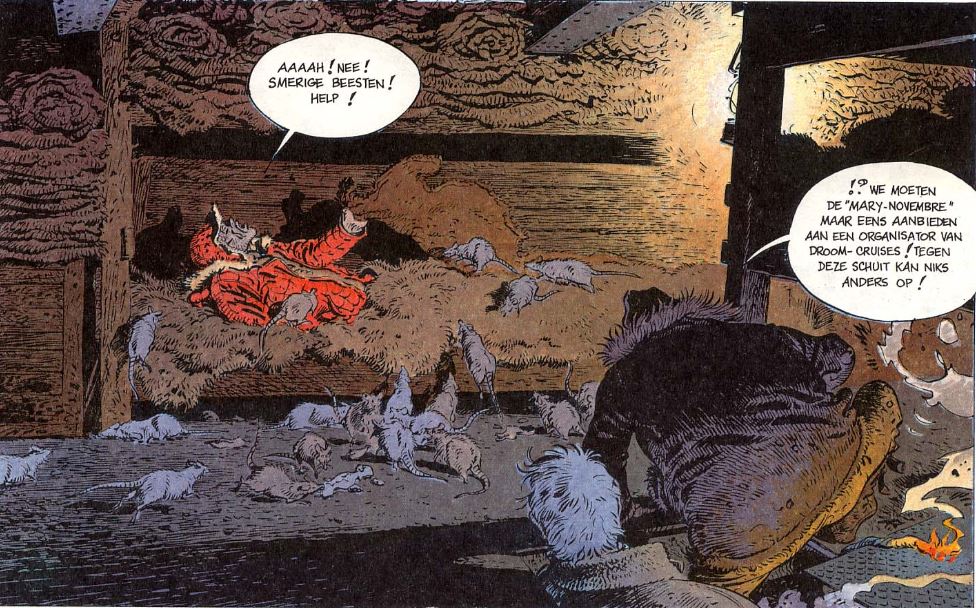
On Bernard Prince, as on Comanche, the western series he again started with Greg in 1969, Hermann was just the artist, with little to no input in the stories, though for Bernard Prince he did insist that each story feature some sort of natural disaster or extreme weather. (In this particular story for example Prince and Jordan have to investigate a lost freighter, trapped in ice in the Canadian Arctic). As Hermann grew more confident as an artist he also started to chafe under the restrictions he worked under. Hermann never was one for boy scouts or conventional heroes and he disliked the moralising tone Greg put in his stories. The world wasn’t fair, there’s no such thing as a true hero like Prince and he felt that comics should reflect this. Which is why, when he got the idea for a series all of his own, he dropped Bernard Prince, having outgrown the character, even though he would return for one last adventure with him, this time with his son Yves H. providing the scenario.
With Bernard Prince Hermann learned to become a comics artist. It and Comanche made his reputation of one of the most exciting of the new generation of realistic adventure cartoonists that broke through in the sixties. Though hard to imagine now, he, as well as similar artists like William Vance, were actually controversial for their embrace of cinematic violence and a willingness to acknowledge that the world wasn’t quite as black and white as portrayed in the fifties.
No Comments