Fortynine years after it launched in 1977, Voyager 1 has travelled a light day away from Earth. And that this is even possible was entirely due to one man:
Minovitch, in 1961 a 25-year-old graduate student at the University of California-Los Angeles (UCLA), began his research while working a summer job at the Jet Propulsion Laboratory (JPL) in Pasadena, California. He calculated that a flyby spacecraft which passed behind a planet would be seized by the planet’s gravity and in effect towed as the planet orbited the Sun. This would increase the spacecraft’s speed. As it departed the planet’s vicinity, it would keep the speed it gained. Conversely, a flyby spacecraft that passed ahead of a planet would be slowed. Minovitch viewed this as a new form of propulsion; he called the effect the planet’s motion had on the spacecraft “gravity thrust.”
Minovitch determined that a spacecraft could use gravity thrust flybys to travel from world to world indefinitely without use of rocket propulsion. It could even return to the vicinity of Earth, enter a close solar orbit, or escape the Solar System entirely. In all, he calculated about 200 different planetary-flyby sequences using charts he devised and computers at JPL and UCLA.
Many engineers who learned of Minovitch’s results assumed at first that they violated fundamental physical law. It seemed that the flyby spacecraft would get something for nothing. This was, of course, incorrect: when the spacecraft was slowed, the planet gained a very tiny amount of momentum; when the spacecraft was accelerated, the planet lost a very tiny amount of momentum. Nature thus balanced its books. Minovitch, for his part, was not very skilled at first at explaining his discoveries; he seems to have understood the clean elegance of numbers far better than he did the fuzzy vagaries of human beings.
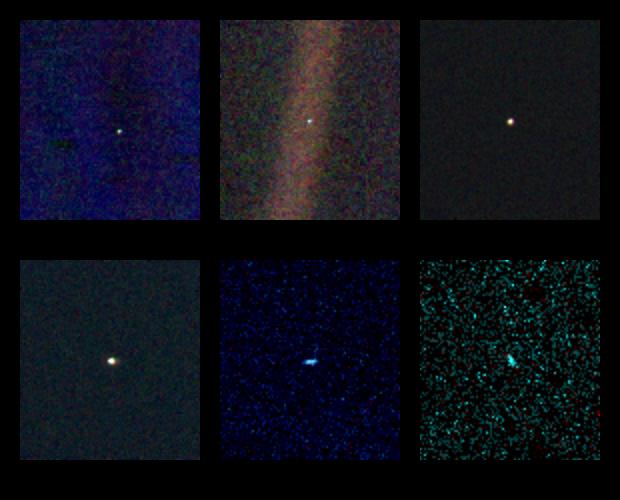
Because of the insight of one grad student Voyager was possible. It took years of work and thousands of people to make that possibility a reality and now, almost half a century later, we are still profiting from their efforts. If nothing else we got decades of images like the one above, the last one Voyager 1 took, twentysix years ago.
No Comments