Three cheers — Na Nare Hana Nare — First Impressions

Na Nare Hana Nare opens with a great looking cheerleading performance that sets the tone for the rest of the show:

An original cheerleading anime done by P. A. Works of all people, with the director, Kakimoto Koudai and writer, Ayana Yuniko, having also worked on MyGo in the same roles. The series even opens in a similar way, with a big incident that happened some time ago, as shown above; the the opening credits roll and we’re in the present dealing with the fallout. In this care it was Kanata, a first year at a school famous for its cheerleading club, the girl launched into the air when the accident happened, who still seems to suffer some sort of trauma from it, even if she wasn’t directly involved. Na Nare Hana Nare is a lot cheerier handling this than MyGo was however.
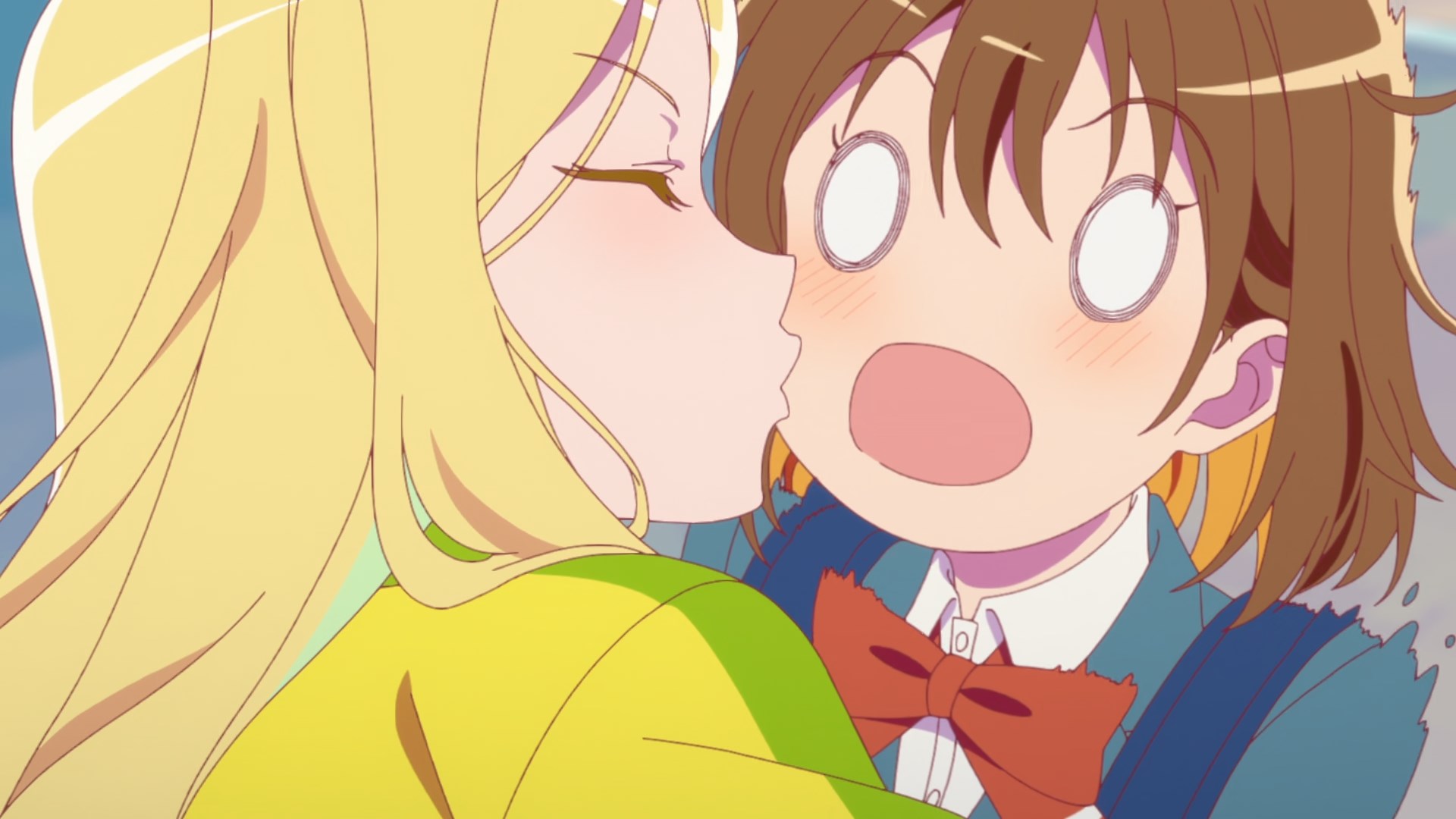
Anna kisses Kanata on the cheek at her first meeting. Kanata is shook.

But about as gay.

That’s Anna from Brazil kissing Kanata because that’s what they do over there apparently, though usually not with complete strangers. They only met because both were following Obunai Suzuha, a student from what turns out to be a very sort of gokigenyou young ladies school — literally called Ojou Girls — who commutes by doing parkour. Anna is interested in her because she wants her to start in the videos she’s making together with her friend, Nodoka, who’s slightly less outgoing. What I like about Anna is she doesn’t talk in the usual highly accented Japanese foreigners get saddled with in anime, but does actually struggle sometimes to find the words she needs. Nodoka so far has been the least developed of the characters, mainly trying in vain to slow down Anna a bit.
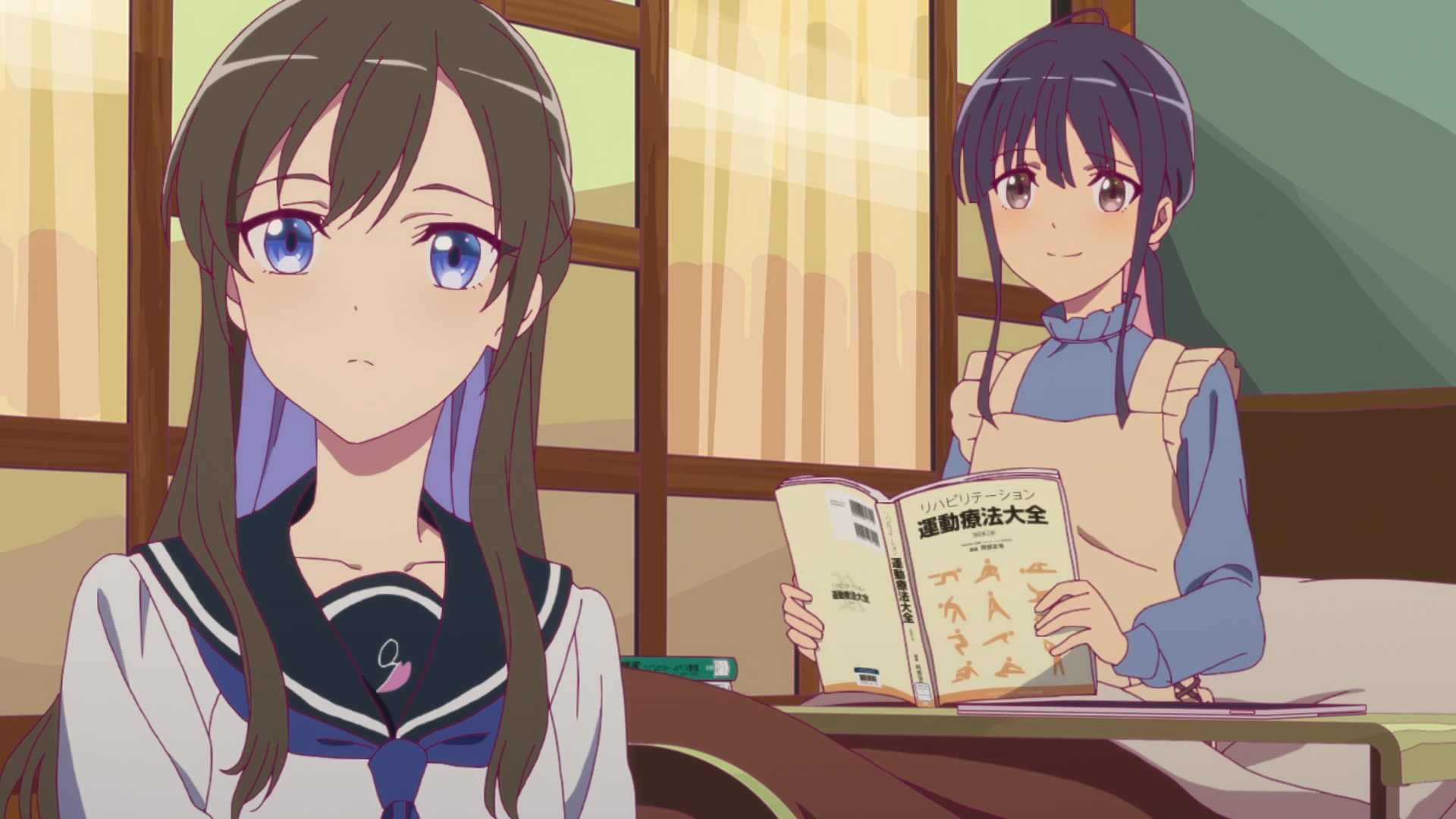
Shion sitting in front of Megumi in her bed

Rounding out the cast are Megumi, a childhood friend of Kanata who did cheerleading with her in middle school but got an undefined illness in her last year that left her in need of physical rehabilitation and unable to attend high school. She’s also friends with Shion from the same school as Suzuha, who is a talented gymnast. So we got half a dozen girls, each with their own talents, who obviously are going to do some sort of cheerleading together, but not quite yet. I really like each of the characters and it will be interesting to see how the series develops. The animation is on point as expected from P. A. Works and the little details like Anna struggling with her vocabulary or Megumi having to come to grips with her slow rehabilitation make this extra special.

Why translations shouldn’t be too faithful

If, like me, you find yourself occassionally nostalgic for the era when anime series could get multiple fansub groups working on them, none of them just ripping off Crunchyroll, this 2011 vintage discussion about how several fansubbers translated one particular scene in Bakemonogatari is right up your street:

For some reason, I was watching Coalgirls’s release of Bakemonogatari. It was the second episode, and the scene was when Hitagi, in her own unique tsundere (read naked) fashion, was hitting on Koyomi, even though he’s too stupid to realize it. Incidentally, this part was what got me into the show two years back because the jokes and Hitagi’s all-around verbal abuse here is fantastic. Coalgirls’s translation up to this point can be best described as “understandable” despite the translator’s poor sense of style. Or at least until it got to the punchline of my favorite joke in the scene.

Your amateurish virginity will infect me

“Amateurish virginity?” What the hell does that even mean? Let’s ignore the Japanese here for now and judge this based solely on the English translation, which is what I would assume most people who watch subs (and don’t know Japanese) would do. Interestingly, the translator didn’t even provide a translation note to preach to the viewer about the finer details of Japanese slang.

The writer goes on to compare Coalgirl’s subs to two other fangroups, Thora and GG’s, finding the latter to have the best translation. “Amateurish virginity” turns out to be Japanese slang for men who only have sex with sex workers and never had a proper relationship. In English you’d call them incels these days. It’s a good example of why a translation should not be too literal or too faithful to the original wording, when this does not make sense in the target language.

Cringe comedy at its finest — Make Heroine ga Oosugiru — First Impressions

When you go to a family restaurant to read the latest romance novel you’re into, see a classmate get dumped in front of you and then see the most cringe of down bad scenes play out in front of you as she drinks his leftover cola to get that indirect kiss and worse — you make eye contact:

Make Heroine ga Oosugiru (Too Many Losing Heroines opens strong and even better, continues to be funny as Nukumizu Kazuhiko gets further involved with the girl he watched being dumped by her childhood friend for the transfer student he only knew since last May. Nukumizu may want to have nothing to do with her, but Yanami Anna thinks otherwise. Being neither a friend nor acquaintance she can vent to him without embarassment. Nukumizu has no choice but to put up with it, as she owns him money for the food he bought her after he caught her slurping her crush’s leavings. Which she intends to pay back by making lunches for him every day.

Anna being hugged by the pink haired Karen as her crush looks fondly on and she is struggling to get loose

Anna is trapped in a manga romcom, with her crush Sosuke and Karen his girlfriend see her as their dear (not deer) friend who they want to keep hanging out with as if nothing has changed. Hell for Anna of course and an indirect taste of hell for Nukumizu as he has to listen to her telling him about it. As a viewer though it was hilarious. Both the voice acting and character animation are on point and it’s such a relief to get some competent cinematography as well. This whole episode was an excellent balancing act between the humour in the absurd situation both find themselves in and the ongoing romcom they’re reacting to. As kViN put it on Twitter:

This is a series with two sides that work surprisingly well together: one that’s irreverent and toys with genre conventions, but another one that’s unashamedly in love with the concept of romcoms.

Make Heroine ga Oosugiru works because it’s not afraid or disdainful about being an anime romcom while making fun of its cliches. I actually like it better than the source manga, which wasn’t as funny to me. The only thing that bothered me here were the multiplying bowties on the girls’ uniforms. Even for anime school uniforms they make no sense.

Peeping Life: the mundane lives of anime heroes

ANN’s This Week in Anime about anime crossovers reminded me in a roundabout way of this spectacular weird oddity:

Peeping Life was an improvisational anime focusing on the “the listless minutiae of everyday life” which for one glorious season in Fall 2015 decided to do so using Tezuma and Tatsunoko characters, some of the most recognisable anime/manga characters of all time. Which led to sketches like Astro Boy going through puberty or Black Jack visiting a doctor because he has the flu. Fall 2015 was the first season I actually followed seasonal anime and this series was one of the ones I watched each week. A real surreal experience when you barely recognise one in three of the characters featured and are also completely new to the style of humour it uses. Gina Szanboti over at the ANN forums has episode recaps if you want to get the flavour of it.

Sadly, while Crunchyroll does have another season of Peeping Life, it doesn’t have this one.

Close but no Kill Me Baby — Shikanoko Nokonoko Koshitantan — First Impressions

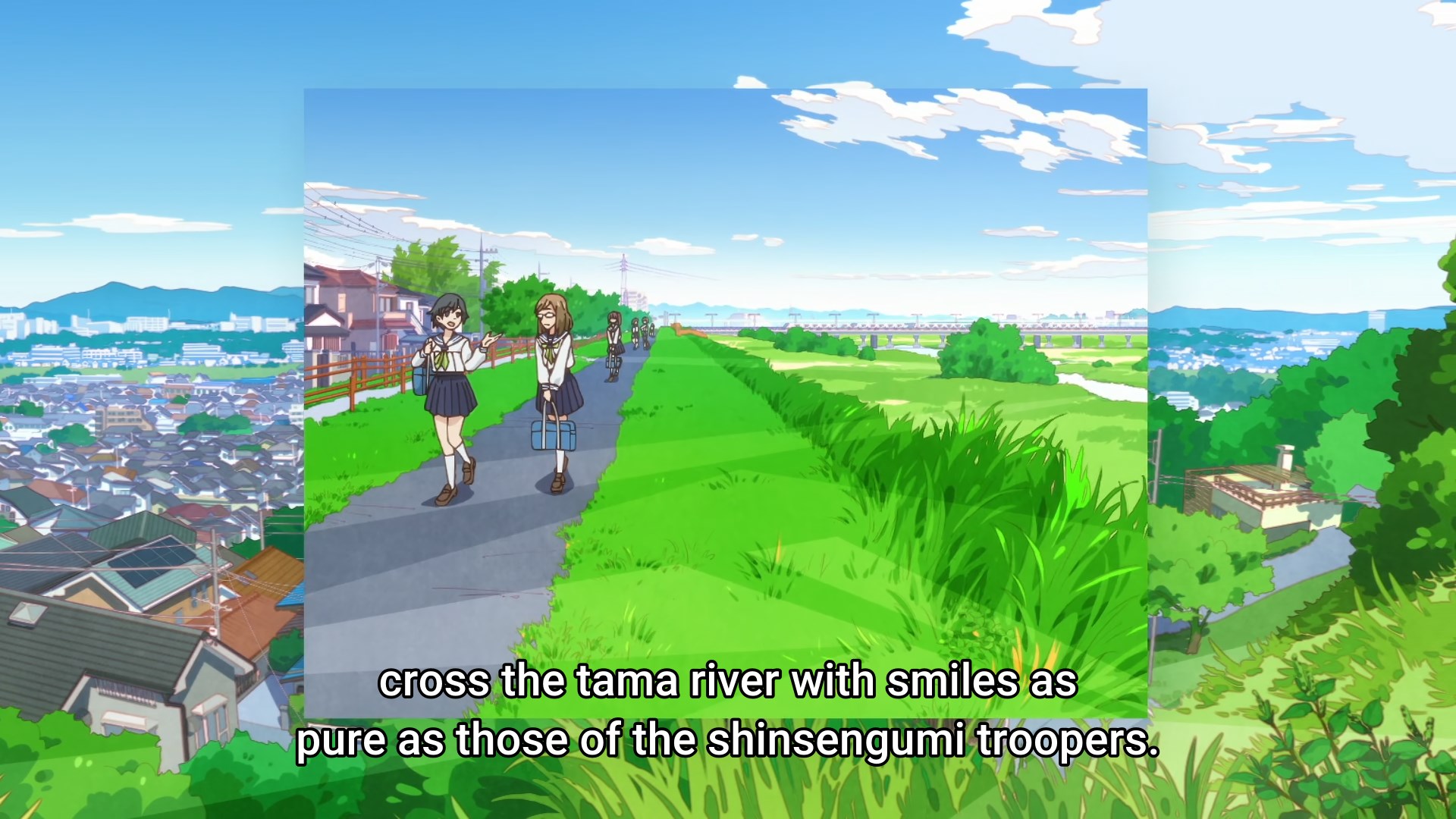
To be honest, I sort of knew who the Shinsengumi were — late 19th century fascistoid thugs who for some reason are very popular BL fodder — and I assume the Tama river is the one in the background here, so this sort of mangled allusion in my subtitles doesn’t bother me. I’ve watched too much fansubbed anime and read too many scanlations to even notice this sort of thing anymore:

School girls apparently crossing the Tama river, smiles as pure as shinsengumi troopers

But it is indicative for the quality of the subtitles, when one of the first things you see is an unaltered reference not too many people outside of Japan will understand. It and similar references, as well as a fair few misspellings as well as typeset errors, with words running into each other e.g. showed that whoever had translated this, had done the bare minimum with results barely above machine translation quality. Subtitles which apparently were forced on Crunchyroll by the Japanese distribution company Remow, also involved with last season’s Ooi Tonbo! whose subtitles were not great either. All of which has overshadowed Shikanoko Nokonoko Koshitantan‘s premiere quite a bit. And this for a series with a lot of hype behind it: “the new Lucky Star or Nichijou” it was supposed to be. Now completely hobbled by being too cheap to get proper translators involved.

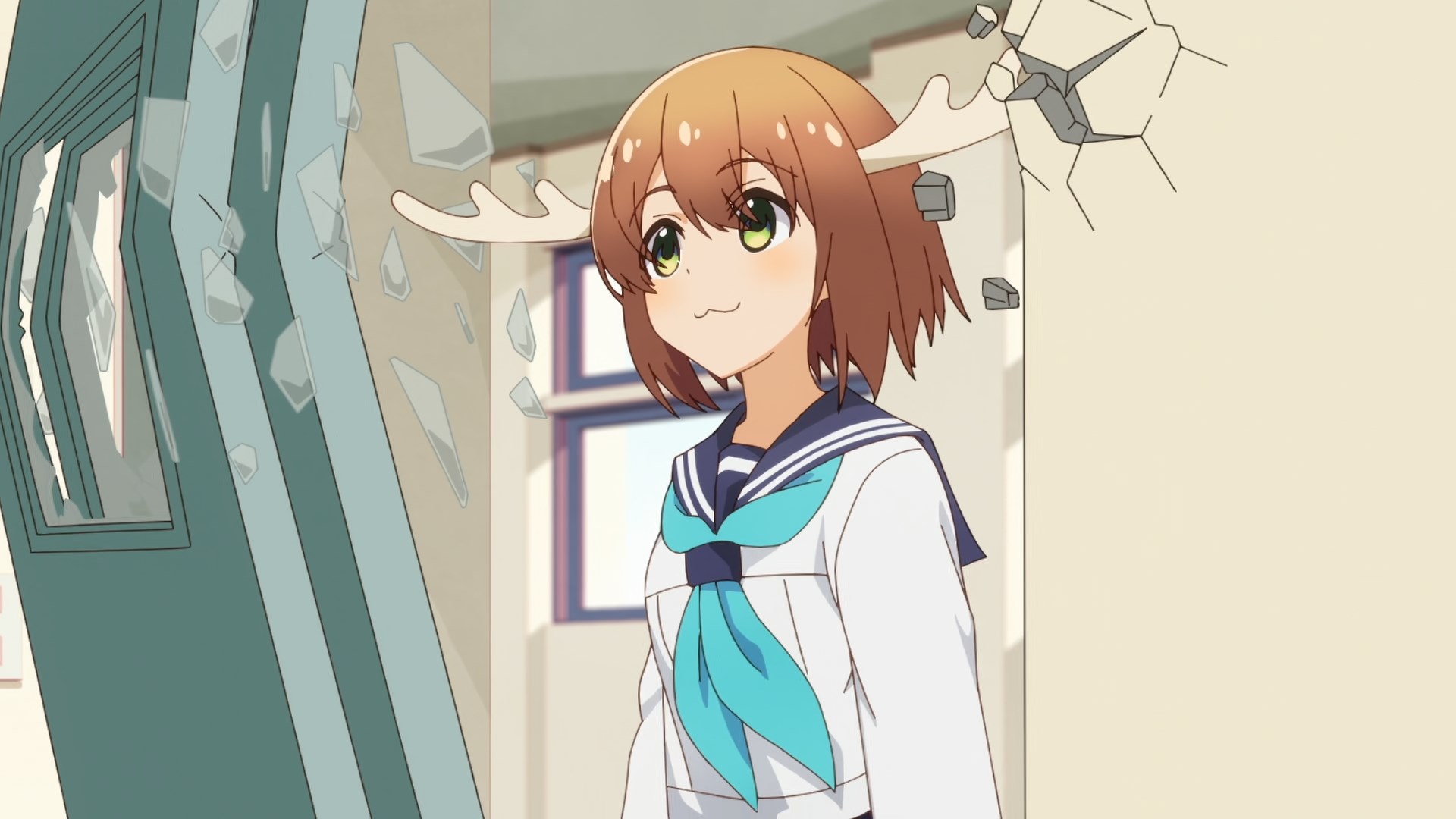
Nokotan making her entrance into the classroom, her antlers too big for the door, destroying the wall

It all starts when Koshi Torako, former deliquent turned perfect student at a prestigous high school, finds a girl hanging by her antlers from the powerlines at the side of the road. She rescues her and hopes never to see her again but guess who turns up as a new transfer student? Shikanoko Noko — call her Nokotan — makes a devastating impression entering the classroom, but Torako is the only one who finds anything strange. That of course Nokotan sits next to her is bad enough, but she also sniffs out — literally — Torako’s deliquent past. What will this do for her carefully cultivated reputation?

Yes, poor old Koshi Torako — Koshitan as Nokotan immediately calls her — is stuck being the straight man in a zany comedy in which Shikanoko is the agent of chaos ruining her life. A tried and true concept for a comedy anime, but does it work? Not quite for me. It all feels a bit try hard and artificial. There were a few good jokes that landed in this first episode but nothing as funny as the choco cornet discussions that Lucky Star opened with.