Bloody Mary

Remember this? Well, now there is a sixteen minute pilot featuring the same characters as they go ghost hunting:

Best of all, it’s available in your choice of dub: English or Japanese. The plot is simple. Paranormal Youtube streamer Betty, now living together with Seeka, the demon she half assed summoning in that earlier video, gets an invitation to a ghost hunt in an abandoned mansion at the edge of town. Said mansion is supposedly hunted by a ghost that will pop out of the mirror if you say her name three times in front of it: Bloody Mary, Bloody ?Mary, Bloody Mary. When she appears things do not go according to plan…

Very much running on Loony Tunes logic here, this is more funny than scary. I love the CG animation here, that doesn’t bother to hide it’s CG animation. If you like this, Studio Wrong has a lot of shorts starring the same cast up on its Youtube channel.

Intoxicated Yuri — First Impressions

Kamiina Botan has rizz when she’s tipsy.

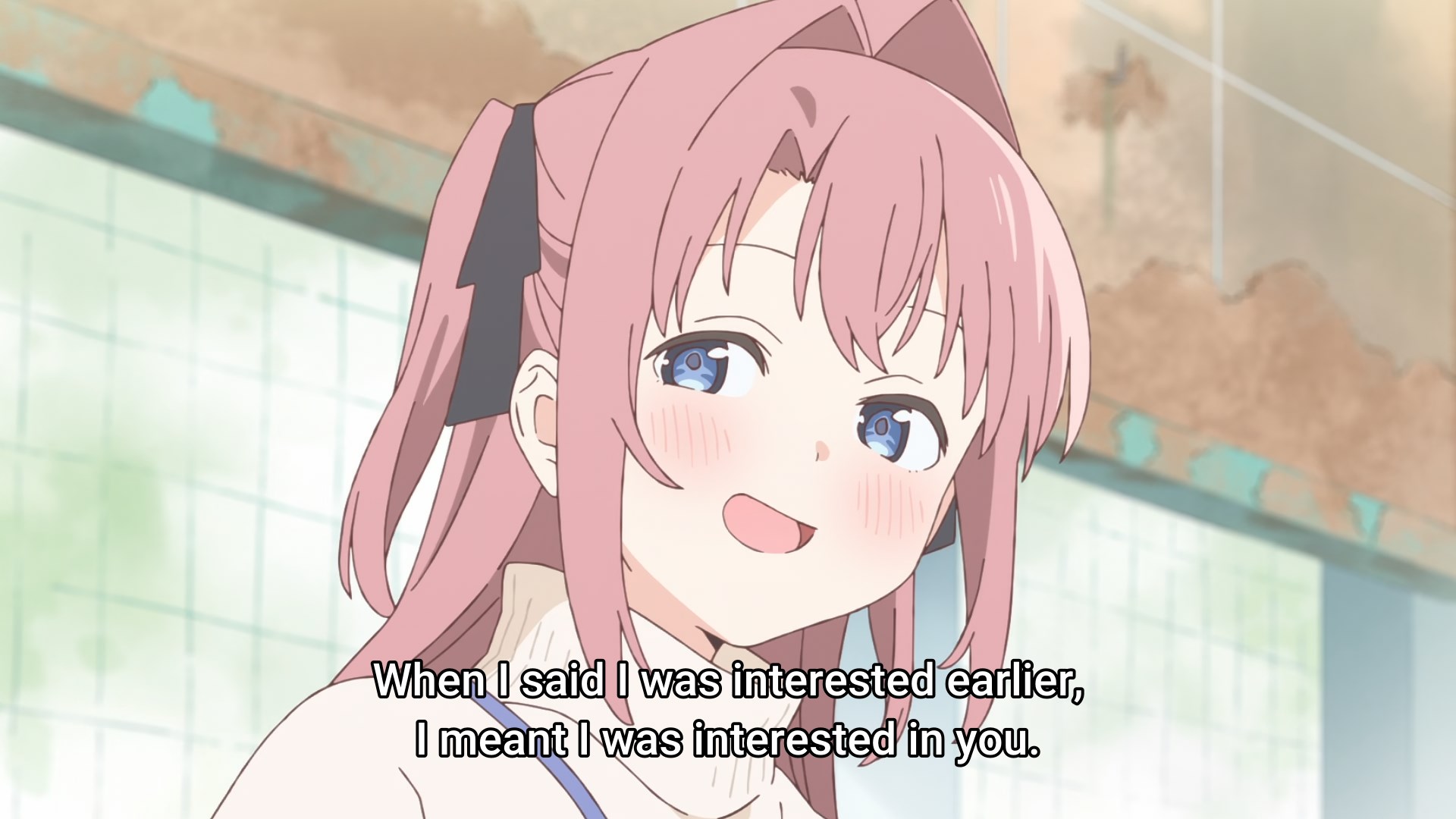
A pink haired anime girl blushes gently and smiles as she says that when she said she was interested earlier, she was interested in you

Kamiina Botan, Yoeru Sugata wa Yuri no Hana is about what happens when the titular Kamiina Botan (twenty) gets her first drink in her. Not only does she take to it as a duck to water, she’s a flirty drunk. A first year student doing an engineering degree, she;s on a sight seeing trip with a few girls from her residental hall, but when they stop for lunch Ibuki, their RA has disappeared on them. Botan goes in search for her and it turns out Ibuki slipped away to get herself a drink: a truly humongeous whiskey highball.

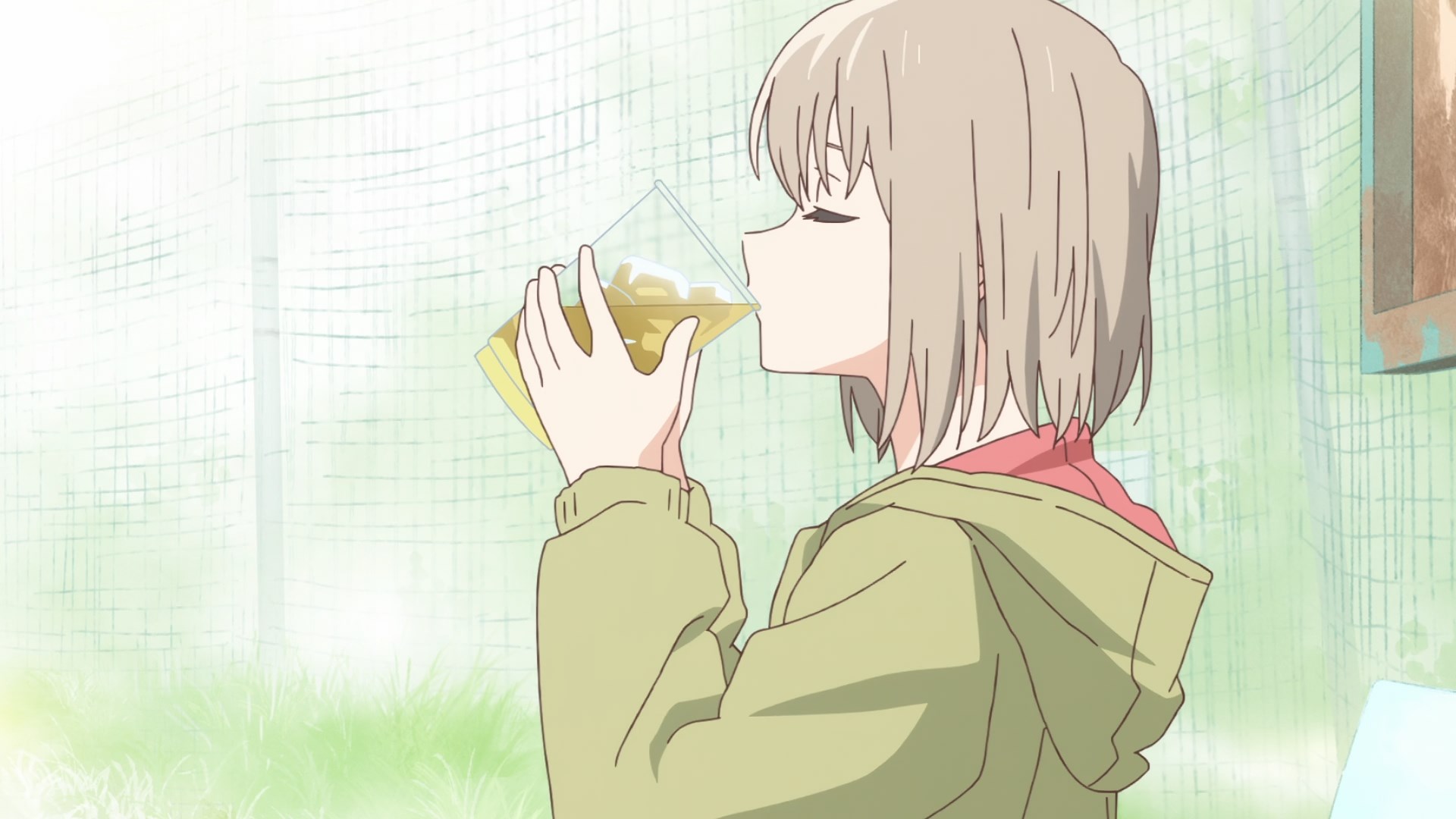
A small, young looking but actually old enough to drink, grey haired girl in a moss coloured hoodie lifting a glass to her face that is almost big enough for her to drown in

Even watered down that’s an absurd amount of booze for just 500 yen. I tend to estimate amounts by assuming one euro equals a hundred yen, making this excellent value for money when the average boring pilsner here is not that much cheaper, but of course these days 500 yen is more like three euro, which makes it even better. Later in the episode we learn that Ibuki has a display cabinet filled with booze in their hall’s common room, which makes a little bit more sense if all alcohol is this inexpensive in Japan… Anyway, it turns out Ibuki is a bit shy about her drinking as it makes her hiccup and she has had bad experiences when others saw that. When she finds out Botan doesn’t mind, she thinks drinking with others might not be so bad…

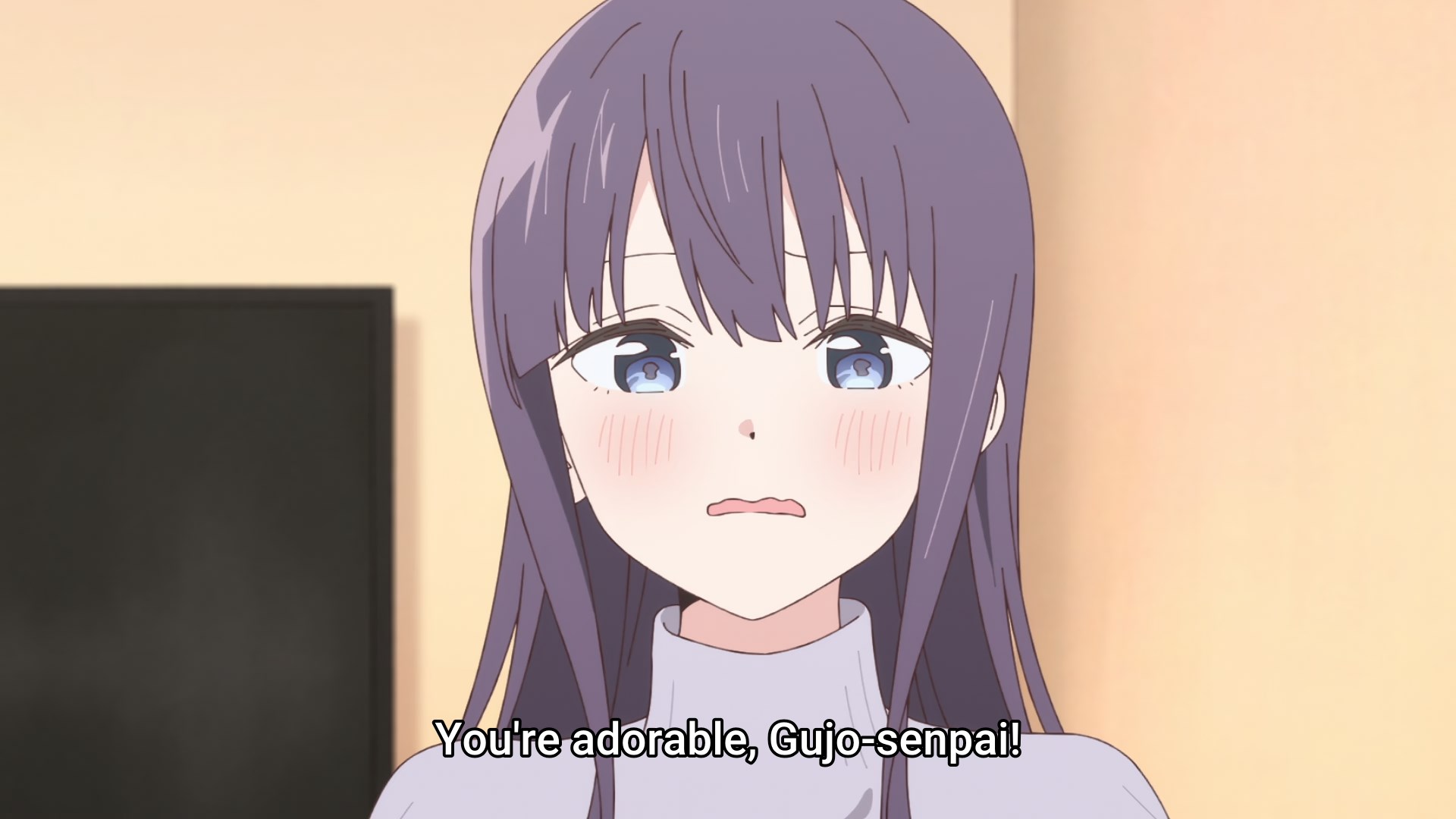
A flustered looking purple haired girl. Botan tells her that 'You are adorable, Gujo-senpai!'

Which may be good news for Gujo-senpai here, the other person Botan drinks and flirts with in this episode, as she has been looking for a way to drink with Ibuki. When Botan confronts her with this, she turns from confident, cool senpai, in a blushing, awkward mess. Yes, Kamiina Botan has rizz when she’s tipsy.

I had no idea what to expect from this series but the word “yuri” in the title had me hopeful and fortunately I got what I wanted. This is a slice of moe series about college girls drinking with and being flirted at by Kamiina Botan and I’m all for it. The animation is gorgeous and matches the laid back feeling of the show, as Kvin explains over at Bluesky. The only real quibble I have is that the subtitles transposes the characters’ names from Japanese order (surname, given name) to western order.

this actually gave me a bit of nostalgia for my own college days, hanging out with friends and room mates in our student flat. and not only do we see people drinking, Gujo-senpai smokes too! Refreshing to have such a properly adult series for once among all the endless series set in high school.

An Uncomfortable Dose of Reality — Ikoku Nikki

If you wondering what this scene at the beginning of episode eleven (and the end of episode ten) of Ikoku Nikki was all about:
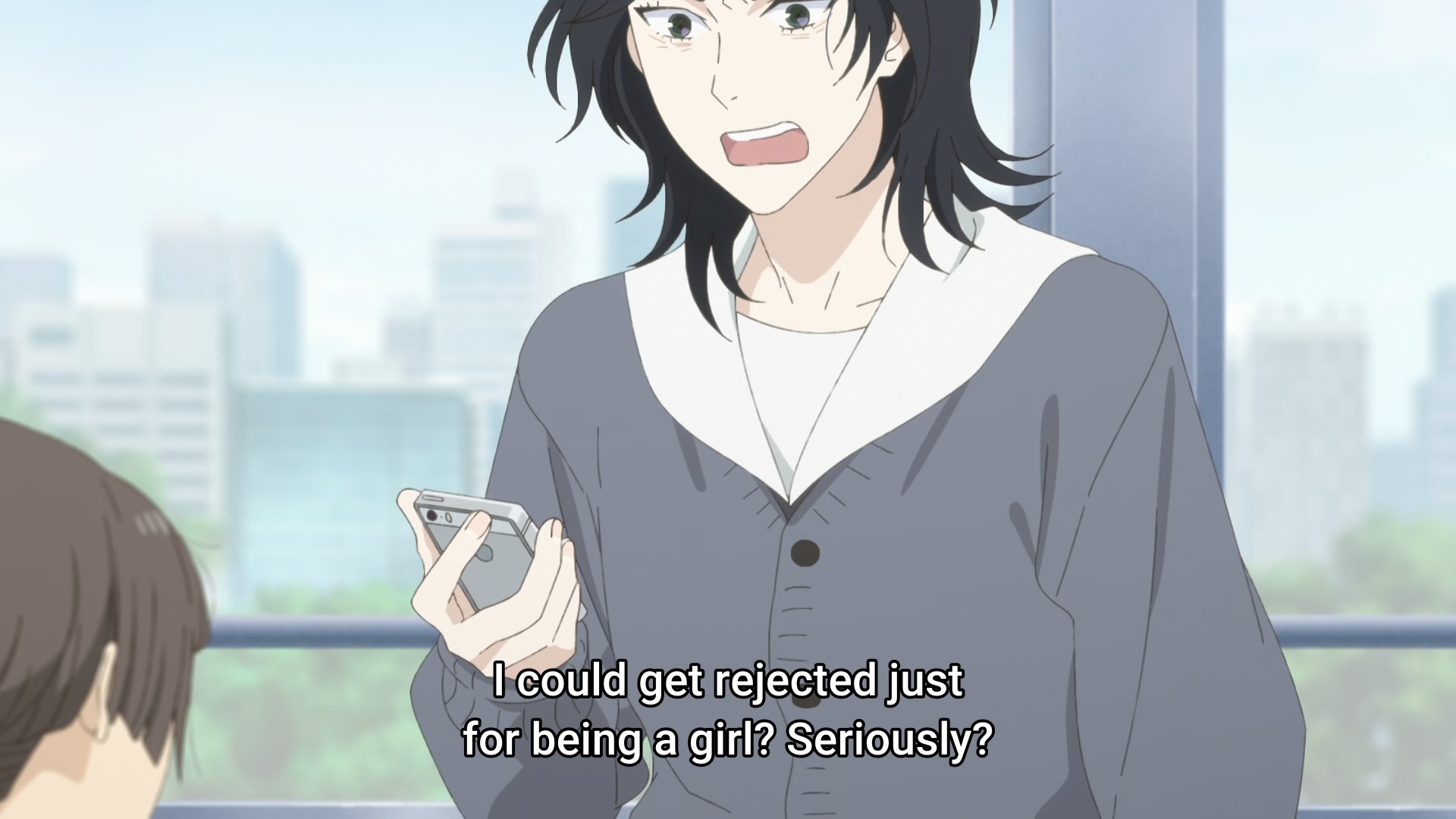
A high school girl looking at her phone in outrage, saying 'I could get rejected just for being a girl? Seriously?'

Morimoto Chiyo is one of Asa’s classmates, a hard working, diligent student. Top of her grade, she’s ambitious and has plans to study medicine and become a doctor. So far the anime hadn’t spent that much time on her. She was introduced in episode four as the representative for the new class of first year students. Apart from that she was occasionally shown talking to Togo Yuto, a huge football player also in Asa’s class. Just one of the incidental characters drifting in and out of Ikoku Nikki‘s story or so it seemed.
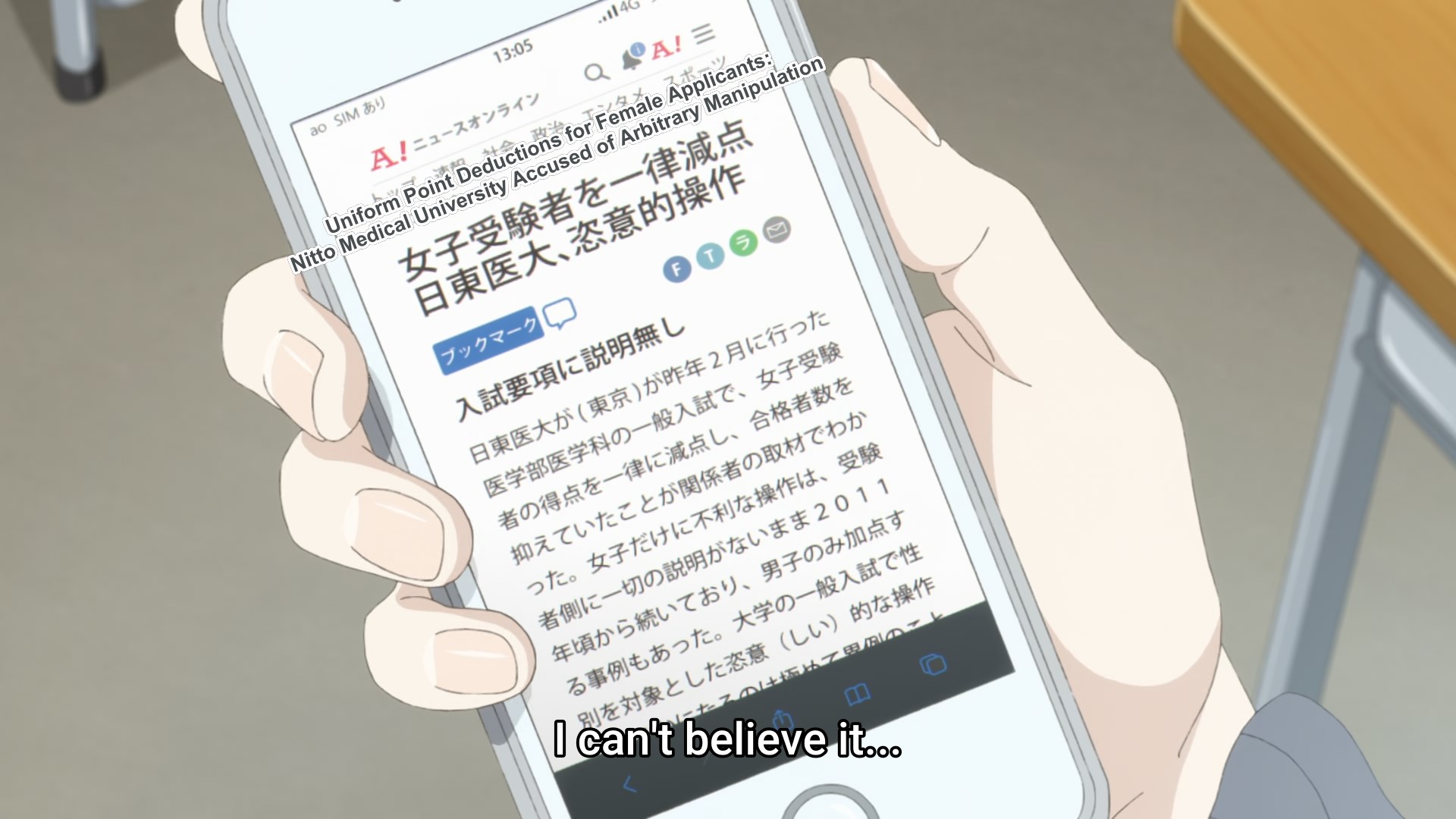
A close up of a phone screen  showing 'Uniform point deductions for female applicants: Nitta Medical University accused of arbitrary manipulation'

What’s she’s reacting to isn’t something made up for the series. Back in 2018 a huge scandal broke out when it was revealed one of the top Japanese medical universities had had deliberately set a quota of no more than thirty percent of its annual intake for female entrants:

It quotes an unnamed source saying officials adopted a “silent understanding” to reduce the number of female entrants over concerns female graduates were not going on to practice medicine in employment.

“Many female students who graduate end up leaving the actual medical practice to give birth and raise children,” the source told the newspaper.

The way it did this was by falsely reducing the scores of female exam takers and had been doing so since 2006, while also inflating the scores of male applicants who had donated to the school. Even in a country where societal expectations are indeed still are that women will only work until marriage, this was still a huge outrage. Chiyo’s anger here was and is widely shared, with various female authors responding to it in their stories that year and the next, the most well known probably being Sexiled, where a similar conspiracy is uncovered in the Adventurers Guild. The scandal was an insult to all Japanese women. It wasn’t just that society treats you as if marriage and children should be your highest calling, expects you to sacrifice your career for it, now these same expectations were used to deny you the chance altogether. With Ikoku Nikki the manga having started a year before the scandal broke, it’s unsurprising that Yamashita Tomoko too would incorporate it in her story.
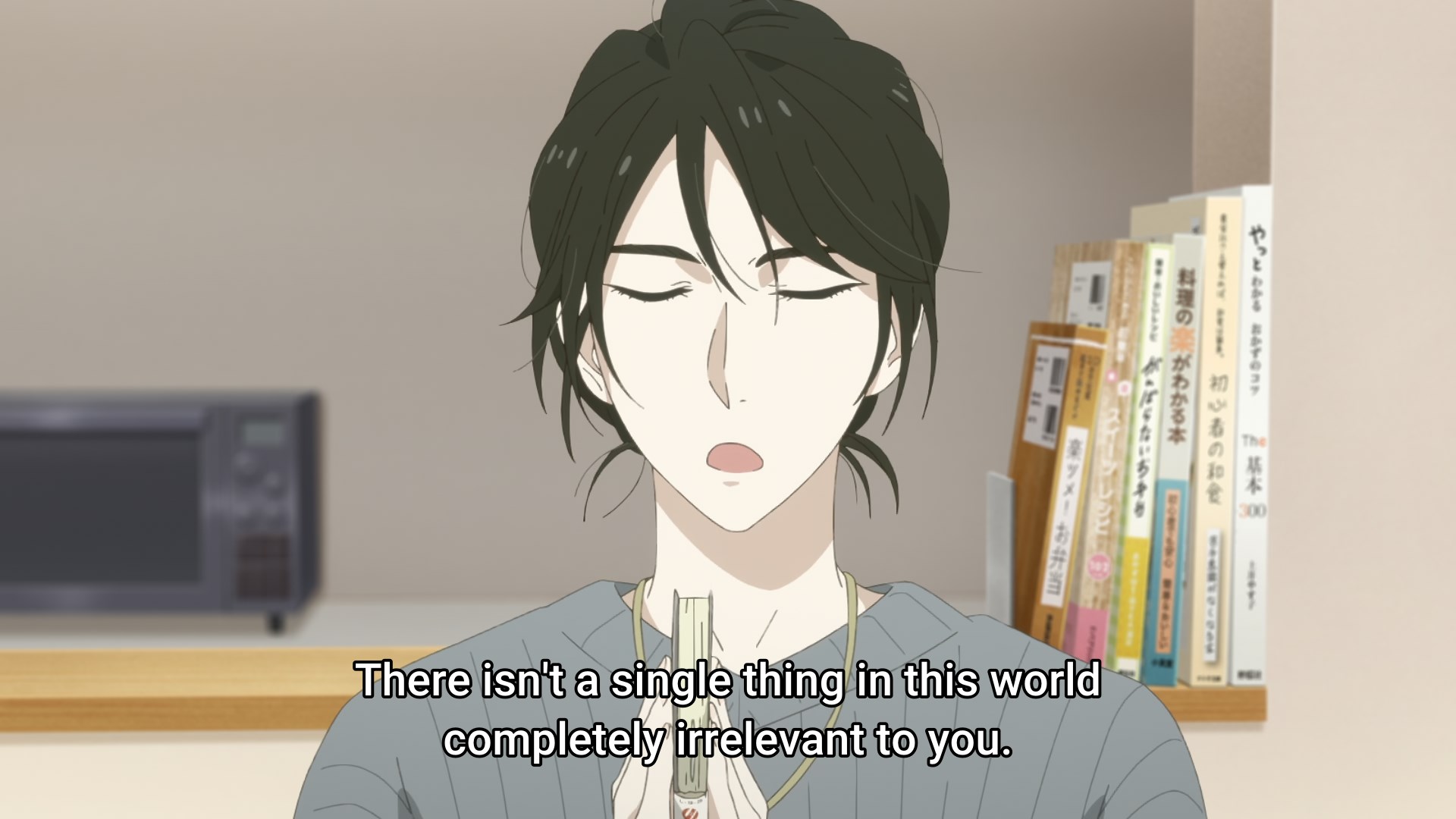
There isn't a single thing in this world completely irrelevant to you says Makio to Asa, closing her book

And it fits so well too, even if it’s not directly relevant to Asa as it clearly is to her classmate Chiyo. As Makio tells Asa in episode eleven, “There isn’t a single thing in this world completely irrelevant to you” after all. One of the themes of the manga and the anime both have been her wrestling with the “infinite possibilities” that lay ahead of her afterall, of knowning at fifteen what you might even want to do with your life. Wanting to become the person you want to be but not necessarily knowing yet who that is. And here is Chiyo, who does know who she is and what she wants to become, having her nose rubbed in the fact that there are people deliberately setting out to make that impossible. It’s not as if this series offers a particularly naive or rose tinted version of growing up, but it’s still a painful dose of reality slamming down on it.
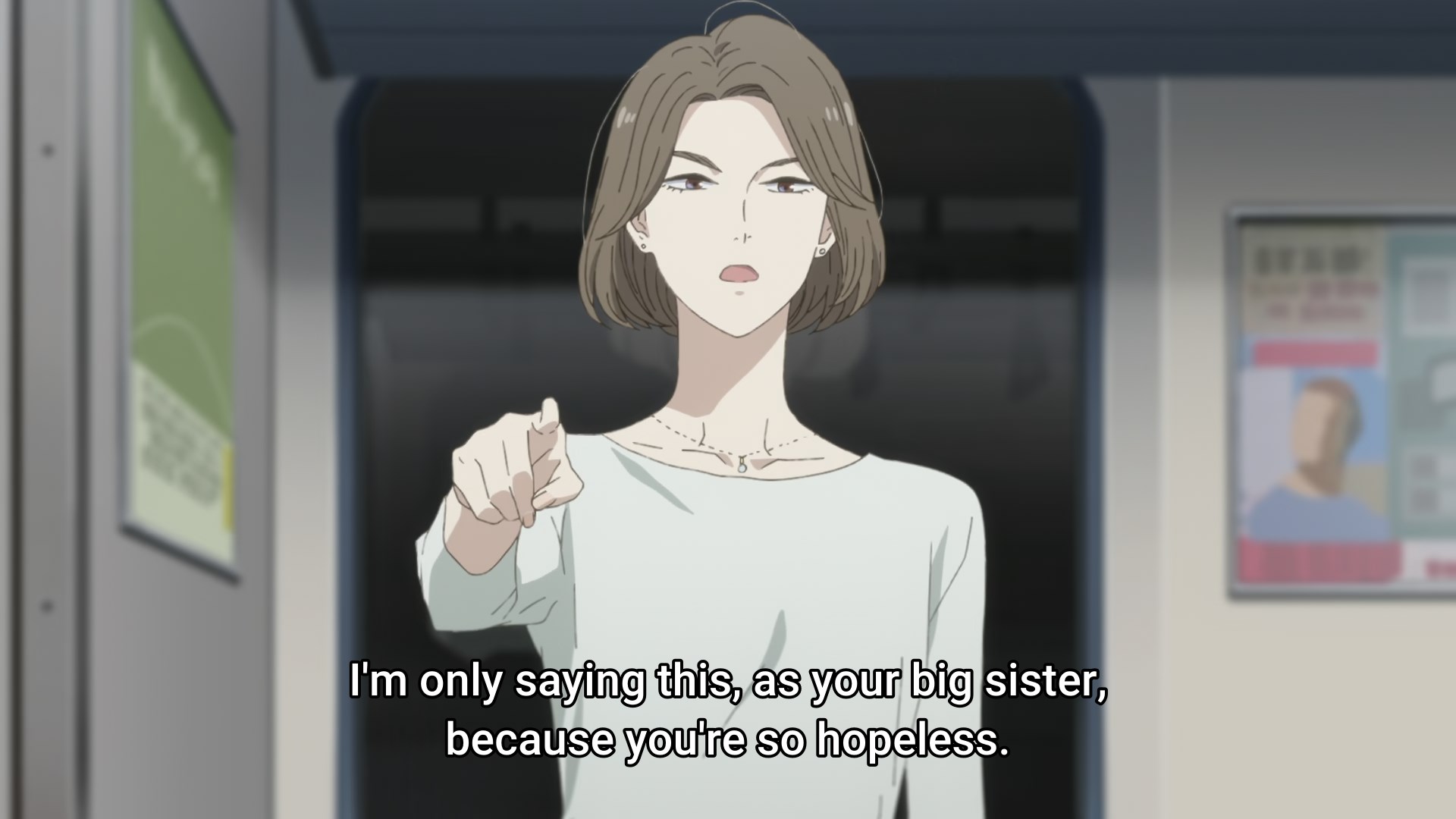
I'm only saying this, as your big sister, because you're so hopeless: Minori point her finger at the camera, addressing Makio

Now obviously this wasn’t planned; the manga started a year earlier after all, but that’s the genius of serialised manga, that it can incorporate such contemporary issues so quickly when the mangaka is up for it. this is a series which is partially driven by the conflict between Makio — unconventional, neurodivergent, not afraid to go her own way — and her older sister Minori, always seeking the societally approved way of doing things. Makio had to constantly fight her sister about how what she was doing was wrong, or strange, or couldn’t work to the point she still haunts her after hear death. Yet Minori could only argue with her, never force her to give up her ambitions, the way Chiyo’s could’ve been crushed by this conspiracy to deny women access to medical university. The scandal brings to the surface a feminist undercurrent that had always been lurking in the series, some of which we already say in episode nine. That manipulation of exam results is the ultimate expression of what Minori used to tell Makio: “we know better than you what’s good for us, so if you don’t listen, we will make sure you do what’s best for you”.
She could’ve been somebody important

This week’s episode of Ikoku NikkiJournal with Witch hit where it hurts.

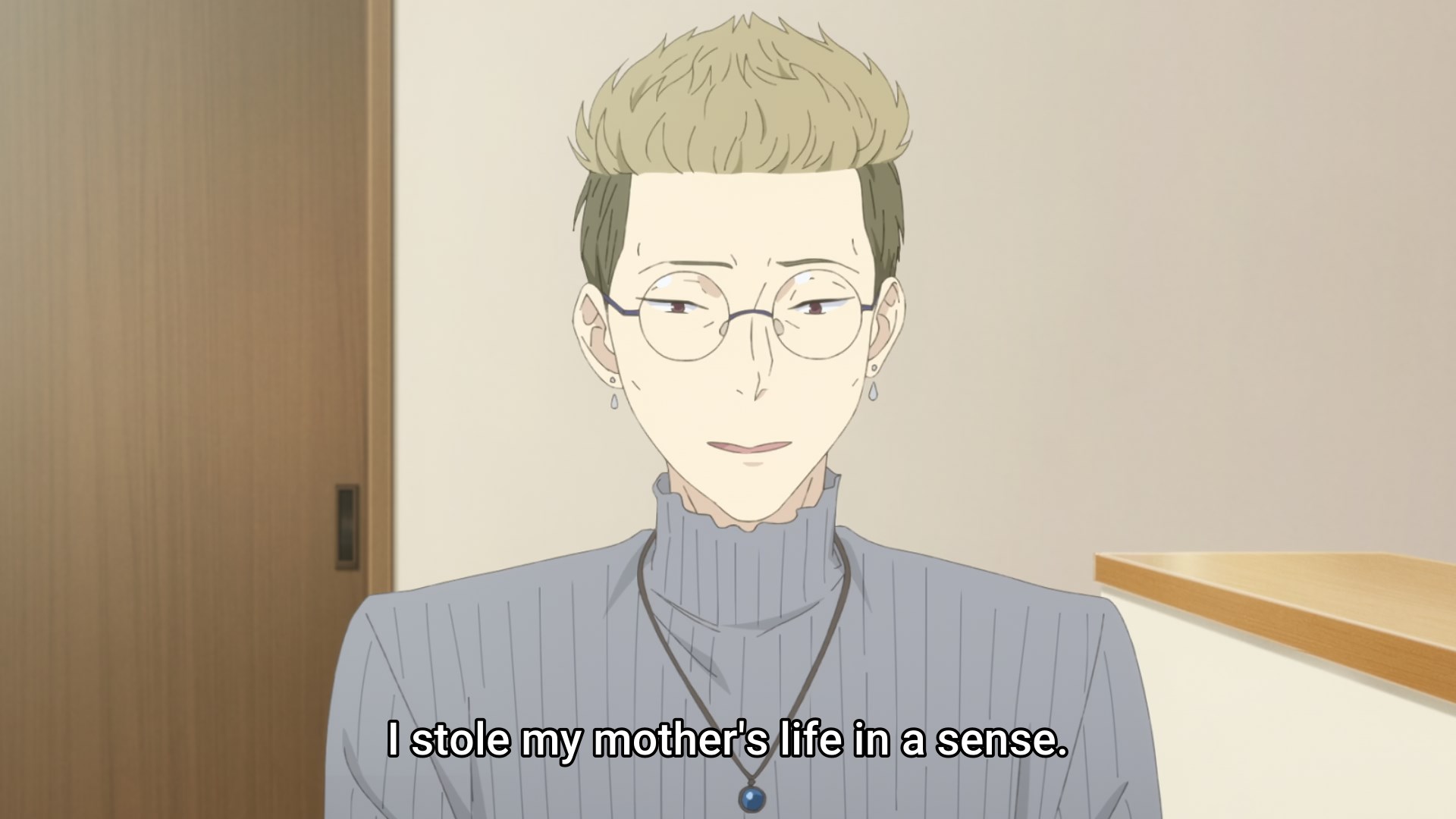
I stole my mother's life in a sense

I was born in 1974, which is long enough ago that my mother lost her job as a kindergarten teacher when she became pregnant. That’s how things worked back then in the Netherlands. If you became a mother you obviously could no longer work. You had to take care of your baby after all: that’s your job now. The father? He can’t help you, he has a real job. Believe it or not, this state of affairs was already an improvement on a decade earlier, when she would’ve lost her job on marriage. Progress!

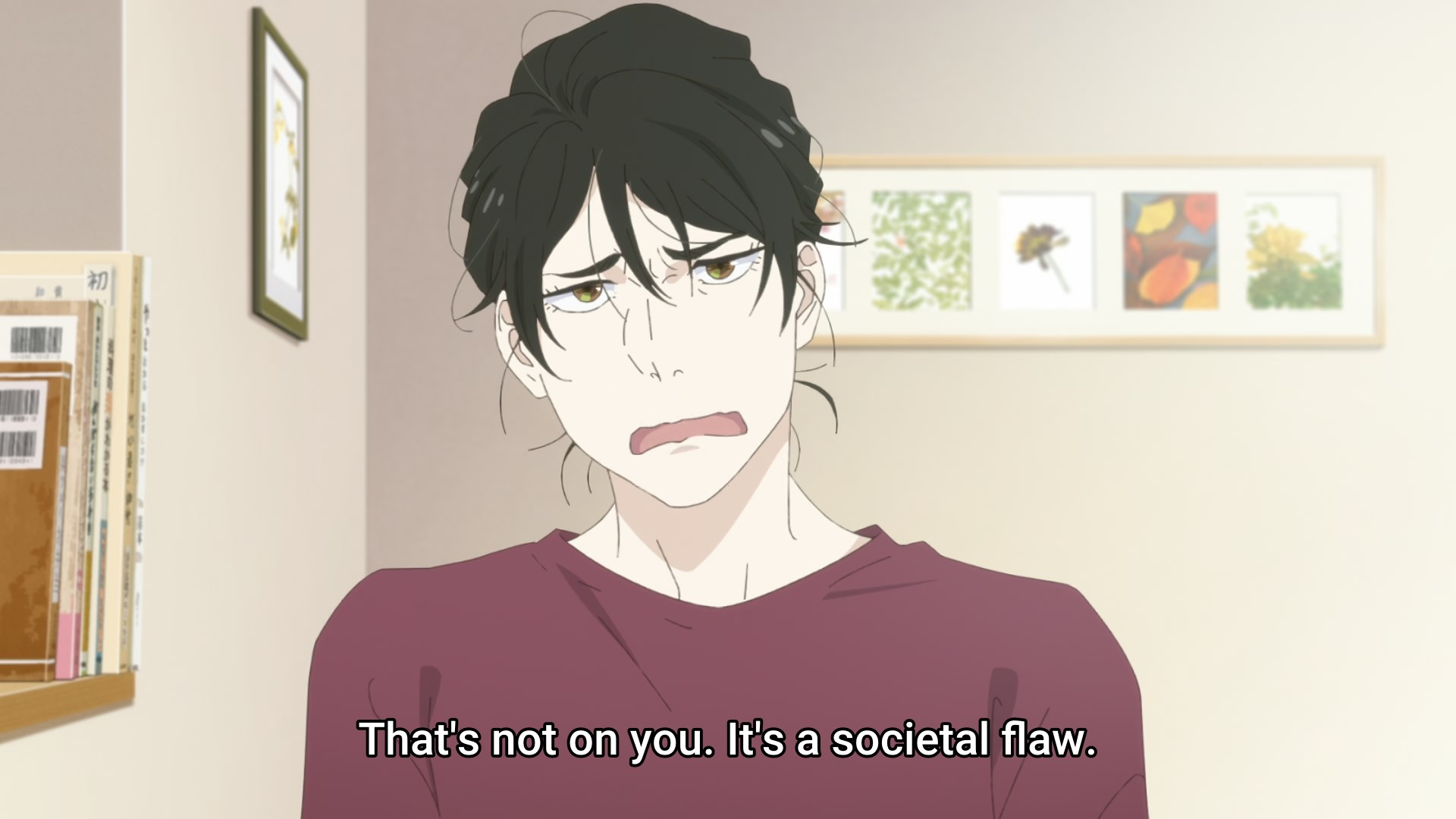
That's not on you, that's a societal flaw

Not that my mother didn’t want children or that she didn’t look forward to being a mother. It’s just that the option of “have children AND a career” wasn’t available for women then. So when Juno-san started talking about their mother, how she was a sharp woman and how had she not had her child or had been born a generation later, she could’ve been somebody important, that struck me. Especially coming in the middle of an episode that revolves around becoming who you want to be and discovering who that is. Even though Makio is right and society is to blame, I share Juno’s sense of guilt. It’s not that my mother has been generally unhappy with her life, but that there were choices that were made for her, that limited her opportunities. What if she could’ve stayed a teacher and my parents had split the work of raising children they way my sister and her partner do now? What would her life be like now?

An Uncanny Valley Version of Patlabor: The New Files

Ever started a sequel to a favourite series and found something …off with it?

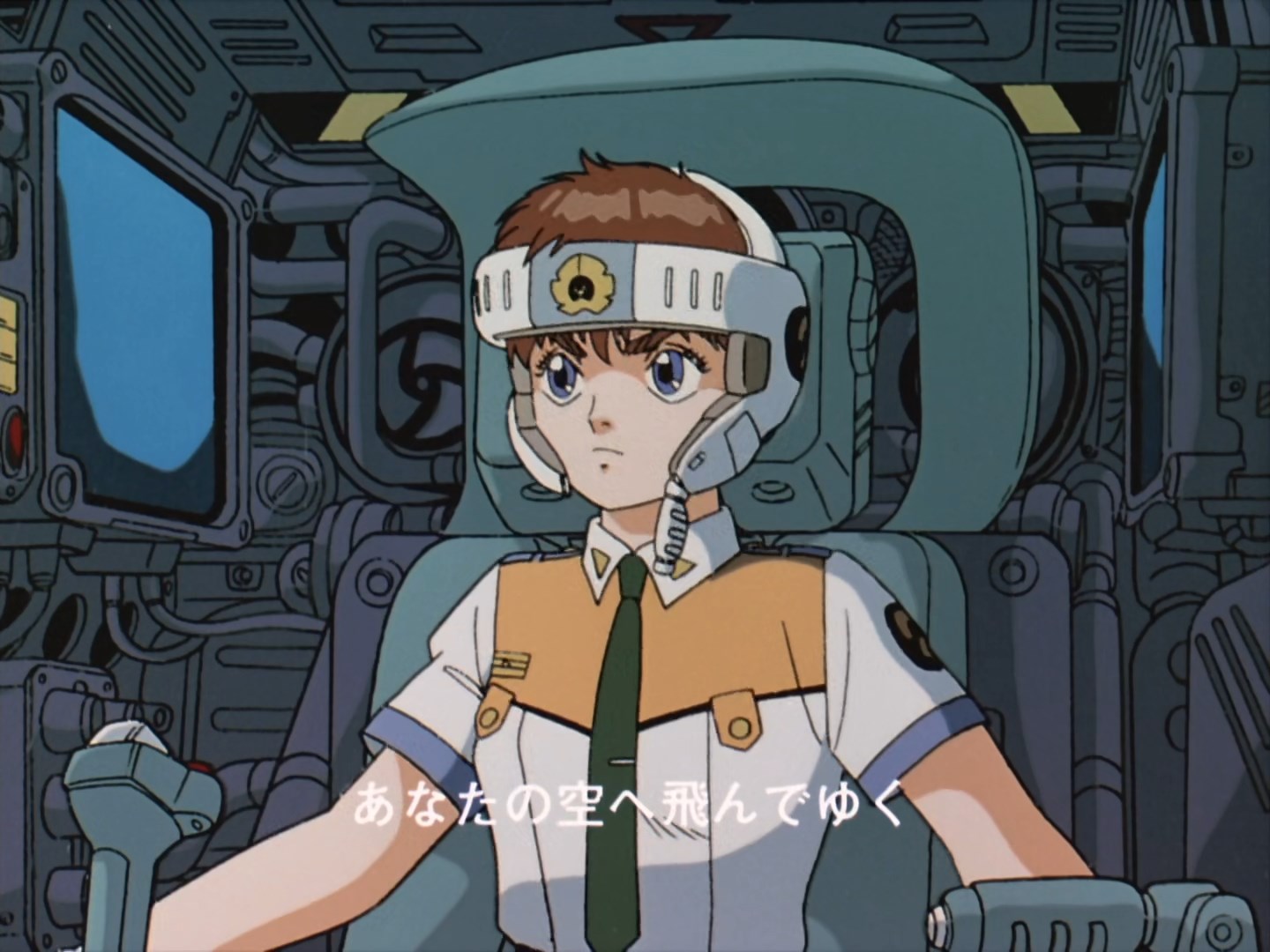
Noa in the cockpit of her mech, her face looking wider and off model

That’s what happened to me starting Patlabor: the New Files. As soon as I saw the shot above, from the series opening theme tune, it felt off. That wasn’t the Noa I remember from the original OVA series or the television show. Having now watched the first two episodes this feeling persists: none of the characters I remember look quite right while the animation itself feels slightly cheaper and stiffer too. To be fair, these are only minor defects and on its own it’s perfectly servicable, but it put me off nevertheless.

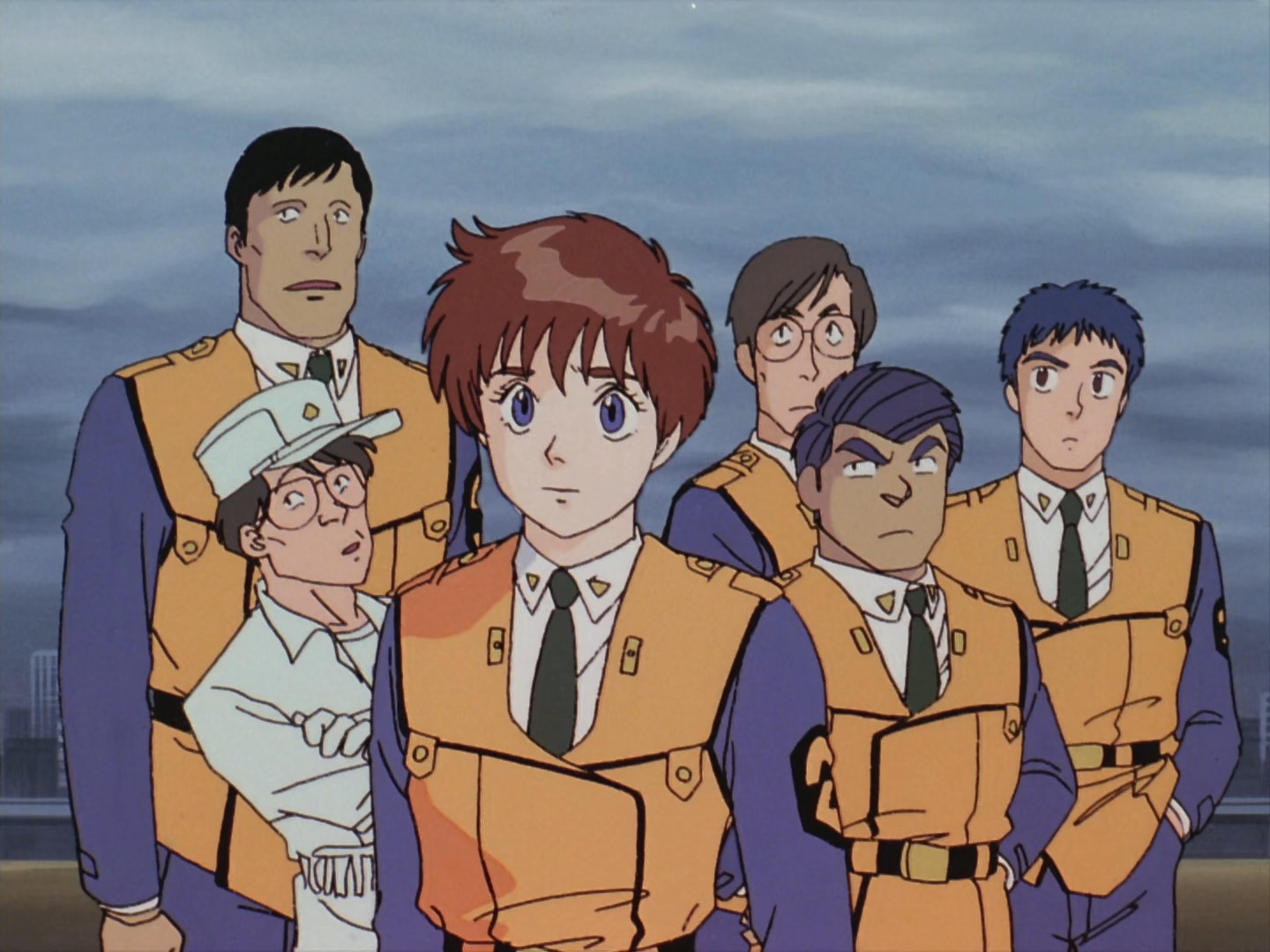
Most of the cast, off-model and stiff looking

Patlabor is important to me. Manga Entertainment brought out the first two movies in the early nineties and these were among the first anime I watched consciously as anime; I think I also watched at least some of the original OVA series. The television series as well as the rest of that original OVA I watched when I got back in anime in 2015-2017, leaving The New Files as the only major Patlabor series I still needed to watch. If you’re familiar with the franchise, you know there’s quite a tonal difference between the OVAs, the movies and the television show. The OVAs tend to be serious near future science fiction, while the television series is somewhat more goofy and more slice of life. The movies meanwhile are much more philosophical in nature, with the second one being a sort of Ghost in the Shell before Ghost in the Shell. The central concept of each is best summed up by the opening narration of The New Files:

“Labor” is the common name for robots developed for industrial use.
Their use became widespread in construction and civil engineering,
but Labor-related crimes skyrocketed as well.
To combat this, the Metro Police created a Patrol Labor unit:
The Special Vehicles, Section 2.
This was the origin of the Patlabors.

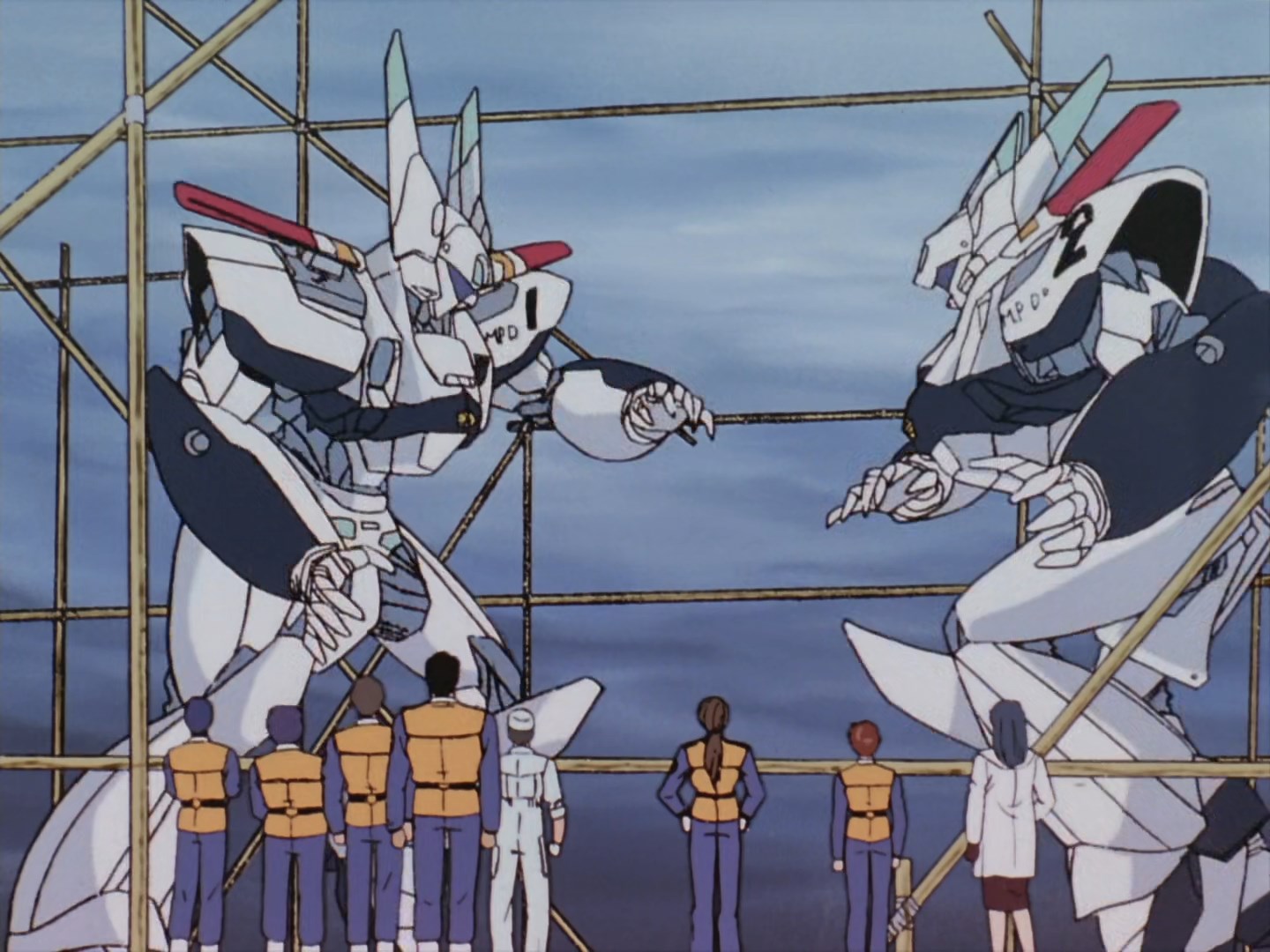
Two of the Patlabors fighting a mock duel

The New Files starts where Patlabor: the TV finishes, with a rematch with Griffin, a mysterious black Labor which fights the police as a sort of sales demonstration. Originally the first OVA was published just after the television series had ended, so this would’ve been fresh in the viewer’s memory still, but I finished watching it in 2017 and almost a decade later the details had somehow slipped my mind. It was fairly easy to get back in the swing of things nevertheless, but that feeling of unease remained. Part of that was that the cast just didn’t look like themselves, part of it was the awkward character animation. Characters are posed stiffly and while the animation on the whole is decent, at times it just doesn’t feel as fluid as I expected. It took me the best part of these two episodes to get used to it and actually enjoy the story. Even below average Patlabor is still a cut above most anime.