Sewayaki Kitsune no Senko-san is a deeply dystopian anime, in which the only way to even alleviate the stress and worries build up by Japan’s horrifying work culture is to have a cute little fox goddess willing to serve as your house wife:
Yes, this is a feel good series about an ordinary, overworked salary man coming home to find out a friendly kitsune fox goddess has adopted him to pamper like an indulgent grandmother would. The first episode is basically him adjusting to this, after first worrying she was a cosplaying neighbourhood kid who snuck in his apartment. Doga Koba, the studio responsible, has made its niche by adapting this sort of cute, fluffy slice of life manga and this was done with their usual quality. I do think though that the manga’s art style doesn’t translate to anime well, it falls a bit flat at times. The pacing is a bit off too. What are quick one/two panel sequences in the original here are dragged out a bit too long, receiving undue emphasis. What in the manga was a one panel gag about him panicking finding a cosplay wearing little girl in his house in the anime becomes a scene where he imagines himself being led away by police as a pedophile, complete with responses by his co-worker and family. It kills the joke and undermines its own premise to fill up screen time.
Because unlike the worries Vrai Kaiser put in their review over at Anime Feminist, I don’t think Senko the fox goddess is meant as a girlfriend to our overworked protagonist. Rather, she comes across to me as an indulgent granny wanting to spoil a favourite grandson. The episode isn’t particularly subtle about this either, what with several flashbacks to Nakano’s actual grandmother. Senko is there to comfort Nakano, not sexually gratify him, but the scenes Vrai Kaiser complains about, do reinforce the idea that this is one of those series.
But despite these missteps, the fantasy that Sewayaki Kitsune no Senko-san wants to indulge in isn’t sexual. Rather, it’s the fantasy of going back to childhood, to simpler times without the responsibilities and stress of an adult in a job that overworks you. To have somebody waiting for you, cook you dinner, pamper you. To not have to face life alone when you’re only living to work, rather than working to live. Somebody there to selflessly love you without expecting anything in return. That fits a grandmother more than it fits a lover. It’s still a very male fantasy of course, to have this no questions asked love and devotion magically appear in your life.
It’s a fitting fantasy for those salary men who have no option but to overwork themselves, trapped in the exploitative, dead end work culture of Japan. Only the interference of a benevolent fox goddes can bring them any relief and even then only temporary because tomorrow they still have to go back to work.
Sometimes you read a manga and it doesn’t work for you, then it gets an anime adaptation and it all clicks? Well, Midara na Ao-chan wa Benkyou ga Dekinai isn’t one of those. The first episode was less than 13 minutes long, but I didn’t even make it half way. Horie Ao, our protagonist is a very serious high school student convinced all the boys are sex crazed monsters, because she was raised by her porn writing father and he is a sex crazed monster. And that’s the joke. It’s deeply unpleasant as well as not very funny, nor is thhe idea of “ha ha she’s actually horny all the time behind her serious student facade”. Dropped.
The one joke in Nobunaga-sensei no Osanazuma is that the wife to be of famous Japanese warlord Oda Nobunaga is displaced in time and mistakes his far distant descendant also called Oda Nobunaga for the real thing. She’s fourteen so of marriagable age and therefore immediately attempts to sleep with our protagonist, who at least has the grace to refuse. Nevertheless his first reaction to finding her in his arms is that it’s like one of those anime where a girl falls from the sky so she’s going to be his wife. He’s a teacher by the way and in the very first scene one of his students tells him she’ll marry him after she graduates if he remains single, which he is actually happy about and just no.
Spring 2019 anime preview 18: Kono Yo no Hate de Koi wo Utau Shoujo YU-NO
Based on a classic visual novel apparantly so I expect harems, metaphysical pounderings and people telling me I really should’ve played the game to understand the story pic.twitter.com/JXySybvuki
This was very much what you expect from a belated adaptation of an nineties visual novel. A lot of setup, as we follow our protagonist around school talking to the various girls he knows before the plot kicks in about a quarter to the end. Quite a lot of the shots actually resemble those you’d see in a visual novel, overly rendered static backgrounds with the characters talking in front of them. To be honest, it’s not a very visually interesting series, so-so character designs matched with sub par animation and boring backgrounds. And when it does try to be interesting you get shit like this:
That’s the obligatory sexy school nurse, who has heard of the notion to dress professionally but didn’t think it applied to her, waking up the protagonist by standing over him and giving him a good look at her panties. Dude himself starts propositioning her immediately in a way that’s clearly a routine between the two of them. Again, it’s all visual novel stuff we’ve all seen a million times before and you have to wonder why anybody would create this particular adaptation now. Even if the original was ground breaking in its time, that’s almost twentyfive years ago and we’ve seen a lot better since than what this first episode promises. The rampant sexism of the protagonist doesn’t help either.
If the plot is interesting a lot of this can be forgiven, but so far the story has barely kicked in. There’s a mysterious controversial scientific project going on which the protagonist’s step mother is involved with, there’s a mysterious shrine and an archeaology club at school investigating it, led by an obviously evil professor and finally there’s the strange object protag-kun’s dad — who disappeared a few months before — sent him. And finally there’s the mysterious naked glowing girl, who is not his father in disguise. All of which comes together at the end of the episode, when Something Happens and our hero wakes up again in his own bed, with nobody having noticed anything strange…
Again, all stuff I’ve seen before but for the moment just about enough to give this a second episode. I don’t think this will be a good series, but I’ll settle for mildly interesting. I need something to play in the background while doing the dishes after all.
The first anime series I can remember watching I don’t actually remember watching, I just remember playing it in kindergarten afterwards, in what must’ve been 1980. The series was the original Gatchaman, or rather the Dutch dub of the American reworking Battle of the Planets, Strijd der Planeten, with the heroic adventures of the Giefors team. I think I mostly played either the princess or that one fat dude, setting up some expectations for later life.
That’s obviously long before I ever heard of anime, or even Japanimation as it would still be called once I did learn about it, sometime in the later half of the eighties. Before that it was all just cartoons, mostly dubbed into Dutch and often edited for a children’s audience, not that different from all the French or English or Canadian co-productions that we would watch back then. That was in a time when we only had two national channels in the Netherlands, no cable and if you’re lucky and lived close enough to the border, perhaps you’d get a Belgian or German channel too. I remember one glorious Spring afternoon when conditions were clear enough to receive BBC one for five minutes. It was cricket.
For the better part of two decades now I’ve been following Andrew Weiss, first for his comics blogging, then for the mix of insightful commentary on pop culture and autobiographical examination of same. One of the things I envy in his blogging is his dedication to long series of posts on a single subject and ability to see them through even if they take years to complete. One of those series was about albums that mean something, looking at the circumstances in which some of his favourites albums were purchased. When I started thinking about doing a series about the anime that influenced me it was this that came to mind as a template. I’m not sure yet how regular this feature will appear or how many installments it will take, but I’ll try and do it in a rough sort of chronological order.
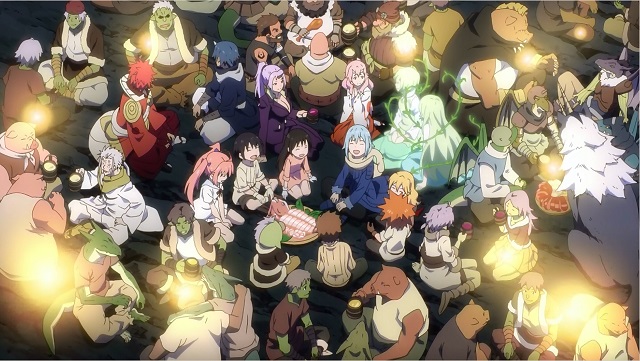
The best recent isekai series is about an enlightened Japanese incel who gets reincarnated as a slime in a fantasy world and teaches all the grateful natives how to live in harmony with each other even though they’re different species.
Is this a fantasy of colonialism? Well, it’s not a million miles away from something like Tarzan. As you know Bob, isekai is a rather popular fantasy subgenre, where the protagonist either gets transported from modern day Japan to a fantasy world, or gets reincarnated into it after dying in an accident (usually courtesy of Truck-kun) or something similar. Sometimes they’re summoned, sometimes it’s an accident and if they’re reincarnated, it’s usually as a reward or apology for dying. Sometimes it’s a light hearted power fantasy, where protag-kun defeats all sorts of threats without breaking a sweat while collecting a harem of grateful fantasy girls, sometimes it’s a grim and gritty revenge fantasy where his seemingly thrash power is revealed to be game breaking because of how cleverly he applies it while seeking revenge on those that done him wrong and defeat the evil overlord menacing the world (the harem is still there of course). Sometimes it’s much more innocent; two recent examples where both of restaurants being transported to a fantasy world and teaching the natives about the wonders of Japanese food. But through all of it runs an imperialist, colonialist streak, as this Pause and Select video argues:
Sometimes this is very obvious, as in Gate, which starts with a dimensional, well, gate opening up in Tokyo through which a fantasy army emerges to attack the city. After initial panic the police and Japanese Self Defence Forces rally and defeat it, with an expeditionary force sent to the other side of the gate to prevent a second attack. A series of battles there results in the deaths of hundreds of thousands of imperial soldiers for little loss on the Japanese side. Once a base is established, the series follows the protagonist, who also helped foil the initial attack on a series of what are essentially hearts and minds missions. A comparison with the US War on Terror and its continuing occupation of Afghanistan and Iraq is obvious. Especially when it quickly becomes clear Japan would very much like to ‘develop’ the new ‘Special Region’.
But usually it’s a bit more subtle, just the idea of a random Japanese person being better at being a hero than the actual inhabitants of fantasyland. That’s colonialism in a nut shell, familiar from Tarzan and decades of American science fiction. The latter makes for a good comparison. The Campbellian/Heinlein science fiction of the socalled Golden Age was cheerfully imperialistic, manly men conquering the stars and engaging in the occasional bit of genocide to make the universe safe for Anglosaxons. Coming from a country still high on manifest destiny it was no surprise that alien races were there only to be conquered or pitied.
Modern Japanese isekai fantasy isn’t this aggressive in its colonial fantasies, as that Pause and Select video explores. It’s more about ‘soft power’, about Japanese culture being superior to the indigenous cultures of fantasyland, as seen in the two “restaurants trapped in fantasyland” series (Isekai Shokudou & Isekai Nobu) we’ve seen the past two years. In both the Japanese food is so obviously more tasty than the fare the fantasylanders are used to even though both are bog standard restaurants serving bog standard food. The latter series was actually commissioned to promote the 2020 Tokyo Olympic Games. Cool Japan in Another World. The most blatant example of this Cool Japan imperialism was 2013’s Outbreak Company, where a shut-in otaku is given the task of selling anime culture to a newly discovered secondary world in a government sponsored attempt to ‘conquer’ this world through culture.
Tensei Shitara Slime Datta Ken, which we started with, is less blatantly otaku pandering and therefore more interesting as an example of soft colonialism. Our protagonist Rimuru is a fairly average isekai protagonist, stabbed to death defending his friends/co-workers from an attack, reincarnated as a slime who has the power to swallow up bigger monsters and copy their power. It’s a classic power fantasy, the meek looking person (or slime) being much more powerful than they look. When he encounters a group of goblins driven from their home by dire wolves, he takes their side, takes out the leader of the wolves and becomes the ruler of both sets of monsters. From that humble beginning he builds up a country where all sorts of monsters can live together in peace under his benevolent dictatorship. It’s a very seductive sort of fantasy and I can’t say I don’t like it, certainly moreso than something like Goblin Slayer, but it remains a colonialist fantasy.
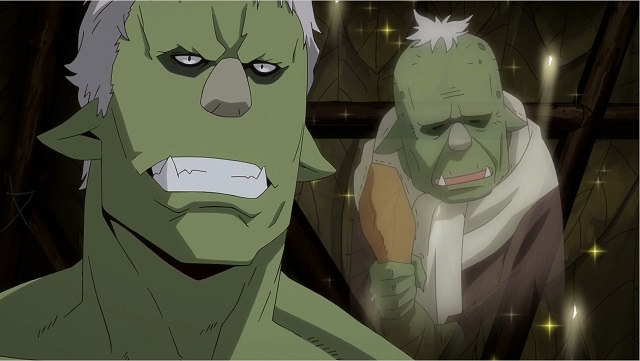
Nothing makes this as clear as the naming scenes. It’s a bit of a fantasy gaming cliche that ordinary monsters are nameless while named monsters are more powerful. And indeed, the low level monster tribes Rimuru encounters are almost entirely nameless, untill he sets out to name them, at a cost to his magic. The results are spectacular, with ordinary goblins becoming super powered and much more human looking. This repeats with every race Rimuru names: the men always become buff slabs of beef while the women gain bouncy bouncy chests, even when they’re lizard people. The unnamed people gain recognition and value only when named by the colonial authorities. Before that, they’re just a mess of small fry.
As an European, this sort of attitude is not new in the stories I’ve consumed, just the way in which this Japanese variant differs from what I’ve read in French comics or seen in American movies. A series like Tensei Shitara Slime Datta Ken is fairly innocuous in context, if patronising towards fictional species and with an attitude that can be traced back to Japan’s WWII era imperialism. Few of us do better here in the west. It’s not vile like Goblin Slayer or Shield Hero which wallow in resentment, but it does pay to keep the background of its particular narrative in mind. It’s not necessarily bad to watch this sort of series, as long as you acknowledge its less savoury aspects.