The first boy Precure is genderqueer

Well, it took Henri until episode fortytwo, but they told you so in episode eight:

Hugtto Precure: maybe I will try to be a Precure too

Hugtto Precure is the fifteenth installment in the Precure franchise, which as Andrea Ritsu explains has always been somewhat progressive and queer friendly, especially for a kids franchise. In recent years this has intensified: the Maho Girls Precure protagonists kissed, while there was a canon lesbian couple among the precure in last year’s Kirakira PreCure a la Mode . In this context it would make sense for Precure to finally introduce a boy Precure as well, something with which it has flirted in the past. Not out of some percieved need to always crowbar boys into something intended for girls, but because “boys can be princesses too”. And Henri is the perfect “boy” to do so. After all, they are:

Hugtto Precure: a refined Japanese lady and a Parisian

From their very first appearance it’s clear Henri doesn’t think of themselves as a boy, but as somebody for whom gender is irrelevant, wanting to be both and lucky enough with how they look that they could pull this off. Henri is self assured, confident and completely open in how they perform their gender. Henri starts off as a bit of an antagonist of the Precure girls, being friendly ice figure skating rivals with one of them and thinking the others are holding Homare back. Once that’s resolved though Henri becomes somewhat of a friendly face, helping Emiru standing up to her far too serious brother Masato, who’s obsessed with propriety. Said brother ends up becoming his somewhat over protective boyfriend not to long after by the way:

Hugtto Precure: precious boyfriend

That’s from episode 33 when Henri blows a kiss to their adoring audience and everybody, men and women both, get hearts in their eyes, except for Masato, whose actual heart lights up. It’s a nice touch. In general I like the way the relationship between those two is shown: it’s never spelled out but it’s clear these are more than just friends with Masato always there to help Henri whenever the latter is getting depressed. And Henri does have problems: a potential injury threatens to derail his skating career, while the simple act of growing up, of getting taller, having their voice changed threatens their ability to have the gender they want.

Hugtto Precure: precious boyfriend

Henri isn’t in a lot of Hugtto Precure episodes, but the ones they’re in are some of the best of the series, laying the foundation for their eventual transformation into a true Precure. His story fits the theme of the series, with Henri’s worries for a future in which they may have to leave behind skating. Not to mention the fear that puberty will put an end to their ability to be “both a refined Japanese lady and a Parisian” as their body grows more masculine. The villains of the series too are obsessed with the future, wanting to stop time because only that way will people be unable to feel any more pain. They try to seduce Henri with this shared fear of the future and almost succeed, until:

Hugtto Precure: Cure Infini

Becoming a Precure doesn’t solve Henri’s problems or fears, but it gives back hope, a way for Henri to fight through his momentary depression at losing his skating career and see new possibilites again. Having Henri, somebody who struggled not with who they wanted to be but with being able to keep being that person as the first ‘boy’ Precure fits with the whole ethos of the franchise. Of discovering yourself, of finding new ways to be yourself if the old way no longer suffices. Had they just plunked in some random guy this wouldn’t have worked, but with Henri you have somebody who is queer enough to be a Precure, who can serve as a bit of a role model for all boys to know that they too can be princesses, without having to fear Precure will be remade to appeal more to boys in general.

This is the eight post in this year’s twelve days of anime challenge. Tomorrow: I watched way too many pretty boy series this year.

Frankenstein Family: normality is overrated

Anime is lousy with absent or downright evil parents, but the ones in Frankenstein Family take the cake, being mad scientists who genetically manipulated their own children for their experiments. They’re gone by the time the series opens, arrested and in prison, which leaves their children to have to care for themselves.

Frankenstein Family

So from left to right we have the twin sisters, one a flower woman who can photosynthesise and grow all sort of flowers on her, the other a spider woman with artificial arms & hands. The oldest brother in the middle looks normal here, but is a weredog (not wolf) and tends to like his doggo form more than being human. Well, who wouldn’t? On the far left is the youngest sister, a mind reader who can’t turn it off so by necessity is a bit of a NEET. Our protagonist is Tanisu, the youngest brother, relatively normal because he’s ‘only’ a genius. Perhaps that’s why he’s the most obsessed out of all of them with appearing normal, conforming, trying to do all the things a normal family would do. Which is hard to do because none of them really have any idea of how to act this way, having been raised by their asshole scientist parents in what was arguably one huge experiment. What’s more, the rest of his siblings aren’t actually all that concerned about this, prefering to do the things that come naturally to them rather than forcing themselves into some ideal of what the average family should look like.


The desire for normality, for being an ordinary school boy is what drives a lot of anime protagonists just before they get dragged up into some grand adventure. That doesn’t happen here. Instead we have Tanisu coming to terms with his sibling’s nature & behaviour, as they in turn adapt a little bit to living in the outside world. In the end however it’s Tanisu who changes the most. He’s still somewhat obsessed with his brother and sisters passing as human, but less uptight about it, more accepting of their monstrous sides, no longer wanting them to repress them all the time. There’s a little bit of a queer subtext to this, isn’t there? Being seen as something that you are not, perhaps needed to be seen that way to not be hassled, but still living with the stress of having to repress parts of yourself.

What else made Frankenstein Family interesting to me is that it’s an actual Chinese cartoon redubbed in Japanese and then brought over by Crunchyroll. Some of the cultural assumptions and shorthand is just that little bit different form ‘real’ anime and I can’t quite put my finger on it. Also, because this is a half length show, the Japanese dub pads things out by having the actual voice actors do some silly skitches and such after each episode. This also include a visit to the company licensing & publishing the original manga with some neat if surface details about translating from Chinese to Japanese and the challenges that brings. It made for a nice little package each week.

This is the seventh post in this year’s twelve days of anime challenge. Tomorrow: let’s talk about the first boy Precure again.

Kindred spirits under one roof: Himote House

To be honest, it’s not hard to understand why Himote House hasn’t gotten a lot of buzz. A half length series about five girls with super powers living in a shared house in Tokyo, talking about everyday stuff, with thrash tier CGI animation does not for an appealing series make, right?


And yet it does have its charms, if you can look beyond the CGI animation. This is definitely a series to listen to rather than watch and it helps that the voice actresses have such good chemistry with each other. Something that’s especially apparant in the improvised parts of the show, which take place after the main episode, with several episodes being almost full improv. These bits feel like a real group of friends bullshitting, as they act out random scenarios chosen by the house cat (who talks, because this is anime). They’re actually funny too, which is not something you can say from many other improv anime.

Himote House: sitting around in face packs talking bullshit

It’s also surprisingly fresh to see anime girls sitting around with face packs and scruffy house wear and not have them be caricatures like the usual hard working hard drinking career woman slobs. It all feels more like how real women would live together than the stale stereotypes of other anime. It’s also reminds me a bit of this winter’s Takunomi, which was about four young women living together getting drunk. And speaking of real, episode seven got extra real when they played the Yuri Game of Life and the difference in treatment of gay people in Japan and Europe came up:

Himote House: Yuri Game of Life

You hold a happy marriage in a country where same-sex marriage is permitted by law vs You deliver a marriage form to the city, but you’re shut down by the both sexes clause of the Japanese constitution. That’s pretty real. Usually it’s all a bit more surreal though. So in one episode they play an indoor baseball game because baseball loving girls are supposed to be more popular but every play ends as an out because of obscure rules. In another they wake up in the living room together and have to find out what happened (with a lot of improv), in a third they use neo feng shui to rearrange the house furniture, and so on. The absolute highlight of this so far is episode nine but you need to see it unspoiled to have the full effect. The latest episode, eleven, has them go to a bath house for the obligatory fanservice episode, then spent their time discussing bitcoin & blockchain.

One last fun thing about the series is that the credits have the girls cosplaying characters from classic anime series; there are some real surprises in there and they’re not always easy to recognise either. What other series has Nanoha homages? All in all Himote House isn’t an essential series, but it’s far better than you’d assume and that little bit of social criticism thrown in is the cherry on the top.

This is the sixth post in this year’s twelve days of anime challenge. Tomorrow: Frankenstein Family, an actual Chinese cartoon about, well, a monster family and what it means to be ‘normal’.

This zombie is trans and that’s NO coincidence

Just in case you thought Lily coming out as trans in episode eight of Zombieland Saga was a coincidence or a Crunchyroll SJW conspiracy, we got this shot of her the very next episode, or do you think that’s coincidence too?

Zombieland Saga: Lily creates a rainbow

What pisses me off is that there are probably a lot of people who would still believe this rather than admit even Japan has LGBT people or animators clever enough to put together a visual pun like this. Which is a bit strange for people who profess to actually like anime, but this sort of double think is sadly common among the 4-chan crowd. Not uncommon outside it either and if you want to be depressed, take a look at the Zombieland Saga talk page at Wikipedia. Marvel how one stubborn wiki editor just refuses to believe all evidence and insist Lily isn’t trans. And there’s a lot of evidence, as Andrea Ritsu proved with her video:


It all shows that what looked like Lily coming as trans in episode was in fact Lily coming out as trans. What those who deny this are doing is actually what they usually accuse others off: projecting their own bigoted values on anime, desperate as they are for a form of entertainment not ‘spoiled by political correctness’ or whatever. It’s disappointing that this attitude is so prevalent in anime fandom, rather than being happy to finally see some positive trans representation. There was no need for Zombieland Saga to do this, but they did anyway and that means a lot. There have been a lot of could be trans characters in anime — most being the obligatory feminine boy who likes to dress as a girl — but few who actually stated they were trans. Having Lily as an out character, for whom being trans is part of her personality and not a gimmick is a step forward. Trying to deny it with dumb conspiracy theories does nobody any good.

All of this also proves a point I’m trying to make with this series of the 12 days of Anime: that a lot of the more interesting things in anime happen not in what we in the west think of as prestige or core anime series, but in series with less critical attention. Your slice of moe, your pretty boy series, the sort dismissed as trash, or only of interest to hardcore otaku or fujoshi. Here we have a series that nobody really expected anything off, an idol anime even and it has given me at least some of the most emotional stories of the season, if not the year. It’s not just Lily, but also Saki’s lesbian biker past or just having Yugiri as part of the cast, a former courtesan and therefore not likely to still be a virgin, which is a Big Thing for purity obsessed idol fans. Zombieland Saga now has gotten a bit of attention from western fandom, but there have been plenty of series this year which also deserved it but haven’t gotten it. Which is something I hope to remedy a bit with this series.

This is the fifth post in this year’s twelve days of anime challenge. Tomorrow: Himote House, another underrated series of this season.

Slime versus Slayer

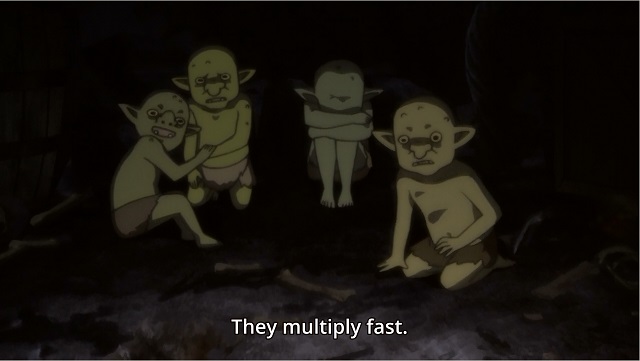
This is going to be a tad unfair, as I’ve only watched the first episode of Goblin Slayer, but I think it’s still interesting to compare its worldview as shown in that first episode with that of Tensei Shitara Slime Datta Ken. Both after all are variations on the standard Japanese RPG inspired fantasy story and its trappings, but their politics are quite different. Whereas in the first goblins are depicted as mindless raping monsters, the second has them as people to protect and nurture.

Goblin Slayer: ethnic cleansing is okay

What I despised about Goblin Slayer was not just that it used rape as a cheap way to create drama in its first episode, but what that was in service off: ethnic cleansing. And it doesn’t matter that were talking about a fictional species here, because it draws on some very real world history. A race of insatiable rapists lusting after your women has been used against everybody from Black people in slavery America to Jews in Nazi Germany (and long before). The idea that the only way you can deal with that sort of people by violence and indiscrete murder? Also not new. Goblin Slayer justifies it by saying that this is just how goblins are, being all male they need to rape women of other species to reproduce, their innate nature being such they have no choice. But all that is just bollocks that the author made up to justify having a jolly old tale of genocide. We like that sort of thing in science fiction and the list of excuses we find to justify genocide is impressive; nothing gets an sf writer’s blood pumping faster. Just in case you thought Goblin Slayer was unique in this.

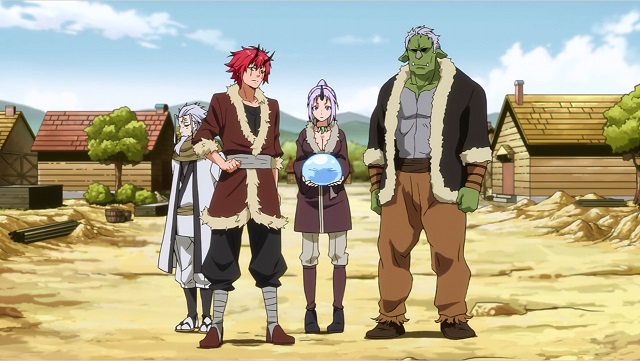
Tensei Shitara Slime Datta Ken

By contrast Tensei Shitara Slime Datta Ken does something much more interesting with its goblins. As with Slayer, goblins in the fantasy world it’s set in are some of the weakest monsters, always threatened by more powerful ones or humans. The only thing less impressive is a slime, but our protagonist slime is no ordinary slime, but a reincarnation of a virgin salaryman whose dying wish was for his friend to erase the porn on his computer. As per usual with this sort of story he gets a boat load of special powers and blatant cheats and he ends up taking the goblins under his wing as their protector. He becomes their ruler, evolves them by giving them names and helps upgrade their living situation. Other monsters too join him and his protection, with the main plot just having kicked in a few episodes ago as an invasion force of orcs is threatening to destroy everything.

It’s a much more positive portrayal than Goblin Slayer — even that evil horde of orcs is brain washed and under a magic spell, not inherently evil. Yet it’s still a colonial fantasy, of the White Man (well, Japanese Man in this case) coming to the aid of the noble suffering savages and teaching them the wonders of civilisation. Therefore, while it is more benign than Goblin Slayer, it’s still something not to watch uncritically. It’s still rooted in old habits and ideas, still a bit orientalist. It is possible to enjoy either of these series — and I certainly enjoy the slime anime — while being aware of these problems. It’s when you don’t notice it that there’s danger. For me personally the rape justifies genocide elements of Goblin Slayer are vile enough not to want to watch more, while with Slime-kun the white saviour parts are overshadowed by the sheer novelty of seeing several fantasy races work and live together in a way that rejects the social darwinist mindset of so many other fantasy stories.

This is the fourth post in this year’s twelve days of anime challenge. Tomorrow: more trans zombies.