Books Read November

Twelve books read this month, finally starting to make a dent in my backlog, though I’m still buying books faster than I can read them #firstworldproblems.

The Dispossessed — Ursula K. LeGuin
Le Guin’s classic utopian novel is interesting but dated in its gender treatment, especially in the segments outside of its anarchist utopia.

The Normans — Marjorie Chibnall
A short introduction to the history of the Normans.

Silk — Caitlín R. Kiernan
Horror fantasy by a writer who has said some very smart things in various online sexism controversies. Good enough for me to read more of her work.

Italian Aces of World War 2 — Giovanni Massimello & Giorgio Apostolo
One of those slim Osprey books, mostly tedious summings up of various Aces’ kills and such. But the pictures are good.

Ancillary Justice — Ann Leckie
It was Ian Sales review that got me to read this and I wasn’t disappointed. A very solid space opera debut.

Command and Control — Eric Schlosser
Schlosser, who you might know from Fastfood Nation dives into the history of nuclear weapons in the USA; specifically how they were controlled and by whom. Turns out that control was often illusionary and accidents with nuclear weapons happened more often than you’d like…

Vanished Kingdoms — Norman Davies
Norman Davies looks at the more obscure corners of European history, showcasing some of the countries and states that didn’t quite make it. Interesting but a bit wearing in the end.

Plague Ship — Andre Norton
Read on my mobile phone, a download from Project Gutenberg, this is the second novel in her Star Queen series in which wily independent traders outwit the stodgy cooperations that rule the stars.

Conflict of Honors & Carpe Diem — Sharon Lee & Steve Miller
The second and third novel in the Liaden series. Very readable science fiction adventure stories, the sort you plow through in a couple of hours.

Dust — Elizabeth Bear
The first in a trilogy, a science fiction story set aboard a crippled generation ship parked in orbit in a binary star system which could go supernova any moment…

Chill — Elizabeth Bear
The sequel to Chill, opening up the world and dealing with the fallout of the previous book.
“I am trying to imagine a reader who wants to read this book”

Alexandra Petri is not happy at the Sebastian Faulks written authorised Jeeves & Woster sequel:

If you want to read a story about Bertie and Jeeves where people deal with World War I and everything changes, go to the Indeed, Sir fanfiction archive where there is plenty of that, much of it better written. If you want to read a story about a young Wodehouse male who falls in love and gets into scrapes, read the “Indiscretions Of Archie.”

[…]

By the eighth page I was emitting a stricken woofle like a bulldog that has been denied cake. There had been the introduction of a girl with “chocolate eyes” and a kind heart who is far more beautiful than anyone Bertie Wooster has ever dated. Anyone who has read fanfiction will note the tell-tale sign of a Mary Sue, but I thought, surely not. Not in a first outing.

Course, anybody with any sense who isn’t paid to read this book, would have dropped it at “the new Sebastian Faulks Jeeves and Wooster novel” because from that you can predict with a saddening certainty that it will be a cloying pastiche that may, at best, get some of the surface elements right, written by a smug, sad wanker far too pleased with his own writing talents to recognise how mediocre they are.

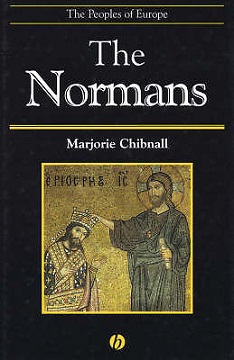
The Normans — Marjorie Chibnall

Cover of The Normans


The Normans
Marjorie Chibnall
191 pages including index
published in 2000

So the Normans eh? Bunch of Vikings who plundered the English and French coasts for a while, before the king of France made an offer they couldn’t refuse and they settled in what became Normandy, named after them, to defend France against, well, other Vikings. Traditionally this is supposed to have happened in 911 CE. unlike other Scandinavian invaders attempting to set up stock in the countries they raided, these Vikings not only survived but thrived, creating essential a new people, the Normans and a new country, Normandy, in the process. Not only did Normandy become a powerful duchy, more or less indepdent from the kingdom of France, from there on William the Conqueror went on to take over England and Wales and invade Ireland, while other Normans went on to the Mediterranean and found kingdoms in Sicily and Antioch.

What the Normans managed to do looks a whole lot like what earlier “barbarian” invaders like the Goths did to the Roman empire, grabbing a piece of it and settle there in return for protection against other “barbarians”. But, as Marjorie Chibnall explains in her book, the Normans were “a product, not of blood, but of history”, not so much a people on the move as in the “classic” — and quite likely never to have happened in that form — people movements of Late Antiquity. Instead, it was a tightly knit group of warriors loyal to a specific ruler which took over and created Normandy, mixing with and ruling over the original populations. It was similar ties between ruler and noblemen that would later enable William the Conqueror to win the English kingdom.

Read more…

Books read October

I finally picked up the pace somewhat this month, with seven books read.

Fledgling — Sharon Lee & Steve Miller
Another free novel set in their Liaden universe, this is a classic coming of age science fiction novel, amusing but perhaps better read when you’re twelve.

1938 Hitler’s Gamble — Giles MacDonogh
A very useful overview of the political and military events that shaped the last year of peace before World War II, showing how opportunistic Hitler’s policies were.

Filthy English — Peter Silverton
An amusing overview of bad language of all kinds.

Vast — Linda Nagata
Hard science fiction of a subgenre that also includes Alastair Reynolds’ revelation Space and Paul McAuley’s Eternal Light: humantiy stumbles over the remains of a millions of years old war and is hunted to extinction by the left over killing machines of the war. I hadn’t read anything by Nagata yet, save for perhaps some short stories but on the strength of this she’s a writer I need to read more off.

The Battle for the Rhine 1944 — Robin Neillands
An overview of the campaign in western Europe from Normandy up until the Battle of the Bugle and very concerned with putting the record straight with regards to Montgomery’s part in the war.

The Eye with Which the Universe Beholds Itself — Ian Sales
Second chapbook in the Apollo Quartet, this is alternate history hard science fiction about a slightly more ambitious Apollo programme.

Child of the Grove — Tanya Huff
I like her military science fiction so I thought I’d check out her fantasy work as well. A decent but weirdly paced novel.

Books read September

Another month and five more books read. I can’t seem to read much more than a book a week recently.

Swords -Dancer — Jennifer Robson
A northern swordswoman comes to the desert south to search for her brother, taken by slavers. Tiger, one of the greatest swordmen of the south, takes pity on her and accompanies her on her quest.

The Silver Ship and the Sea — Brenda Cooper
On a barely settled colony world, six posthuman teenagers have to win the trust of the small human colony, a decade after the war their parents waged against the colony was lost.

A Bridge too Far — Cornelius Ryan
The classic account of Operation Market Garden, the airborne assault on Arnhem to provide a corridor over the Rhine into Germany and how it failed.

Going Under — Justina Robson
Third in the Quantum Gravity series. Lila Black is still in hell, now married to one of the top demons there and has to deal with becoming increasingly less human as her machine parts slowly take over her body.

Agent of Change — Sharon Lee & Steve Miller
Lee and Miller have just released this as a free ebook, a teaser for their Liaden series. This made it perfect for me to finally try this series, a cult favourite amongst online sf fandom. What it turned out to be was a decent romance/adventure science fiction romp, that unfortunately ended on a cliffhanger. Which means I’ll have to get the rest of the series. Bastards.