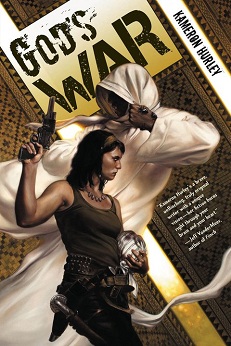
God’s War — Kameron Hurley

Cover of God's War


God’s War
Kameron Hurley
286 pages
published in 2011

The main problem with God’s War is its setting. Kameron Hurley’s debut novel is set in an unspecified far future, on the alien planet of Umayma, featuring an unending, religious war between Nasheen and Chenja, Umayma’s biggest nations. The war has warped both nations’ societies, with each country’s men either dead or at the front, leaving only the very young and very old at home. Despite both societies’ innate conservatism that has left women to take up the slack, having to take on traditional male roles, resulting in what’s best called a violent matriarchy in Nasheen, with women in all positions of power and the men constantly being sacrificed at the front. Nyx, its protagonist, is a brutalised, aggressive, scary woman, a deliberate attempt by Hurley to create the female equivalent of somebody like Conan while the background against which Nyx plays out her story was meant to show how a brutal, violent hierarchical society doesn’t magically become better because women are now in power, how easy it is for women to keep perpetuating the same violence and abuse as the men, just with different people in the victim and oppressor roles.

It’s an interesting concept, but the execution is troubling. Because while it is set on another planet far in the future and the politics and religion that’s being fought about is fictional, the images that Hurley creates are very familiar, because the religion she creates looks a lot like Islam, veiled women, multiple daily prayers, holy book and all, with the war and the societies it has left in its wake familiar from what we’ve seen on the news from Iraq or Lybia or even Chechnya. The landscapes are all desert landscapes, the cities are Middle Eastern, with mosques and minarets, often broken, often bombed out. As Tariqk put it, it’s as if Hurley “took every stereotypical Arab world depiction & TURNED IT TO 11”. It’s this orientalism that fails this novel, this inability to do more than use orientalist stereotypes, that reduces it to just another grim and gritty adventure story when it could’ve been so much more.
Read more…

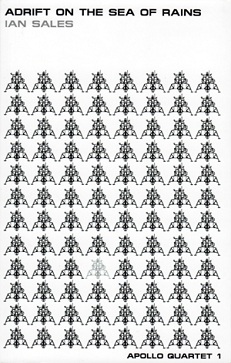
Adrift on the Sea of Rains — Ian Sales

Cover of Adrift on the Sea of Rains


Adrift on the Sea of Rains
Ian Sales
75 pages
published in 2012

Ian Sales is a blogger and science fiction critic with strong options about what science fiction should and shouldn’t be and the conviction to put his opinions into practise. So for example, being dissatisfied with the lack of attention to women writers in science fiction and especially in the Gollancz science fiction Masterworks series, he launched the Sf Mistressworks blog to showcase overlooked classics by women writers. I don’t always agree with him, but he’s always interesting. Which is why I took a gamble on his fiction writing with Adrift on the Sea of Rains, a self published chapbook; normally something I wouldn’t bother with.

As he mentions in his biography page, Ian Sales was only three years old when Neil Armstrong set foot on the Moon, but it clearly left a deep impression nonetheless. It makes him about a decade older than myself, of the right age to be impressed by the seeming inevitability of nuclear war in the late seventies and early eighties, a Third World War that like the first seemed destined to be stumbled into rather than actively desired, all the more difficult to stop because of this. Somewhere in the mid-seventies we crossed the threshold where any nuclear war could still be survivable and reached the point where it just meant the end of the world. That was also the point at which the space race, the symbol of early Cold War machismo, ended, not in victory or defeat, but in a stalemate. The link between a better space programme and nuclear war is an old one in science fiction, as writers like Jerry Pournelle or Ben Bova, both in their fiction and outside it, arguing that space was vital for American national security, honest enough to understand that the space programme they wanted was only possible this way. Adrift on the Sea of Rains shows what could’ve happened had they been right, a story of nine astronauts in the US moonbase, left adrift after nuclear war destroyed the world.

Read more…

Women to Read Wednesday 03: Tricia Sullivan

Yeah, so I’d forgotten I was doing this and it was only thanks to a Tricia Sullivan post calling out the lack of support from blokes for female writers that I remembered about it. I could make excuses but I won’t. It clearly wasn’t important enough to me to keep in mind. Nevertheless I do think this is important enough to restart, one of the ways in which I can make my own little contribution to making science fiction/fantasy slightly more equal.

Because, as Tricia Sullivan notes, it clearly isn’t at the moment. Taking her as an example, we have a critically acclaimed writer, who has won the 1999 Arthur C. Clarke Award for Dreaming In Smoke and who was nominated again in 2004 for Maul, yet she doesn’t have a book contract at the moment, having to write her next novel on spec. This is hardly an unique situation for a female writer, especially an UK based one, to find herself in and things aren’t made any easier by the slow collapse of science fiction publishing in the last few years. As there’s less room for science fiction in publishers schedules, the unfair advantages of the old boys’ networks matter more and it’s a minor disaster that a talented and interesting writer like Sullivan is passed over for yet another mediocre male mil-sf writer.

Since 1995, Tricia Sullivan has written seven novels, most of which are now out of print it looks like. I’ve read two of them, her latest one, 2010’s Lightborn and 2005’s Double Vision. Both are novels in which the normality of the world as we know it has been upset one way or another, with the protagonist in each having to deal with the challenges the new reality brings with it.

Lightborn:

What Tricia Sullivan has done with Lightborn is create a concretised metaphor for growing up, that long drawn out moment when you’re a child on the edge of becoming an adult, looking out over the abyss to the incomprehensible horrors of adulthood. Both Roksana and Xavier are young teenagers, forced by circumstances to become more mature, but also kept from being fully adult. It’s no coincidence that all adults in the novel are unreliable or downright dysfunctional, Shined or not Shined; they have to make their own decisions and every time they want to trust an adult, it turns out to be a mistake. Yet Sullivan doesn’t glorify childhood: her heroes do have to grow up, make compromises, without being overtly dramatic about it.

Double Vision:

As a science fiction reader you’re obviously biased towards the strange, the potential hallucination to be real, even if there’s a long tradition to use this against the reader. In Double Vision you start off with the default assumption that what Cookie experiences is real, only for Sullivan to sow doubt in your mind as certain inconsistencies become clearer. For example, if the scouting she does in the Grid is so important, why is it that her boss is only interested in which brands she heard mentioned by the soldiers? What is she really used for?

Books Read June

Again only six books read, all science fiction novels of one kind or another:

Hunting Party — Elizabeth Moon
Heris Serrano has just left the Regular Space Service for reasons and is now reduced to being the captain of the luxury space yacht of Lady Cecelia, who has been saddled with ferrying some of her own wayward family members to one of the Family’s private planets, for fox hunting season. Stuff happpens and foxes turn out not to be the only things being hunted…

Five-Twelfths of Heaven — Melissa Scott
In a far future where space ships are run on alchemical principles, havbing to seek out Purgatory inbetween Heaven and Hell to travel from system to system, one woman pilot fights for her freedom.

Sporting Chance — Elizabeth Moon
The sequel to Hunting Party, dealing with the fallout of the revelations of the previous story, which Lady Cecelia and Heris Serrano have to resolve. Another fun read, slightly better than it needed to be.

Inversions — Iain M. Banks
Read in remembrance of the passing of Iain M. Banks. This was his one true fantasy novel, though there are some “subtle” hints that this may in fact be set somewhere within the Culture series.

Adrift on the Sea of Rains — Ian Sales
In an alternate world where the Apollo project lasted much longer and was militarised, a handful of US astronauts are stranded on the Moon when World War III broke out in the early eighties. Now they need to get home.

God’s War — Kameron Hurley
I’m not quite sure yet what I think about Hurley’s debut novel. It’s been criticised for its pseudo-Islamic setting and I’m not quite comfortable with it myself, but there are hints of greatness in it nevertheless. An interesting debut.

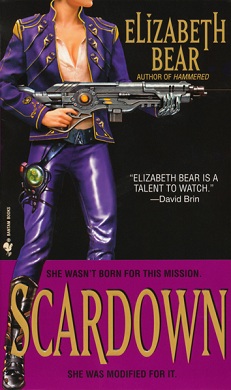
Scardown — Elizabeth Bear

Cover of Scardown


Scardown
Elizabeth Bear
368 pages
published in 2005

Scardown is Elizabeth Bear’s second novel, sequel to Hammered, continuing the adventures of Jenny Casey. Where Hammered was straight up streetlevel cyberpunk, in Scardown the perspective opens up. That opening up actually started in the last pages of Hammered and Scardown continues seamlessly. Middle books in a trilogy, as this is can often sag, neither setting up plotlines nor resolving them, but Scardown avoids this fate. Each of the books in the Hammered/Scardown/Worldwired has its own story, but together they do add up to one coherent one.

Jenny Casey is a veteran who lost her left arm and eye in a war in South Africa decades ago, replaced by fairly primitive cyborg implants. Her ability to cope and survive for so long with these implants made her an unique candidate for starship pilot training, as these pilots would need to be plugged into their spaceships. This is why she was being pursued by the Canadian government in the previous novel, Canada and China being the world’s two superpowers in 2062. The world is dying, killed by climate change and humanity’s hope lies in the stars. Which is why both superpowers are building starships, starships made possible by alien technology found on Mars.

Read more…