If you had $500, what science books would you buy for a high school library?

That’s the question Robert left on my review of Kraken:

Here’s a challenge for you, if you want it. Suppose you had $500 to spend on science books for a high school library, what would you buy? I’ve got a small budget, so I want to get the most bang of the buck

Which books I would recommend? Ben Goldacre’s Bad Science to get some inoculation against quackery. Any of Richard Fortey’s books on evolution and geology, particularly Life and The Earth, but also Trilobite, Chad Orzel’s How to Teach Physics to Your Dog which is a popular science book on quantum physics, any of Ian Stewart’s or Martin Gardner’s books of mathematical puzzles, Gabrielle Walker’s Snowball Earth just to show how cool Earth’s long prehistory has been, any of Richard Dawkin’s recent books in which he doesn’t bang on about religion.

Which books would you recommend?

Kraken — Wendy Williams

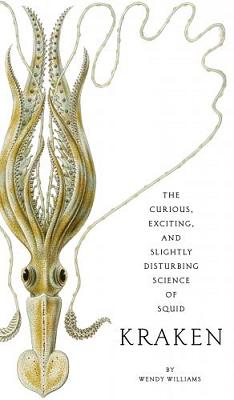
Cover of Kraken


Kraken
Wendy Williams
223 pages including index
published in 2011

This was a bittersweet pleasure to read. As an homage to Sandra I wanted to read some of her favourite books and writers this year and Weny Williams’ Kraken was one of the last books she was really enthusiastic about. I had gotten it for her as part of an Amazon order in June of last year, when it still looked she was going to beat her illness and to cheer her up in hospital. Once she had read, she was keen on me to read it too to see what I thought, but I never made the time to do so, having so much else to read. It’s something I regret now, as I would’ve liked to discuss this with her, but at the same time it is nice as well to be able to read a book that reminds me so much of her. Sandra loved squids, octopuses and every kind of cephalopods; they were her favourite animals and any book on them that was any good had her favour.

And Kraken is quite good. At some twohundred pages without the index it’s not an indepth treatment of Cephalopoda, but it is a good look at what makes these creatures so fascinating. The cephalopods are invertebrates, part of the molluscs, with octopussies and squid traditionally seen as evil devil beasts that as soon drown a sailor as look at them. Yet the more we learn about them, the more fascinating they’ve become. It’s quite clear that many of them are incredibly smart, well adapted to their surroundings and with some amazing abilities — most possess chromatophores, coloured pigment cells under conscious muscular control which they can use to camouflage themselves or even “speak” with. They’re curious, they’re playful and in short, they remind us a little bit of ourselves.

Read more…

The King’s Name — Jo Walton

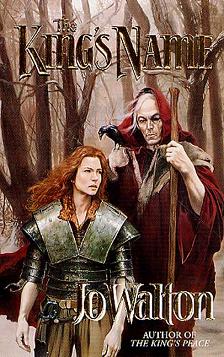
Cover of The King's Name


The King’s Name
Jo Walton
320 pages
published in 2001

“The first I knew about the civil war was when my sister Aurien poisoned me.”

As opening sentences go, the one that opens The King’s Name is great, starting off the sequel to Jo Walton’s The King’s Peace with a bang. It’s been five years after the end of the previous book, the peace that Sulien and her lord king Urdo had fought for so hard has held all these years, but there have been some rumblings amongst the kings and rulers of the countries of Tir Tanagiri about the high king’s rule. But for Sulien there was no real indication for danger until her sister poisoned her. Luckily one of her companions was quick enough to recognise it as poison and not a sudden drunkness and manages to get her back to her own lands, which is the only reason she survived. And then she comes home and her own steward tries it too. Something more is going on than just a grudge her sister may have held against her. Clearly she needs to warn Urdo and rejoin him to fight for the peace again…

With The King’s Name Jo Walton’s histoire à clef becomes more explicitely Arthurian, with Urdo as king Arthur, his wife Elenn as Guinever and Sulien as a distaff Lancelot, with the traditional love affair not between the queen and Sulien/Lancelot, but implied between Urdo/Arthur and Sulien. It’s long been supposed that the night Sulien spent with Urdo in his command tent early in her career was one of passion rather than exhaustion, with Sulien’s son Darien as the result. The civil war, started through the manipulations of the Modred equivalent Morthu, is of course also an Arthurian theme, the war that ends the Golden Age, kills the hero-king and restarts history. Not quite what happens here and don’t think that if you know the Arthurian template you know what Jo Walton is doing here.

Read more…

Sandra’s books

The last couple of months, both before and after Sandra’s death, I’ve been busy putting her book collection into Librarything, both because I was doing that anyway for my own books and as a memorial to her tastes in reading. As you can see from the relative sizes of our collections (and not everything has been catalogued yet) she was always much more picky in which books she bought, much more discriminating. She didn’t buy books she could get from the library, nor was hesitant to recycle books once she read them if she didn’t feel it worthwhile to keep them. Whereas I’ve always had a tendency to hoard, Sandra always argued that if she felt the need to reread some cheap thriller or detective novel, it would be easy enough to buy it again and besides we’re running out of shelf space already.

What she kept therefore were books she knew she would want to reread, that she knew she would not be able to get easily and were important enough in their own right as well as to her personally. While she didn’t mind recycling modern detective novels e.g., she did collect classic Golden Age writers like Ngaio Marsh, Agatha Christie, Patricia Wentworth, Gladys Mitchell and especially Margery Allignham. These were books that she reread often enough and had enough sentimental worth to her to keep. She also had a thing for classic literature and argued that any library should have at least some Dickens or Thackeray in them.

When we merged our libraries there was remarkable little overlap: she read science fiction and fantasy, which with comics collections make up the majority of my books, but felt no need to collect them, whereas I had only a few detective books. She was also much more interested in pure quill horror than I was, with Peter Straub and Stephen King amongst the modern writers being particular favourites, but where her preferences mostly lay with the Victorian/Edwardian and pre-war writers (Benson, M. R. James, Lovecraft, Le Fanu, that lot). She also collected classic humour writers, again with the emphasis on those eras (Benson again, the Mitford sisters, Waughg, classic New Yorker writers like Thurber or Edmund Wilson). She liked social history, if it was abour regular people, especially women and their lives and not too dry and again, especially if it was about 19th century or prewar Britain. There are the science and natural history books, geology especially (Fortey) and oceanology (sucker for squid), the country and travel classics (bit of Bryson, Eric Newby), the cook and gardening books (she was keen and gifted in both departments and thank god my father is the same in the latter or i would’ve no hope of keeping up the garden), also quite a few of those glossy historical thrillers that have been all the rage the past decade, a few other miscellaneous bits and bobs. It’s a collection that’s grown organically, that you can’t really fit into a specific pattern, but which does clearly shows the mind of its curator and her intentions. In many ways it’s a much more interesting collection of books than my own.

Sandra was never shy about sharing her books with me, always recommending new ones for me and through her I discovered a lot of authors: Thackeray, Trollope, Ngaoi Marsh, Richard Fortey, Dawkings, Jessica Mitford, though quite a few I resisted (Dickens for example, perhaps her favourite author). I’ve been thinking of doing a year of Dickens — one each month — in her honour but was worried it would be too limiting and doing some more entry work this afternoon gave me the idea to instead just take any book each month from her collection, starting with Kraken by Wendy Williams this month.
The King’s Peace — Jo Walton

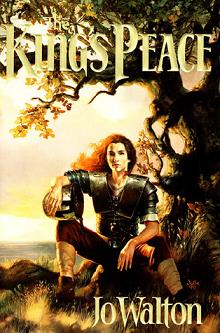
Cover of The King's Peace


The King’s Peace
Jo Walton
416 pages
published in 2000

When I put together the list of science fiction and fantasy books I’d planned to read for my Year of Reading Women project last year, I’d knew I’d want something familiar and enjoyable to close out the year, as a reward. Looking over my bookshelves the choice was easily made: I hadn’t read The King’s Peace since it had first come out in 2000 so it was high time I reread it. Back then I had come to it cold, without any preconceptions other than Jo Walton’s reputation as one of the best posters on the rec.arts.sf newsgroups. Rereading it now, having read more of her novels and also knowing somewhat more about the setting she used or at least the historical inspirations for it, have changed The King’s Peace for me, in a positive sense.

To start with the setting, you could call The King’s Peace an Arthurian romance set in a fantasy Britain, but that’s not quite right. I prefer to call it a histoire à clef, where Walton has taken post-Roman Britain at the time of the Saxon invasions and changed it. So the Roman Empire here is called the Vincan Empire, the Saxony raiders are Jarns, Britain is called Tir Tanagiri and instead of a King Arthur there’s king Urdo whose Lancelot, Sulien ap Gwien is the first person narrator of the story. When I first got to grips with the story more than a decade ago this all seemed needlessly complicated and I wondered why she hadn’t just written a straight Arthurian story. But I think it makes sense.

Read more…