Fifty Essentials in Fifty Days 26: Essential Avengers Vol. 2

cover of Essential Avengers Vol. 2


Essential Essential Avengers Vol. 2
Stan Lee, Don Heck, Roy Thomas and friends
Reprints: Avengers #25-46, Special #1 (February 1966 – November 1967)
Get this for: Avengers hitting their stride — four stars

Essential Avengers Vol. 2 starts where the first volume ended, with Lee and Heck getting into their stride and the Avengers themselves reduced to Captain America and his three juvenile deliquents: Hawkeye, Quicksilver and the Scarlet Witch. This combination worked much better than the original Avengers, who all had their own titles and didn’t mesh together that well. Of the New Avengers on the other hand only Cap had his own title, which meant there was room in The Avengers for some character development. It took a while for Lee to get a handle on the new team, but in this volume he has managed it.

The “kooky quartet” did not stay a quartet for long however; in the second issue collected here Giantman and the Wasp join the team, Giantman rechristening himself as Goliath. They’re not the only additions to the team: both the Black Widow (last seen in Iron Man) and Hercules (from Thor) drop by later in the volume and keep hanging around. In the King-Size Special things go even further, as a long running Avengers tradition was established as every Avenger but the Hulk and the Black Widow teamed up to defeat the Mandarin.

This volume is wall to wall action, with few issue to issue subplots, apart from the Black Widow’s problems with her old masters back behind the Iron Curtain. Lee doesn’t try to do anything difficult here with the Avengers, but just keeps throwing villains at them, from Attuma to Doctor Doom to the Living Laser to the Sons of the Serpents. It’s all very entertaining if a bit slight. things do pick up a bit as Roy Thomas takes over scripting duties, but here he’s not doing that much different from Lee.

The only time Lee does add some depth to The Avengers is with the Sons of the Serpents story, in which the Avengers take on a KKK standin and reveal it to be led by … a foreign communist leader. This also has the first appearances of Bill Foster, one of the first Black supporting characters in a Marvel comic. Yes, he is largely used solely for a clumsy parable about the state of race relations in America, but at least Lee means well…

Don Heck handles most of the artwork in this volume and his sleek style started to win me over. In the previous volume he wasn’t at his peak quite yet, here he has a good handle on all the characters and especially seems to have fun to draw the ladies. It’s less flashy and more restrained than a Kirby’s or a Ditko, but it suits the less powerful Avengers team.

This is still not the classic Avengers, but it’s getting there.

books read September

Whoops! The new month is almost a week old and I still haven’t put up a post of what I read in September? Bad Martin. Not much to report though, as most of my reading time has been taken up with the Fifty Essentials in Fifty Days project and comics don’t count. Which left me with only four five proper books read this month:

Ha’Penny — Jo Walton
Best way to describe this novel: how would the Mitford sisters fare in a world in which Germany and England made peace in 1941?

The Fuller Memorandum — Charlie Stross
The latest entry in Charlie’s spy thriller/horror story mashup series. As good as his earlier two novels.

The Steel Remains — Richard Morgan
Morgan is best know for his cynical take on hard sf space opera; here he branches out to fantasy. Slightly awkward to read as it felt like the middle part of a trilogy.

Three Hearts & Three Lions — Poul Anderson
Another type of fantasy altogether, this is something of a classic. In the midst of WWII, a Danish resistance member is transported to a magical world where he is the only thing standing between it and unending evil….

All You Need Is Kill — Hiroshi Sakurazaka
Groundhog Day meets Starship Troopers (the novel) — in a good way.

Fifty Essentials in Fifty Days 25: Essential X-Men Vol. 2

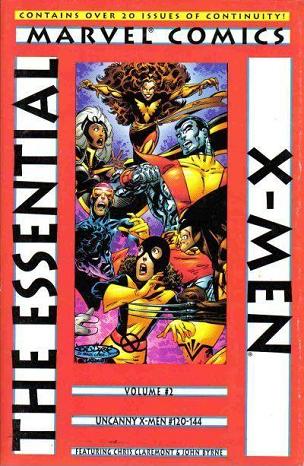
cover of Essential Essential X-Men Vol. 2


Essential Essential X-Men Vol. 2
Chris Claremont, John Byrne and friends
Reprints: Uncanny X-Men #120-144 (April 1979 – April 1981)
Get this for: Byrne and Claremont at their peak together — five stars

Essential X-Men Vol. 2 contains the first X-Men comics I had ever read, which was also one of the very few superhero stories that ever gave me nightmares: X-Men #141-142, “The Days of Future Past”. It’s the story in which the X-Men found the nemesis they would be fighting for the next two decades, the inevitable future that would await them if they slipped up, that for all their victories they might not be able to prevent happening. It’s a great story, perhaps the best Byrne and Claremont ever did together and it captured the essence of the X-Men.

And here it comes at the end of a great run of stories. While the first volume saw Claremont still finding his feet, here both he and John Byrne are fully in control and confident of their craft. The volume starts with the last leg of the X-Men’s world tour that had begun in the previous collection, as the X-Men run into Alpha Flight attempting to take back Wolverine into the Canadian secret service. This followed by their first match against Arcade, the murderer for hire who likes to kill his victims by funfair. Barely recovered from these fights, they discover Jean Grey, whom they had thought had died in the climatic fight against Magneto a dozen issues or so again, was still alive and kicking at Muir Island, but menaced by a new menace: Mutant X. Defeating him turns out to be the heaviest fight and costliest victory they have known yet, but that’s just the start.

Now things kick into high gear, as professor X is back, two new mutants, Kitty Pryde and the Dazzler are found and turn out to be bait in a trap a new group of villains, the Hellfire Club, has set. Meanwhile this same club turns also be behind a long running subplot in which Jean “Phoenix” Grey has had multiple flashbacks to the live of one of her ancestors, which turns out to be the result of manipulation by Mastermind, in order to recruit her for the Club. The X-Men manage to defeat the Hellfire Club in their first encounter, go on offensive but this turns into tragedy as Jean Grey is indeed turned to the dark side, so to speak. Their second clash with the Hellfire Club sets in motion two new menaces, one long term as senator Robert Kelly is confirmed in his suspicions about the X-Menb and mutants in general, the second an immediate threat as Mastermind’s manipulations awaken Jean Grey’s cosmic powers and she turns into the evil Dark Phoenix.

The Dark Phoenix Saga is the end point of more than two years of stories and subplots coming together, as Jean’s powers ultimately consume her in one of the most moving issues in the entire X-Men run. Reading these stories in one sitting, all the way from the still fairly mundane fight with Alpha Flight in #120 to the end of Phoenix in #137, you can see how Claremont and Byrne slowly but relentlessly speed up the action and danger until at the end the X-Men have no breathing space whatsoever going from one menace to another. Whereas other heroes, other teams might get some time to savour their victories, the X-Men never get to catch their breaths until it is too late. Even after the climax of the Dark Phoenix saga, there’s only one issue of recaps and half an issue of Kitty’s introduction to the X-Men before the race starts again. First it’s Wolverine and Nightcrawler up in Canada helping out Alpha Flight with Wendigo, then as said, it’s “Days of Future Past”.

Now from the start the X-Men had had as their hook, the thing that made them unique, that they were mutants, heroes different from normal people not through some unlucky accident, study of magic or high tech battlesuits, but because of what they were born with. For a long part this aspect, that they were supposed to be the team that made mutants acceptable to a world that might otherwise hate and fear them, was only paid lip service to, the occasional Sentinel appearance not withstanding. Under Claremont this aspect had become more prominent, but it was only with “Days of Future Past”, which showed a nightmare future in which the X-Men had not succeeded in their mission and the Sentinels had wiped out most mutants and taken over the world, that this became the cornerstone of the series. With the original X-Men, all that suspicion and fear people felt was just a typical Lee shtick to handicap his heroes: here it became something real and tragic. You could call it a metaphor for racial or sexual prejudice, or more cynically, a metaphor for adolescence, but this is a metaphor made concrete: in the end it is a story about how we might react to the discovery of a mutant race of superpowered beings living amongst us…

That delayed future would become everything the X-Men fought against, though it was still some time away before it would really dominate the series — we must also remember that basically this future denies the very reason of the X-Men’s existence. As long as it is still a possible outcome, it means that all their victories are hollow…

Back to the current volume, the “Days of Future Past” is followed by a perfect one issue story, as Kitty Pryde takes on a demon that does looks nothing like the Alien from the Sigourney Weaver movies at all, uh huh. It’s a textbook example of an “outmatched hero uses the environment and her brains to defeat her almost invincible foe” story. This is followed by another one issue story, a solo Cyclops story following his adventures after he left the X-Men what with Jean’s dead and all, which ends the volume.

That last story is the only one not to feature Byrne on the art. It’s not always easy to appreciate him, what with the great volume of mediocre work he has done since X-Men, but he starts great and keeps getting better each issue. You understand why he set the style for at least one generation of superhero artists. He takes the best aspect of the Marvel Housestyle of the seventies, that clear, easy to follow style of layout and drawing that means you can immediately understand what’s happening on any page and puts it together with his own flair for composition and figure drawing. His work is always in the service of the story but he always makes it look good as well. He has that knack that so few artists have, of not only making you see the world in his art, but seeing the world through his art. Reading a huge chunk of his work in one go like this means I will see Byrne poses everywhere for the next few days.

A small sacrifice.

Fifty Essentials in Fifty Days 24: Essential Ghost Rider Vol. 1

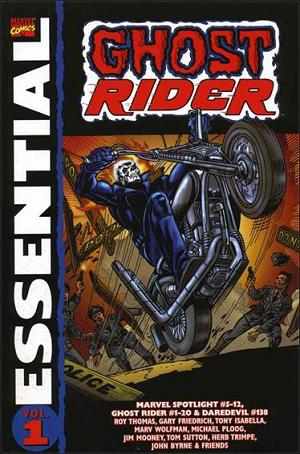
cover of Essential Ghost RiderVol. 1


Essential Ghost Rider Vol. 1
Gary Friedrich, Tony Isabella, Michael Ploog, Jim Mooney and friends
Reprints: Marvel Spotlight #5-12, Ghost Rider #1-20 & Daredevil #138 (August 1972 – October 1976)
Get this for: Mike Ploog, Jesus and Satan — three stars

The first thing to remember about The Essential Ghost Rider Vol. 1 is that Johnny Blaze, the Ghost Rider is well, kind of a tool, as well as dumb as a bag of rocks. Created by Gary Friedrich and Mike Ploog in Marvel Spotlight #5, Johnny Blaze is the adopted son of Crash Simpson, stunt motor cyclist extraordinaire, who took him in after his own father died.

Though a natural motor cyclist himself, Blaze made a vow to his adopted mother on her deathbed not to stunt ride himself. Then Crash gets cancer, plans to do one more great stunt to make sure his daughter (Blaze’s love interest, natch) will be taken care off after his death and Johnny, unable to help out due to his vow, makes a pact with Satan to make sure his adopted father does not died of cancer, in return for his own soul. Satan cheats of course, Crash dies doing his stunt and when Satan comes to take his prize, it’s only Roxanne’s love that saves him. But that night he finds out his curse: to be transformed into the Ghost Rider!

Now this origin has been retold every time the Ghost Rider guest starred in another title and when recapped it sort of makes sense, but reading the original story here for the first time just made me realise how incredibly stupid it actually was. The vow Blaze made to his dying stepmother is dumb, but Johnny selling his soul to Satan is even worse. It’s al stated matter of factly, as if the only choice you could make in such a situation is indeed to sell your soul. As a superhero origin it sounds noble when recapped, but Johnny does it for purely selfish reasons, as he would keep doing things for purely selfish reasons as long as Gary Friedrich was writing him. He’s completely unsympathetic as a protagonist, so unsympathetic that you have to have some admiration for Friedrich to keep on writing such a character.

But there’s another aspect to Friedrich’s writing that made me uncomfortable. I don’t mind an unsympathetic hero, though Johnny Blaze did get on my nerves, but I didn’t like the worldview that Friedrich build around him. Especially in the the Marvel Spotlight stories it reminded me too much of a Jack Chick tract. Not only is it possible for a stunt cyclist to call up Satan pretty easily, but there are Indian shamans dabbling in black magic, whose daughter is herself a satanist witch woman, inducted into satanist by a cult of liberated college women, not to mention satanic biker gangs. It’s all a bit too sleazy for my liking.

I’ve never been so glad as to see Tony Isabella take over a series; he may not be the best or most original writer in the world, but at least he manages to lose that Chick tract vibe, as well as make Blaze an actual hero, of sorts. The Ghost Rider, who at that time still clearly is Johnny Blaze, unlike the more demonic figure he would become later on in the series, becomes more of a regular superhero, fighting foes like the Trapster. It’s more mundane and not so wild, but I liked it better. What I also liked is Isabella’s solution to Johnny’s struggle with Satan: a bearded, long haired hippy with a certain resemblance to you-know-who stops Satan by reminding him of the power of love. More neat Isabella touches: a demon named Slifer (Roger Slifer perhaps, or is that coincidence) and two members of the supporting cast once Johnny hits Hollywood: Wendy and Richard Pini…

Artwise, the Ghost Rider never looked as good as in his first few appearances in Marvel Spotlight, when Mike Ploog was drawing him, inked by Frank Chiaramonte. Granted, he does have the same sideburns as that other Ploog hero, Jack Russell of Werewolf by Night, but it’s gorgeous, pulpy, atmospheric art. Ploog inked by Jim Mooney on the other hand doesn’t do anything for either artist. After Ploog, it’s Tom Sutton on the art in his last few Spotlight and first solo title appearances, followed by Mooney, Herb Trimpe and Sal Buscema. In fact, these first twenty issues of Ghost Rider are a parade of Marvel most dependable if least exiting artist of the seventies. Apart from the ones mentioned above, there’s also Frank Robbins, Bob Brown and George Tuska. Only at the very end, in the two part crossover with Daredevil, written by Marv Wolfman and penciled by John Byrne does the art even come close to the standard Ploog set. Byrne is completely the wrong kind of artist for Ghostie though, much too realistic.

Essential Ghost Rider Vol. 1 then shows the evolution of a flawed but original concept into something that’s much more closer to a standard Marvel anti-hero, with his demonic possession degraded to his version of the standard Marvel Hero Handicap. Nothing that’s really unmissable, but Ghost Rider was a mainstay of seventies Marvel, so recommended reading for anybody interested in that era.

Hitler’s Empire – Mark Mazower

Hitler's Empire


Hitler’s Empire: How the nazis Ruled Europe
Mark Mazower
726 pages including index and notes
published in 2008

“Germany could have racial purity or imperial domination, but it could not have both.”

That’s the fundamental paradox that Mark Mazower uncovers in Hitler’s Empire: How the Nazis Ruled Europe. On the one hand, there is the Nazi’s obsession with making Germany a pure Aryan state, expelling or murdering the lesser races within its borders. On the other, their equally compelling obsession to rule Europe, or at least “reunite” all those parts of Greater Germany outside the German borders. But with the Anschluss of Austria, the annexation of the Sudetenland, the further invasion of what was left of Czechoslovakia, not to mention the invasion of Poland, it brought not just many more Germans, but also millions of Poles, Czechs, Jews and others under Nazi control. The question was, what to do with them and the somewhat accidental empire Nazi Germany had acquired.

Read More…