Fifty Essentials in Fifty Days 18: Ms Marvel Vol. 01

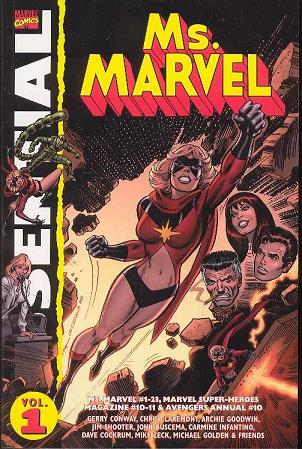
cover of Essential Ms Marvel 01


Essential Ms Marvel 01
Gerry Conway, Chris Claremont, Jim Mooney and friends
Reprints: Ms. Marvel 1-23 and more (January 1977 – April 1979)
Get this for: seventies feminist superheroics — Four stars

Now for a complete change of pace, from the heart of the Silver Age taking a giant leap forward into the Bronze Age, long after the people who had laid the foundations of the Marvel Universe had left (and had come back and left again) and some of the creativity and magic had gone out of it. The mid to late seventies were a rough patch for both Marvel and DC, as the old newsstand distribution networks were in upheaval, inflation and economic depression made comics expensive and there was little room to experiment with new titles. So what you get is attempts to play it safe, through either cashing in on some trend or by creating a spinoff — Ms. Marvel is a combination of both: a spinoff of Captain Marvel and an attempt to cash in on the resurgence of second wave feminism, as seen through a comics prism. Despite this the title would last barely two years, being canceled with #23 and with the last two issues, already prepared only seeing print two decades later, in the early nineties Marvel Super-Heroes Magazine.

I don’t know why M.s Marvel failed the first time around: perhaps it could never find an audience out on the newsstands, or people didn’t buy it because it featured a girl (Marvel never having had much luck with female headliners) or just because not enough newsstands stocked it. But one thing I know, quality couldn’t have been the issue. True, it took a couple of issues for Ms. Marvel to find its feet, but once Chris Claremont comes onboard with issue 3 it settled into a nice rhythm. I’ve certainly read much worse titles from that time which were much more successful.

Ms. Marvel is Carol Danvers, an old supporting character from the sixties Marvel Captain Marvel series, reintroduced in Ms. Marvel as the eponymous superheroine, in the first three issues suffering from amnesia and not knowing she’s Carol. Carol meanwhile gets a job as the editor of Now Magazine, Jolly Jonah Jameson’s woman’s magazine. He wants the traditional subjects: cooking, fashion, gossip, she wants it to make a hard hitting, proper news magazine: soap opera gold, though as per usual with superhero jobs it plays second fiddle to Carol’s other career and its complications.

The whole amnesia/two people angle doesn’t really work and is quickly abandoned once Claremont takes over the writing. He does keep the conflict between Carol and Ms. Marvel however, each with a distinctive personality and not always liking the other that much. Personally I never like this sort of forced conflict or handicap so I’m glad to see this slowly disappearing over time here.

On the supervillain side of things, Conway introduces A.I.M. as a recurring foil and Claremont keeps them around, as well as adding MODOK to the mix. Other established villains, including the Scorpion, obscure X-Men foe Grotesk as well as a couple of badniks from the old Living Mummy series from Supernatural Thrillers also appear. Claremont had a knack for getting tough, physical threats for Ms. Marvel to actually beat with her fists like any other strong male hero would do, rather than the usual non-physical threats reserved for superheroines. There are few original creations here, with Deathbird introduced in #9 and Mystique from #16 the most significant, Claremont using both of them in Uncanny X-Men later on. For the most part however Ms. Marvel is mutant free.

But Claremont was leading Ms. Marvel into that territory though, through the long running subplot of some unknown enemy (which turned out to be Mystique) targeting both Carol Danvers and Ms. Marvel. However Ms. Marvel was cancelled before that subplot reached fruition and it took Avengers Annual #10 two years later to tie up these loose ends. That one starts with Carol being thrown off the Golden Gate Bridge, rescued by Spider-Woman (who Claremont was also writing) and brought to Prof Xavier to be examined mentally. Meanwhile the Brotherhood of Evil, led by Mystique attack the Avengers and its newest member Rogue turns out to have stolen Carol’s powers.

Apart from housecleaning however and revealing the final fate of Ms. Marvel Claremont had an ulterior motive for writing this annual. Between the end of her own series and the annual Ms. Marvel had been a member of the Avengers and in a particularly bad storyline had been raped and impregnated (all off panel), gone through the full pregnancy and given birth in a day to a boy who turned out to be her rapist, using her to be able to live on Earth, but when this fails he takes her with her to Limbo, where they live happily ever after, or so the Avengers think, never having spent a minute to think things through. Claremont had done this, had gotten offended and used the final part of the story to spell it all out. It’s one of the best “fuck you” moments in comics I’ve read.

Claremont would return to Ms. Marvel even later, in the early nineties in the anthology title Marvel Super-Heroes, which reprinted both the final finished but never published issue, as well as a followup bridging the gap between her series and Avengers Annual #10. Here they’re presented in chronological order, before the annual.

The final verdict is that this was a perfectly enjoyable series, nothing much out of the ordinary, but never bad either. The art, first by John Buscema, followed by Jim Mooney, Keith Pollard, Sal Buscema, Carmine Infantino, Dave Cockrum and finally Mike Vosburg is decent to good, but with so many artists in such a relatively short period it’s hard to create a real style for Ms. Marvel. Essential Ms. Marvel vol 1 is a nice view of what a lesser title of the seventies looked like.
Fifty Essentials in Fifty Days 17: Fantastic Four vol 02

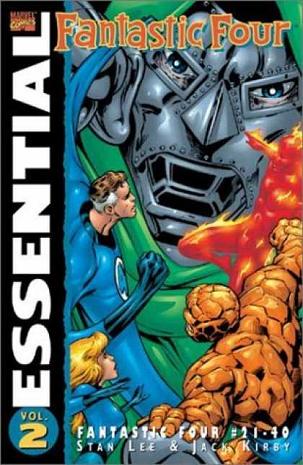
cover of Essential Fantastic Four vol 2


Essential Fantastic Four Vol. 2
Stan Lee, Jack Kirby and friends
Reprints: Fantastic Four #21-40 and Annual 2 (December 1963 – July 1965)
Get this for: Lee and Kirby gathering steam — Five stars

The second volume of Essential Fantastic Four opens with a story that should not work, but does. The Fantastic Four fight a new villain, the Hate-Monger, who is stirring up race hatred, class hatred and religious hatred throughout the country and even manages to set our heroes against each other. Which is bad luck for Nick Fury, who needs them to stop the rebellion in San Gusto which the Hate-Monger is also behind, but with a bit of trickery he manages to get all the bickering members to the little South American country. Of course they manage to defeat the Hate-Monger in the end, overcome their differences and reveal who he really is: Adolf Hitler. Even in 1963 this was corny as hell, but somehow Jack and Stan manage to make it work.

It’s a good example of their growing power as storytellers both individually and as a team. In the first twenty issues of Fantastic Four they were finding out what did and did not work, with some misfires along the way and here they’re building on that foundation. The basics are in place, they know who the characters are, what they can and cannot let them do, how they react to a given situation. Was for e.g the Thing in the first volume still a figure of menace, somebody who could erupt at any moment and become a true monster rather than just looking like one, here he has mellowed to still grumpy but essential loveable, still inclined to lash out in anger, frustration or irritation but never with the intent to hurt anyone. Mr Fantastic in the same way has evolved from the brainy, detached scientist to somebody with deep seated passions normally kept hidden, who scares even his team mates and friends when these passions are unleashed.

Villains too get more multidimensional, with both Doctor Doom and the Submariner becoming more sympathetic in the process. The latter was always more an antihero than a real villain and his own moral code is developed further here, to the point where the Fantastic Four end up fighting alongside him against the menace of a real underwater tyrant, Attuma. Doom on the other hand never becomes an ally of the Fantastic Four, but is made a tragic figure through his origin, told in the second Fantastic Four Annual. It turns out he’s a gypsy, whose mother was killed when he was still a baby and whose father died fleeing for his life from a local baron when he was a small boy. He swears vengeance, starts studying the black arts of his mother, as well as educating himself into science (no finer distinction really necessary in an universe in which a biochemist can create a malevolent artificial intelligence from scratch), gets a scholarship at the same university as Reed Richards and Ben Grimm, tries to contact the netherworld and gets blown up, is thrown out, travels the world and ends up with a mysterious sect of monks in Tibet and becomes Dr Doom. Even the Skrulls when turning up again turn out not to be all bad.

The stories in this volume are in essence midway between the realive realism with which the Fantastic Four started out and the wild, unrestrained imagination Kirby especially would bring to the title in its more mature years. The stories are based around some supervillain or other menace threatening the team or the world or both and the Fantastic Four defeating it. There’s a healthy dose of soap opera as well, revolving around the Thing and his desire to become Ben Grimm again, become human again and his fear that this will mean losing Alica Masters, his girlfriend, as well as around Mr Fantastic and the Invisible Girl and the love they share but are afraid to speak out. The Invisible Girl at the same time also evolves both in power and personality, getting to be a somewhat less stereotypical comics girl, though still vulnerable to being a professional hostage at times.

On the art front, Kirby’s art gets wilder, more experimental, as he integrates photographic backgrounds in his art, develops ever more baroque looking weaponry, vehicles and scientific equipment. His figures and the way they stand and move gets more exagerrated too, underscoring the theatricality of many of Stan Lee’s scripts. The effect of reading a concentrated dose of Kirby art is, as I’ve mentioned before that I start seeing those Kirby Poses and Kirby Figures in real life. Watching sport is especially good for this…

As good as the first volume of Lee/Kirby Essential Fantastic Four was, this volume was better. One of those times when essential is no hyperbole, but the honest truth.

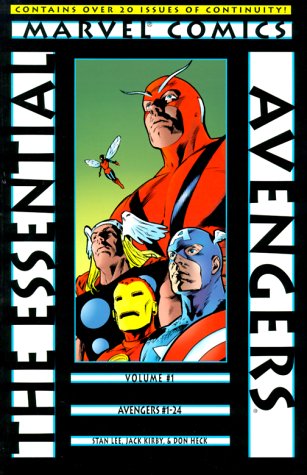
Fifty Essentials in Fifty Days 16: Essential Avengers 01

cover of Essential Avengers Vol. 1


Essential Avengers Vol. 1
Stan Lee, Jack Kirby, Don Heck and friends
Reprints: Avengers 1-24 (September 1963- January 1966)
Get this for: Kang and Cap’s Kooky Quartet — three stars

The Avengers was one of the weaker Marvel Silver Age titles. Though created by Stan Lee and Jack Kirby, it’s neither’s strongest work and neither’s heart seems to be in it. Of course Stan Lee was running Marvel comics at the time as well as writing the other nine series they were then putting out, so it’s no wonder he would take it easy on certain titles. And whereas The Fantastic Four from the start had its own voice, The Avengers put together five heroes with their own titles and not that much in common as a somewhat belated Justice League of America knockoff. If you then have Kirby leaving after only eight issues to be replaced by an uninspired Don Heck you have a problem.

Which is why it was a bit of a slog getting through The Essential Avengers Vol. 1, as quite a few of the stories in here are dull. The origin story is an example. Loki is looking for a way to get back at Thor, spies the Hulk and manipulates him into smashing up a train bridge. Rick Jones and his Teen Brigade attempt to contact the Fantastic Four but Loki redirects their signals to Thor, but what he doesn’t know is that Iron Man, as well as Ant Man and the Wasp have received his message as well. Off they all head to New Mexico to find the Hulk, a big fight breaks out which ends as Thor reveals the real villain. As a story it doesn’t really gell and the Hulk never really fits in with the Avengers. His replacement by Captain America in #4 is a great improvement.

But even then the stories remain a bit dull. Having Rick Jones hang around isn’t helping, as he’s just annoying. Let’s not even mention the Teen Brigade. Then there are the villains. I’ve never liked Loki, the Space Phantom in #2 is alright but not spectacular, then there are two issues with Namor, followed by no less than three issues with Baron “Help my mask is glued to my face! Curse you Captain America!” Zemo. Or there are the Lava Men, yet another subterranean menace. Or the Red Menace threat of the Commissar, slightly later on. As threats, these are all strictly from dullesville.

All is forgiven however with the introduction of Kang the Conquoror in issue eight. Now there’s a real threat, with his mastery of future super science, so confident of his victory he receives the Avengers in a lounge chair. He completely overclasses them at first, defeating the Avengers with ease. He does get his comeuppance of course, but he’s one of the few villains here you could imagine winning. Another great early issue, the next issue in fact, is that which introduces Wonderman, another villain who seems to easily get the upper hand over the Avengers before he has a change of heart.

I felt that The Avengers only reached their stride once the original members had buggered off, leaving Captain America only with three novice heroes, each of which actually started out as a villain: Hawkeye, Quicksilver and the Scarlet Witch. Now that Lee only has to deal with one member with his own title, it gets much easier for him to get some character development going on. Granted, much of it is somewhat artificial as Lee squares off old square Cap against young hotheads Hawkeye and Quicksilver, which is again somewhat tedious. But on the whole much better than the first ten issues or so.

Artwise, while Kirby at this time was incapable of turning in bad stories, it didn’t compare favourably with his work on e.g. Fantastic Four. His replacement with Heck works in the title’s favour, once Heck has found his style. I like his slim, streamlined figures here, as well as the touch of glamour he brings to them, especially to the Scarlet Witch. In general Heck keeps improving over this volume.

Overall this volume shows a title that started out bad, got slightly better after Captain America joined, but only started really improving with “Cap’s Kooky Quartet”. This volume does not show the Avengers at their best, but ends just as they start getting better.

Fifty Essentials in Fifty Days 15: Essential X-Men Vol. 1

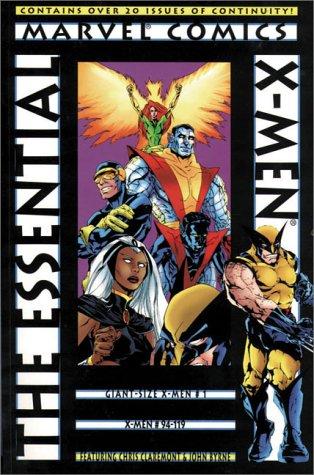
cover of Essential Essential X-Men Vol. 1


Essential Essential X-Men Vol. 1
Chris Claremont, Dave Cockrum, John Byrne and friends
Reprints: Giant-Size X-Men #1, Uncanny X-Men #94-119 (July 1975 – March 1979)
Get this for: the start of the X-Men revolution — four stars

Hard to imagine now, but once upon a time The X-Men were a failure, never having been more than a cult hit throughout the Silver Age, even becoming a reprint series with #67. It limped along for a couple of years, up until issue 93, while the team showed up here and there as guest stars in other titles, some members becoming Champions. The most successful was the Beast, who had his own solo series in Amazing Adventures before joining the cast of The Avengers. It all seemed over for the X-Men, but like good superheroes they came back in the nick of time and it all started with Giant-Size X-Men #1, the first issue reprinted here.

Giant-Size X-Men was followed by a renewed X-Men series, started with #94. While these first two issues were written by Len Wein, by #95 Chris Claremont had come aboard and he would remain the X-Men’s writer for some seventeen years. It takes him a while to find his voice and the first few issues are on the rough side, but it really doesn’t take long for the mutant juggernaut to start rolling. Claremont’s writing on X-Men revolutionised superhero comics and it’s here that it started: by the end of the volume the classic Claremont is established.

Some elements of it pop up even earlier. Both the most loved and hated characteristic of Claremont’s style is having long, drawn out plots and subplots, stacked on top of each other, with one menace fading into the background earning the heroes only a little respite before the next one, long foreshadowed, has to be fought. Here Claremont starts doing this as early as #96-97, the first of which foreshadows the return of the Sentinels, with #97 introducing the menace of Eric the Red, while Prof Xavier was plagued with strange dreams of a Galaxy far, far away. The first threat takes until #100 to be resolved and of course leads to the metamorphosis of Marvel Girl into Phoenix, which comes in handy for defeating the second villain, who turns out just to be a pawn of a mad emperor of the alien Sh’iar Empire, who in turn threatens to unleash the end of everything. It all gets fixed by #108.

Said issue incidentally features something I wish was still used in modern Marvel stories, the half page or full page looking in at the rest of the Marvel Universe while the heroes of the comic you’re reading are struggling to defeat the menace du jour. In this case you have Peter Corbeau onboard the Sunwatch space station briefing Mr Fantastic of the Fantastic Four, Beast and Captain America of the Avengers as well as then president Jimmy Carter via teleconference, explaining that yes, the strange blip felt at the end of the last issue was indeed the entire universe ceasing to exist for half a second and that if it happens again, the universe may not come back… This kind of scene always helped emphasise the seriousness of a threat, that it was not just the X-Men’s fate that mattered, but everybody’s. But it also helps build up a sense of interconnectness, that these adventures are not taking place in a vacuum.

From the start the X-Men are kept busy here; there are no quiet issues. After establishing the new team and sending them on their first mission in Giant-Size X-Men, they immediately have to defeat Count Nefaria’s threat of nuclear annihilation in the next two issues, deal with the death of a teammate, fight the sentinels over multiple issues, see Professor Xavier deal with futuristic nightmares, deal with old enemies gunning for them, first Black Tom and the Juggernaut waiting for them in Ireland, only defeated with the help of leprechauns (not their finest houre), then Magneto returns, but their fight with him is cut short as they’re swept up in the intergalactic adventure mentioned above. Once finished with that, Wolverine has to deal with the Canadian government wanting him back, before yet another old enemy turns up and makes the X-Men into funfair performers. The Magneto turns up again, kidnaps them to his secret base near the Savage Land, which blows up and leaves two sets of X-Men, as the Beast and Phoenix manage to return home, while the rest helps Ka-Zar fight a would be conqueror in the Savage Land, before being picked up by a Japanese vessel who drops them off in Japan just in time to fight Moses Magnum, which ends the volume. It’s all fast paced and incredibly busy, but Claremont always remains in control and keeps things understandable.

He’s helped in this by the art, which from Giant-Size X-Men #1 up to X-Men #107 is in the hands of Dave Cockrum, with the rest of the issues drawn by John Byrne. Quite different artists of course, with Cockrum having a much looser, cartoony and swashbuckling style, lending itself well to widescreen space opera, while Byrne is more realistic in his art. Byrne is also one of those artist who, like Jack Kirby have the effect on me that if I read a large run of their stories in one go, I start to see the world through their art. So now suddenly everybody on tv is standing around in those typical wide legged, slighty skewed Byrne poses… Both Cockrum and Byrne are wonderful artists here, well suited to Claremont, who adapts his stories to their strengths. Of the two I prefer Byrne, just because he does things for me Cockrum can’t.

Sadly, some of Claremont’s more annoying tics are also in evidence here, especially in the characterisation. There’s a lot of ill established antagonism between characters, which especially in the earlier issues was wearisome. There are also the first glimmers of another bad Claremont habit, the subtle and not so subtle references to the past lives of some of the X-Men, especially Wolverine. Some idiot plotting as well, where Claremont goes for the “make life more complicated for the characters through bad communication and drawing out of misunderstandings”. It’s bearable here, but I do remember at the end of his X-Men run, when it just became too annoying.

One other complaint I had was the misuse of Jean “Phoenix” Grey. Supposedly the most powerful person on the team, story after story has her being taken out easy or struggle to defeat villains she should have been able to take with one arm tied behind her back. The same goes for Storm, though to a lesser extent. Also very powerful, she again is kept out of action more than she should have been. If you have strong female heroes, use them, don’t find contrived ways to keep them out of action to keep the story going for longer…

Fifty Essentials in Fifty Days 14: Essential Marvel Two-in-One vol. 1

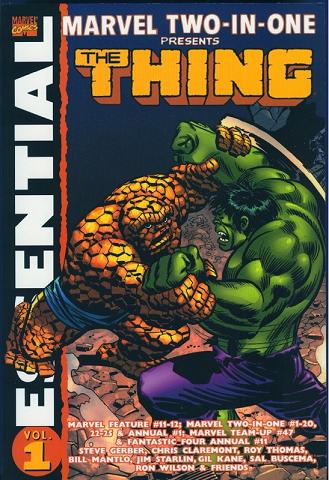
cover of Essential Marvel Two-in-One Vol. 1


Essential Marvel Two-in-One Vol. 1
Steve Gerber, Bill Mantlo, Sal Buscema and friends
Reprints: Marvel Feature #11-12, Marvel Two in One #1-20, 22-25 and more (January 1974 – March 1977)
Get this for: Seventies superheroics — three stars

We’ve already had a volume of Essential Marvel Team-Up, so now it’s time for that other classic teamup title: Marvel Two-in-One. Whereas the former had Spider-Man as its main character, Marvel Two-in-One had The Thing, Marvel’s second most sympathic character. It may seem a strange choice at first to have him as the lead — why not Mr Fantastic or the Torch instead — but it works. The Thing has many of the same qualities as Spider-Man: an everyman, powerful but kind, with problems all his power can’t solve and somebody who you can imagine having a beer with. What also helps is that you can put him in almost every situation and have it make sense, as this volume makes clear; something you can’t do with e.g. Daredevil.

Essential Marvel Two-in-One Vol. 1 contains the last two issues of Marvel Feature, #11-12, the first twentyfive issues (excluding #21) of Marvel Two-in-One plus the first annual, as well as crossover issues with Marvel Team-Up (#47) and Fantastic Four (Annual #11). Issue 21 was excluded because it featured Doc Savage, who Marvel no longer has the rights to. Marvel Feature was a failed tryout title that had also featured an attempt to revive Antman amongst others and it’s clear that this was used to try the waters so to speak.

The first nine issues of Marvel Two-in-One were written by Steve Gerber, picking up one loose thread from his Man-Thing stories: Wundarr, the Superman analog with the brain of a two year old turns up again and Thing becomes his uncle Benji, though he isn’t too pleased about it. Gerber also has teamups with some of his other characters: first the Guardians of the Galaxy, then Doc Strange and the Valkyrie from The Defenders. After Gerber left, Bill Mantlo took over the writing duties, with some fill-ins from people like Chris Claremont, Roger Slifer and Roy Thomas, the latter doing a crossover with his WWII teams Invaders and Liberty Legion. None of the writing, not even Gerber’s is particularly great, with most of the stories being simple “Heroes meet, misunderstand each other, spar a bit, then tackle the real villain together”. The real interest lies squarely with the featured heroes and villains.

Those featured here are a nice mixture of the well known and the obscure. Apart from the ones mentioned above, there’s Thor, Iron Man, Daredevil, Captain America and the Fantastic Four, but also Tigra, Scarecrow, the Golem, the Son of Satan and Morbius to name just a few of the more obscure. For some of these teamups you quickly suspect that they’re mostly done to close up some dangling plotlines from their own just cancelled series. Scarecrow is one of those, a horror hero that had had two previous appearances and had been intended for his own series, which never got off the ground; Marvel Two-in-One #18 concludes his story. As to the villains featured, few are that interesting: also rans like Miracle Man or the Puppet Master or the Basilik, as well as some new ones cooked up especially for the series like Sword of Judgement.

The art for the most part is not … the best … Marvel featured in that period. It’s mostly uninspiring but dependable artists like Herb Trimpe, Bob Brown, Ron Wilson and Sal Buscema, who are all capable of better work than is on display here. As is Gil Kane, normally a welcome sight in a volume like this, but his work in issue one and two is no more than adequate. The art does fit the stories, that’s the best you can say of it.

Marvel Two-in-One would get better much later on, especially when Mark Gruenwald was writing it and George Perez handled the art, but that’s a long way away yet from this volume. It is the sort of comics I grew up with, but for those who didn’t, you’re not missing that much here.