Books read May

Late again as I keep forgetting to write these posts. Another disappointing month reading wise, only six books. I got nobody to blame but myself, having focused too much on other things than reading. This way I’ll not reach my goal of a hundred books read this year.

Bone Gap — Laura Ruby
I only read this to review it for my local science fiction bookstore, but I was glad I did so. A young adult fantasy novel that takes some very old fairy tales and shows what it looks like if the princess isn’t quite willingly taken away by the beautiful prince on the white horse…

The Riddle of the Labyrinth — Margalit Fox
The story of the decyphering of Linear B, the language found on clay tablets in the famous Mycean palace of Knossos and the three people who played key roles in it.

Great Powers and the Quest for Hegemony — Jeremy Black
Written twenty years after the first publication of Paul Kennedy’s 1988 The Rise and Fall of the Great Powers this is an appraisal of and correction to it, treating the same period

Sterrensplinters — Eddy C. Bertin
A career long retrospective collection of one of the best science fiction short fiction writers in the Dutch language.

Solar Flares — Andrew M. Butler
A reappreciation of the seventies in the context of science fiction, long shunted awkwardly inbetween the twin peaks of the New Wave and Cyberpunk. Slightly disappointing as it degraded into long recitations of book titles, movie plots undsoweiter. This needed a better structure.

Night’s Master — Tanith Lee
A reread sadly inspired by Tanith Lee’s death. Lush, decadent, erotically charged fantasy.
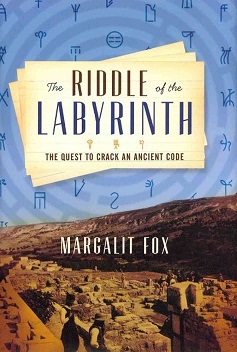

The Riddle of the Labyrinth — Margalit Fox

Cover of The Riddle of the Labyrinth


The Riddle of the Labyrinth
Margalit Fox
363 pages, including notes & index
published in 2013

Linear B is one of those ‘mysteries from history” I’d read about in the local library in the early eighties as a child, browsing through the stacks of occult, ancient astronaut and weird history books, listed along with better known examples like Schliemann’s quest for Troy. It’s one of those pieces of history I sort of, kind of knew about, of how tablets in an unknown language were found on Crete, providing evidence for the existence of a literate, “advanced” Bronze Age civilisation hundreds of years before the rise of the Classical Greek civilisations. But I never read much more about it because other subjects like Schliemann’s discovery of Troy looked much more interesting.

in The Riddle of the Labyrinth Margalit Fox sets out to prove me wrong by telling the real story of the decyphering of Linear B and Alice Kober, the largely forgotten woman at the heart of it, as well as of the archaeologist who found the tablets, Arthur J. Evans and the amateur linguist who finally decrypted them, Michael Ventris. In many ways this is a sad story: both Alice Kober and Michael Ventris died young, one dead of cancer, the other in a car accident, with Kober’s role in the decypherment for a long time remaining obscure because of her untimely death, while Ventris’ accident came at a time he was feeling depressed about what to do with the rest of his life… It’s also a detective story, as Fox tells the story of how the three of them each in turn helped the process of decyphering along.

Read more…

Sterrensplinters — Eddy C. Bertin

Cover of Sterrensplinters


Sterrensplinters
Eddy C. Bertin
222 pages
published in 2013

Eddy C. Bertin was an important author in my personal Golden Age of science fiction. A Flemish author, he was one of the few science fiction writers writing in Dutch back in the late seventies & eighties. Dutch language science fiction has never been particularly abundant and most that was published was not very good. Bertin was one of the few exceptions, an author who could’ve found an audience in English as well (and indeed, has had a couple of stories published in English). Still active, Bertin has written everything from hard science fiction to dark fantasy and horror, often mixing genres and with a tendency towards the Lovecraftian end of horror.

Sterrensplinters (Star Splinters) is a 2013 anthology collecting some of his best stories taken from his 1970s and 1980s collections. These are all long out of print, so a new collection of them is very welcome. The short introduction doesn’t tell much about why exactly these stories were chosen, or why the collection had to be divided into two parts: Membranen and Splinters, other than that the first set of stories takes place in a shared universe, while the remainder are standalone. That second set of stories feels as an afterthought, even if it includeds one of Bertin’s most famous stories.

Read more…

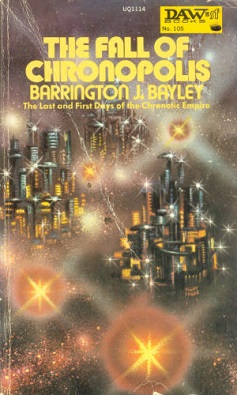
The Fall of Chronopolis — Barrington J. Bayley

Cover of The Fall of Chronopolis


The Fall of Chronopolis
Barrington J. Bayley
175 pages
published in 1974

I’ve always been a sucker for time war novels, starting with Isaac Asimov’s The End of Eternity, Fritz Leiber’s The Big Time and Keith Laumer’s Imperium series. I like the grand scale on which these stories play out, the whole idea of the impermanence of time itself, something that undercuts our most basic of securities, the idea that the past we remember is the way that past has always been, making literal the idea Orwell put forth in 1984: he who controls the past, controls the future. Which explains why The Fall of Chronopolis was one of the first bought at Eastercon novels I finished, even before the convention itself was over, finishing it at the Dead Dog party on Monday.

In the The Fall of Chronopolis the time war rages between the Chronotic Empire, which has steadily increased its dominion over the centuries until it rule a thousand years of human history and its far future enemy, the Hegemony, existing futurewards beyond the Age of Desolation after the fall of the Chronotic Empire. For the most part this time war has been limited, consisting of limited raids on each other’s history, but the Chronotic Empire is raising a grand fleet of timeships to invade the Hegemony directly, while the latter had developed a time distorter which can warp history directly. But this is only the surface story; there’s a lot more going on

Read more…

Books read April

Eight books read is only two per week, which isn’t quite the tempo I’m hoping for, but I have too much fun doing other things. Quite a few books read on the way to and from Eastercon; sadly however I bought roughly ten times as much.

Behold the Man — Michael Moorcock
I read this on the way to Eastercon, the day before Good Friday. It seemed fitting to read this story of a time traveller whose entire life has prepared him to journey back into time to the Crucifixion. One of Moorcock’s early classics, starring one of his characteristic passive protagonists.

Elysium — Jennifer Marie Brissett
This was a novel I might’ve nominated for the Hugos had I read it before. A love story that takes place against a backdrop of constantly shifting alternate histories, with the protagonist and their lover switching gender, sexuality and relationship with each shift, as the world increasingly takes a turn for the strange. Found via James Nicoll, as so much else.

Lost Things — Melissa Scott & Jo Graham
Another James recommendation, who called it “Jazz Age Occult Adventure” which suits this very well. A group of flyers get involved in an occult conspiracy, not entirely by accident.

The Fall of Chronopolis — Barrington J. Bayley
I’m a sucker for this sort of time war, dueling timelines story and Bayley has written a jewel here. Written with a pulpy jauntiness, but much denser than it first looks.

Strata — Terry Pratchett
Sometimes described as a Discworld prototype, this is both a serious sensawunda sort of space opera, Big Dumb Object story and a parody of same, especially Larry Niven’s Ringworld.

The Goblin Emperor — Katherine Addison
Political wishfullfilment fantasy of the benign kind, nominated for a Hugo and so far my pick for the winner. This may change once I’ve read The Three Body Problem.

The Race — Nina Allan
I had just bought this at Eastercon, after seeing the usual British suspect rave about it, when the author herself walked into the room, so now it’s a signed copy. A great novel, which shifts perspective in unexpected ways and does so with great skill. One plot point in the middle of the novel though had me stopped in my tracks, of which more once I review this properly.

Herfsttij der Middeleeuwen — Johan Huizinga
Classic history book by a Dutch historian, first published in 1919 and better known in English as The Waning of the Middle Ages. This is a history of 15th century Burgundy & France, in which the worldview of that period and region is put centre stage, a worlview that according to Huizinga was in the autumn of its existence, tired, wornout and in need of replacement.