Books read May

This is much more like it. Eleven Twelve books read this month, a much more respectable number than I’d managed so far. Some excellent books read as well, as you can see below..

Life — Richard Fortey
Fortey is perhaps the best living natural history writer. Here he tackles the entire story of life on Earth, from its beginnings four billion years ago to us, intermixed with his personal research and recollections. Fortey is the kind of writer who could make the telephone book interesting, let alone a subject like this he is genuinely passionate about.

Kraken — China Miéville
Miéville’s latest novel is a fantasy romp set in contemporary London, where things are not quite what they seem.

Big Planet — Jack Vance
An early Vance novel of planetary romance, which I’ve last read myself a few decades ago. Slightly disappointing as my memory was better than the book turned out to be.

Next of Kin — Eric Frank Russell
An entertaining but slight space adventure story by somebody I’ve read very little of so far.

The Steam-Driven Boy — John Sladek
A collection of not very good New Age Wave stories that haven’t aged well. It’s all a bit too clever-clever and lazy.

Dry Store Room No. 1 — Richard Fortey
The second Fortey book I read this month, which is a look at how the Natural History Museum functions — part collection of entertaining anecdotes, part history, part autobiography. As everything Fortey does, its worth reading.

Why Buildings Fall Down — Matthys Levy & Mario Salvador
Two architects look at various examples of buildings falling down and why they do so. Very good, very clear at explaining complicated realities in a form even an ignoramus like me can understand without doing violence to them.

The 9th Directive — Adam Hall
Adam Hall is a British thriller writer I learned about through Charlie Stross. Found this novel at a jumble sale and read it in a day. Interesting Cold War thriller story written in a very flat affect style.

The British Tanks 1915-19 — David Fletcher
A sufficiently anorak look at the earliest British tanks and how they came to be. Lots of great archive pictures.

The Fox-Magic Murders — Robert van Gulik
The last ever Judge Dee story Robert van Gulik wrote, as he died shortly after. A classic detective story set in Ancient but historical China.

Foundation — Isaac Asimov
The stories that launched a thousand Galactic Empires. The first in the classic Foundation trilogy. Hari Seldon, the greatest psychohistorian ever predicts the fall of the Empire and hatches a plan to shorten the inevitable barbarism that will follow…

Foundation and Empire — Isaac Asimov
Second in the classic trilogy — now with actual female characters. The Foundation confronts the old empire and is then confronted by the Mule, the one factor psychohistory could not predict.

Second Foundation — Isaac Asimov
Third in the classic trilogy, to which no sequels were ever written. The Mule is vanquished, but now Foundation stands against Foundation…
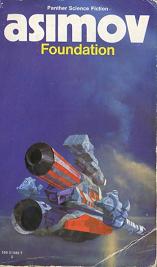
Foundation – Isaac Asimov

Cover of Foundation


Foundation
Isaac Asimov
189 pages
published in 1951

If you’ve ever been in the Netherlands on 30th April than you know we celebrate Queensday (the queen’s birthday party, held on the birthday of the previous queen but don’t ask) by holding massive flea markets/car boot sales. Ideal opportunities to pick up a lot of books fast and cheap. This year it included a lot of Asimov books, from a guy selling off his science fiction collection, including all the good Foundation series books: Foundation, Foundation and Empire and Second Foundation. These were orginally written as short stories in the forties, then reworked into novels in the early fifties, among the first science fiction novels to be sold as such. Much much later Asimov would write new sequels to these three books, but those were .. not good.

The originals though were, if not the first Galactic Empire stories, the ones who popularised it and set the pattern for a flood of imitators (see for example Brian Aldiss’ two anthologies, Galactic Empires volume I and volume 2). Influenced by Edward Gibbons History of the Decline and Fall of the Roman Empire, Asimov basically transplanted the Roman Empire to Outer Space and had it rule the Galaxy, a Galaxy devoid of any other intelligent life and in which it was axiomatic that humanity should be united under one emperor and ruled from one planet and anything else would be barbarism. Yes, these are all utterly clichéd and wornout concepts now, but don’t forget that this was first published in 1951 and based on stories from the forties, in other words, this is some seventy years old. You may therefore wonder if Foundation is worth reading for anything but historical value. Certainly Asimov’s reputation as a not very good writer doesn’t help — you don’t read his stories for his sparkling turn of phrase.

And yet…

Read more…

Fields of Conflict – Douglas Scott, Lawrence Babits & Charles Haecker

Cover of Fields of Conflict

Fields of Conflicts is a collection of essays on battlefield archaeology, based on papers presented on a conference of the same title as the book, held in 2004. Battlefield archaeology as a separate discipline is a relatively recent development, even if military history is of course of quite ancient vintage. Astounding as it may seems, battlefield archaeology only got started in the early eighties, with a groundbreaking research paper on the Little Bighorn battlefield. Though it seems obvious in retrospect to apply archaeological techniques in researching battles and battlefields, battlefields are such ephemeral sites, battles rarely lasting more than a day, while archaeology traditionally focused on sites that had been inhabitated for centuries, that it’s no wonder it took so long for somebody to do so. That somebody was Douglas Scott, also one of the editors of this volume and you realise the impact of his research by seeing how often in the essays collected here it is refered to.

In fact, Douglas Scott is so influential that I’ve seen him on the History Channel showcasing his Little Big Horn research a few years ago, which was the first time I heard of battlefield archaeology. It was fascinating to see how it was possible to almost track the movement of single soldiers on the battlefield by hunting for the detritus they left behind in the course of the battle. Fields of Conflicts shows how much can be known of even obscure battles this way, through creative use of archaeological techniques and especially metal dectoring, but also how much still remains unknownable as well. It’s a fascinating read even for armchair historians like myself, a glimpse in how the real professionals handle these problems.

Read more…

Books read April

I’m still reading nowhere near as much as I read last year or the year before. Because I bought a lot of science fiction this month I also read a lot of science fiction.

The Raw Shark Texts — Steven Hall
What if books and words contained a whole ecosystem and somewhere out there a great word shark is hunting you?

The Night Sessions — Ken MacLeod
A thematic sequel to The Execution Channel.

The Enquiries of Doctor Eszterhazy — Avram Davidson
A not quite serious collection of Ruritarian mystery stories. Somewhat slight perhaps, but a pleasure to read if only for Davidson’s writing voice. Because he clearly had fun writing these stories, you the reader have almost as much fun reading them.

The Gate of Worlds — Robert Silverberg
An unknown to me and minor Silverberg novel, telling the adventures of a young English adventurer in the Americas of a world where the Black Plague was much lethal than our own and England has only recently thrown off the Ottoman yoke. Not very interesting, partially because of its meandering plot.

This Is Not a Game — Walter Jon Williams
I’ve already talked about this novel before. This is a great novel and recommended to anybody who liked Charlie Stross’ Halting State.

The Legion of Time — Jack Williamson
One of the classic time travel/alternate world stories, which introduced the concept of “Jonbar points”, where a decision made one way or another (will a small boy pick up a magnet or a pebble) has huge consequences for how future history plays out. I wanted to say that this was a good story, but unfortunately I can’t; of historical interest only.

After World’s End — Jack Williamson
Though the cover doesn’t mention it, The Legion of Time came bound with a second novel, the hero of which is a contemporary rocket explorer who manages to get stuck in cold sleep in a cometary orbit in the Solar System for a million years. This enables him to play a leading role in the uprising of humans against their robot masters.

The Legion of Space — Jack Williamson
I couldn’t not read this after The Legion of Time. It’s much better, the Three Musketeers in Space! Because it moves much quicker the stereotyping and flat characterisation didn’t have as much time to annoy me.

Dawn of the Dumb — Charlie Brooker
A collection of Brooker’s television criticism and other columns. If you like his writing, this is like a box of candy and it takes discipline not to gobble them all up in one go.

World War Z — Max Brooks
A cult hit a few years ago (show you how “hip” and “with it” I am), this is an oral history of a worldwide, Night of the Living Death style zombie outbreak. It was good enough and scary enough to keep me up till 2:30 AM reading it, then caused me trouble sleeping.

Also read, but not finished: the second book in Steph Swainston’s Castle trilogy, as well as Richard Fortey’s Life.

Librarything

No real posts today — been too busy getting the house on order and now have a bright shiny new distraction to keep me busy. I’ve finally succumbed to Librarything. For years I’ve kept a list of which books I owned in Excel, but I needed something I could look up anywhere, even if need be on a mobile phone in the bookstore. Adding books on Librarything is just the kind of mindnumbing, tedious but oddly satisfying activity that can keep me happy for hours…