Killing Hope – William Blum

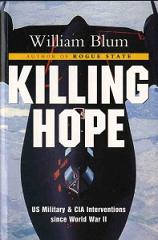
Cover of Killing Hope


Killing Hope
William Blum
469 pages including index
published in 2003

William Blum is a veteran leftwing journalist, active since the 1960ties, who made his name leaking the name and addresses of 200 CIA employees back in 1969. Since then he has been working in relative obscurity until around the turn of the millennium when he wrote a bestselling book about the US’s foreign police: Rogue State: A Guide to the World’s Only Superpower. It came at the right time to find its audience, just as interest in the subject soared due to the September 11 attacks. This succes is probably what got Killing Hope published, as it’s an updated version of one of Blum’s older books, originally published in 1986 as The CIA: A Forgotten History. It certainly has some of the hallmarks of a cash-in book, with the updating only going as far as the mid-nineties and the bulk of the book not noticably updated from the first edition. Many of the earlier chapters do not show much awareness of events and new revelations after 1986, if you see what I mean.

Killing Hope is the history of US military and covert interventions since World War II, with each chapter detailing a specific case. The chapters are in order of chronology, with several countries with a long history of US intervention having multiple chapters devoted to them. As Blum shows again and again in these chapters, the US talks a great deal about democracy and freedom, but the reality of its foreign policy at least since World War II is far different. With the excuse of “fighting communism” (or these days, “terrorism”) again and again the US has interfered on the side of dictatorships, nobbled democracies or fought liberation movements in order to safeguard its interests, be they strategic geopolitical ones or commercial ones. And Killing Hope is far from exhaustive, even in its original timeframe of 1945-1985 with Vietnam e.g. only having one short chapter devoted to it and little attention paid to other Asian countries like Taiwan, Japan or South Korea or even the UK.
Read more…

The State of the Universe – Pedro G. Ferreira

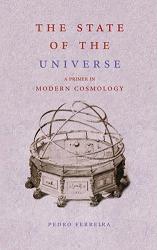
Cover of The State of the Universe


The State of the Universe
Pedro G. Ferreira
320 pages including index
published in 2006

I felt the need to reacquaint myself with modern astrophysics as it has been far too long since I’ve read anything about it. Sure, I do watch The History Channel’s Universe series whever I catch it, but that doesn’t tell me much I don’t know already, while following the vast array of astronomy blogs out there is no real substitute, as they do assume a certain familiarity with the current state of the art. Long live the public library therefore, for providing quick access to what looks like exactly the book I need: The State of the Universe: a Cosmic Primer. Written by Pedro Ferreira, a lecturer in Astrophysics at Oxford, it’s meant as a layperson’s introduction to what astrophysics thinks the universe looks like and what makes it tick.

The State of the Universe is built up logically from first principles. Ferreira starts with a short overview of classical Ptolemaic cosmology, with the Sun revolving around the Earth and how it was succeeded by the heliocentric cosmology of Copernicus and Gallileo. Over several chapters he then shows how our knowledge of the size and complexity of the universe expanded, from what was once thought to be no bigger than our Solar System, through an understanding of how big our Galaxy actually and finally to an appreciation of the idea that all those galaxy shaped nebulas are actually galaxies as well. Then he goes on to the other end of the scale and explains the physics of the universe: the fundamental forces that shape it (gravity, electromagnetism, the strong and weak force), a quick sketch of the whole zoo of the particles that make up the matter and energy in it and how it all sits together. From the classic Big Bang idea of the evolution of the universe he finally moves on to the cutting edge of current physics, where it all gets a lot less clear what’s real and what’s just clever theorising.

Read more…

Imperial Earth – Arthur C. Clarke

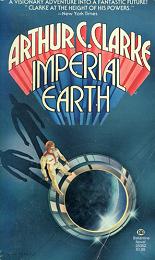
Cover of Imperial Earth


Imperial Earth
Arthur C. Clarke
305 pages
published in 1976

The last Arthur C. Clarke book I’ve read was Rendezvous with Rama back in 2002; unfortunately it was the news of his death that brought me to read another, as a private homage. I had read Imperial Earth before, in Dutch, as Machtige Aarde and liked it, though it never became a favourite. It seemed a good idea to reread this rather than one of the more obvious classic Clarke novels, to get a good idea of the strengths of Clarke’s later works. Imperial Earth was written and published in 1976 and set three hundred years later, at the United States’ quincentennial, which to be honest immediately dates it for me. On the other hand it is refreshing to read a sf novel that has the US still existing three hundred years in the future, rather than as subsumed into a world government or fallen apart into a Balkanised mess. At the very least setting the book at the quincentennial signals how much of a seventies book this is.

Imperial Earth starts on Titan where despite the harsh circumstances a flourishing colony has been established, which makes its living supplying hydrogen for interplanetary fusion rockets as the only place in the Solar System where hydrogen was abundant enough to be worthwhile to harvest and gravity light enough to be able to do it cheaply. It was through the drive and will of one man, Malcolm Makenzie, that the Titan colony became a reality and he and his family have ruled it since. That same drive meant that when it became clear he suffered from too much gene damage due to space travel to produce children the normal way, he instead let himself be cloned on Earth. His son did the same and Duncan Makenzie is the second generation of Makenzies to be born this way, now old enough to do the same himself and fortuitiously invited to the quincentennial celebrations of the birth of America.

Read more…

Books read April

Raw Spirit — Iain Banks
Sometimes the life of a bestselling novelist is hard. This isn’t one of those times, unless you consider driving around Scotland drinking single malt whiskies a hard life. Nicely diverting, nothing knew if you know your whiskies already but who cares?

A Writer’s Diary — Virginia Woolf
Selected by her husband Leonard Woolf a decade or so after her death, this is an extract of her diary edited to keep most of the personal stuff out but the entries about writing in. Completeness aside, this was long enough for me already, hard going in places but ultimately rewarding. Interesting to see the rhytm in how she writes her books.

Cetaganda — Lois McMaster Bujold
A Miles Vorkosigan novel I reread because Jo Walton is rereading the series for tor.com. Ironically, she doesn’t seem to like Cetaganda as much as I did. A fun adventure romp.

Old Tin Sorrows — Glen Cook
Another adventure of Garret P.I. , a Chandleresque hardboiled detective stuck in fantasyland. This time an old army comrade recruits him to find out who might be poisoning the retired general he’s working for.

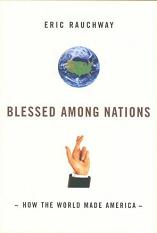
Blessed Among Nations — Eric Rauchway
An examination of how nineteenth century globalisation made America into the country it still is today and why its evolution went so different from that of other advanced countries during that period.

Prador Moon — Neal Asher
Fastpaced space opera in which you don’t have to think too much.

Night of Knives — Ian C. Esslemont
Esslemont is the friend with which Steven Erikson thought up the world of the Malazan Empire. This is his first novel in that world. Quite good, but different enough from Erikson to be confusing at first.

The Worlds of Poul Anderson — Poul Anderson
Three unrelated novels too short to be published separately. Not Anderson’s best work, but entertaining enough though each is decidely gloomy in its own way.

The Pastel City — M. John Harrison
The first of Harrison’s books set in Virconium, the Pastel City in the evening of humanity’s existence. Of course this is inspired by Jack Vance’s The Dying Earth, as viewed through a New Wave sensibility.

The Broken World — Tim ETCHeLLS
My eye fell on this when I picked up Night of Knives. Twentysomething slacker obsessively writes a walkthrough to his favourite game while his life tears apart around them. It reminded me of Douglas Coupland’s Microserfs.

The Wartime Kitchen and Garden — Jennifer Davies
A companion book to a BBC tv series I never saw, this was a quite good introduction of how people on the homefront had to cope with rationing and the demands made on them for food production.

When Daddy Came Home — Barry Turner and Tony Rennell
What happened after World War II was won and millions of British soldiers returned home.

Dread Brass Shadows — Glen Cook
Another Garret P.I fantasy mystery. When his on-again off-again girlfriend is knived in the back on her way to see him, Garret gets involved in the fight over a powerful book of sorcery.

Blessed Among Nations – Eric Rauchway

Cover of Blessed Among Nations


Blessed Among Nations
Eric Rauchway
240 pages including index
published in 2006

The main reason I picked up this book from the Amsterdam library was because I recognised Eric Rauchway’s name; a quick google confirmed that this was the same Eric Rauchway who writes on The Edge of the American West, an excellent history orientated groupblog. It’s always nice to see somebody who can write clever blogposts is able to sustain that cleverness over the length of a book, as Rauchway did here. It’s even better if it’s done in a book I actually would want to read anyway, of course.

Blessed Among Nations is an examination of “American exceptionalism”, the idea that America as a country is different from other countries in more than the trivial way in which every country differs from every other country. In several ways the United States differ from its peers in Western Europe. It is the largest economy in the world, but depends on investment of foreign labor and capital to keep its economy running. It spent much less on social welfare than other rich countries, its government is somewhat less centralised as well and finally there has never been the kind of broad mass socialist or social democrat movement in the US as there has been in Europe. What Rauchway wants to do in his book is to explain these differences without either explaining them away or falling in the trap that America is special, unbound by rules that govern lesser nations.

The explenation Rauchway reaches is contained in the subtitle of the book: How the World Made America. He argues that the foundation for modern post-world war America was laid in the period between the Civil War and World War I, during the first era of globalisation. During this era America was a favourite destination of both labour and capital, the first in the shape of mass immigration from Europe, the second through investments made by British investers. America was far away enough from Europe not to be sucked into the great power conflicts there but near enough through new technology like the telegraph and the steamship to be integrated in the worldwide capitalist system. What’s more, America could make do with a relatively small army and navy as it could shelter behind the might of the Royal Navy as Britain kept the oceans free for their own purposes, while its expension westwards brought the country into conflict with mainly military inferior opponents.

Read more…