Women to Read Wednesday 03: Tricia Sullivan

Yeah, so I’d forgotten I was doing this and it was only thanks to a Tricia Sullivan post calling out the lack of support from blokes for female writers that I remembered about it. I could make excuses but I won’t. It clearly wasn’t important enough to me to keep in mind. Nevertheless I do think this is important enough to restart, one of the ways in which I can make my own little contribution to making science fiction/fantasy slightly more equal.

Because, as Tricia Sullivan notes, it clearly isn’t at the moment. Taking her as an example, we have a critically acclaimed writer, who has won the 1999 Arthur C. Clarke Award for Dreaming In Smoke and who was nominated again in 2004 for Maul, yet she doesn’t have a book contract at the moment, having to write her next novel on spec. This is hardly an unique situation for a female writer, especially an UK based one, to find herself in and things aren’t made any easier by the slow collapse of science fiction publishing in the last few years. As there’s less room for science fiction in publishers schedules, the unfair advantages of the old boys’ networks matter more and it’s a minor disaster that a talented and interesting writer like Sullivan is passed over for yet another mediocre male mil-sf writer.

Since 1995, Tricia Sullivan has written seven novels, most of which are now out of print it looks like. I’ve read two of them, her latest one, 2010’s Lightborn and 2005’s Double Vision. Both are novels in which the normality of the world as we know it has been upset one way or another, with the protagonist in each having to deal with the challenges the new reality brings with it.

Lightborn:

What Tricia Sullivan has done with Lightborn is create a concretised metaphor for growing up, that long drawn out moment when you’re a child on the edge of becoming an adult, looking out over the abyss to the incomprehensible horrors of adulthood. Both Roksana and Xavier are young teenagers, forced by circumstances to become more mature, but also kept from being fully adult. It’s no coincidence that all adults in the novel are unreliable or downright dysfunctional, Shined or not Shined; they have to make their own decisions and every time they want to trust an adult, it turns out to be a mistake. Yet Sullivan doesn’t glorify childhood: her heroes do have to grow up, make compromises, without being overtly dramatic about it.

Double Vision:

As a science fiction reader you’re obviously biased towards the strange, the potential hallucination to be real, even if there’s a long tradition to use this against the reader. In Double Vision you start off with the default assumption that what Cookie experiences is real, only for Sullivan to sow doubt in your mind as certain inconsistencies become clearer. For example, if the scouting she does in the Grid is so important, why is it that her boss is only interested in which brands she heard mentioned by the soldiers? What is she really used for?
Fandom really should clean our act up

So sick and tired of this shit happening in my fandom:

3. Moments later, another guy, a fellow writer, hugs me tenderly from behind, though I do not know him. When I turn, startled, to protest, he says “You have the greatest smile. It just makes me want to hug you.” I’m doomed to avoiding him for the rest of the con, because he’s always wherever I am, charging at me with open arms, hugging me in elevators and moving at me to hug basically just wherever I go. It’s gross. He becomes known to my swiftly formed girl posse as The Hugger in the Hat. And when I say hugger, I mean full body contact with erect bits against my thigh. I don’t report him. I’m new to the scene. I feel awkward. I’m used to being harassed in the world. This is bad, but it’s not insane in terms of how much wrong attention I get from creeps in cities. So, I don’t report.

4. What Cherie Priest says in her post on this is true. We form protective posses. Descriptions of creepers are traded like cards. Women say things such as “Do you need back up when you walk through that room?” “What color is his shirt?” “Oh, I saw The Hugger In The Hat in there – I’m getting between you and him.”

5. Conversely, when I complained about The Hugger anecdotally to men, most of them said he was just clueless and didn’t mean to creep me out, and that if I was clear that I didn’t want to be hugged, I wouldn’t be, because The Hugger was a nice guy. Don’t get me wrong. Most men are great. But I think most guys have also not been witness to a lot of this. Creepers wait til you’re with your girls, or alone. Because Creepers calculate.

Both the actual harassement Maria Dahvana Headley experienced and the dismissal/justification of it should not happen. It’s 2013, not 1973 and even in fandom, even when you are a famous science fiction writer, this sort of behaviour is beyond the pale and we should not put up with it any longer. Nobody should have to worry about how and whether to file a formal harassement report against an editor when going to a con.

For those of us who aren’t douchenozzles, nor likely to be the victim of harassement, what we should do is watch out for it and be supportive, not dismissive, of those who do suffer from it. This can be hard, but that’s no excuse not to.

Expelling Bale from the SFWA is not enough

Amel El Mohtar calls for the expulsion of Theodore Bale/Vox Dale from the SFWA:

While it is my personal feeling that the hateful, harmful, dehumanizing views expressed by Beale on his blog (about women, about religious and ethnic groups to which he does not belong, about queer people) would be “good and sufficient cause” enough to not share an organisation with him, I understand that enforcing expulsion on those grounds is problematic in the absence of an expansive organization-wide Code of Conduct.

However, Mr Beale has repeatedly and aggressively used SFWA platforms to broadcast and disseminate these views with obvious malicious intent. Most recently he has used the SFWA Authors Twitter feed — in flagrant contravention of its terms of use — to broadcast an appallingly racist screed against author N. K. Jemisin, calling her an “ignorant half-savage” and saying that “self-defense laws have been put in place to let whites defend their lives and their property from people, like her, who are half-savages engaged in attacking them.”

This last reads to me very much like a threat, especially coming from a white man to a black woman in a country where public lynchings are a matter of living memory.

I urge you to please represent my views to the rest of the officers and vote to expel a man who has behaved so execrably from our organization.

Note that Beale ran for SFWA president and got some fifty people to vote for him:

Folks, we have to grin and bear it in an organization where 48 people voted for an organizational president who wanted to disenfranchise half the electorate. Women’s right to vote. In my own industry. In the one that pays me to write books. 48 people who were happy to publicly endorse turning me into a non-human. How many more were sympathetic to this? How many that I don’t know about?

In my opinion these people need to be expelled as well. You can’t have an inclusive organisation if it includes people who think women shouldn’t have the right to vote, or out and out racists. The SFWA need to take a leaf out of the Australian Army’s book and get serious about ending sexism and racism in its organisation.

Iain M. Banks (16 February 1954 – 9 June 2013)

Iain M. Banks has died, of the cancer he’d revealed earlier this year he had. Though the news doesn’t come as a surprise, it’s still a shock. He was only fiftynine, far too young. It’s hard to say how much he meant to me personally. I’ve never met him, or had any contact with him, but his novels, especially his science fiction were –are– incredibly important to me.

More objectively, Banks himself was a paradigm breaker, somebody who could write both science fiction and “literary” fiction and be taken seriously with both, who kept writing both and who liberally mixed in his sf with his mainstream stories. There had been other science fiction writers who went in for more mainstream literature, not to mention an army of properly literary writers dabbling in science fiction, but I think he was to first to keep consistently writing sf and literary fiction, therefore helping open up space for science fiction to be taken serious as literature.

Not to mention of course the huge influence he has had on other writers. Entire generations of British sf writers grew up in his shadow. Many of my favourite writers owe a debt to him: Charlie Stross, Ken MacLeod, Jon Courtnay Grimwood, Liz Williams, Justina Robson, China Mieville, Richard Morgan, these are all writers in which I recognise Banks’ influence.

But there’s more. He was also a principled leftist, something he showed not only through his writing –the Culture as the ultimate communist post-scarity paradise– but also in his actions. He was vehemently opposed to the War on Iraq, to the point that he tore up his passport when the invasion started as a protest. As his obituary at the Stop the war Coalition website makes clear, he was also a supporter of the cultural boycott of Israel as a way to pressure the country into giving up its apartheid regime.

“We continue in our children, and in our works and in the memories of others; we continue in our dust and ash.” — Iain Banks, The Crow Road.

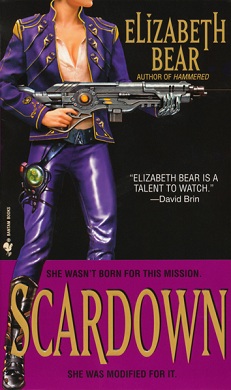
Scardown — Elizabeth Bear

Cover of Scardown


Scardown
Elizabeth Bear
368 pages
published in 2005

Scardown is Elizabeth Bear’s second novel, sequel to Hammered, continuing the adventures of Jenny Casey. Where Hammered was straight up streetlevel cyberpunk, in Scardown the perspective opens up. That opening up actually started in the last pages of Hammered and Scardown continues seamlessly. Middle books in a trilogy, as this is can often sag, neither setting up plotlines nor resolving them, but Scardown avoids this fate. Each of the books in the Hammered/Scardown/Worldwired has its own story, but together they do add up to one coherent one.

Jenny Casey is a veteran who lost her left arm and eye in a war in South Africa decades ago, replaced by fairly primitive cyborg implants. Her ability to cope and survive for so long with these implants made her an unique candidate for starship pilot training, as these pilots would need to be plugged into their spaceships. This is why she was being pursued by the Canadian government in the previous novel, Canada and China being the world’s two superpowers in 2062. The world is dying, killed by climate change and humanity’s hope lies in the stars. Which is why both superpowers are building starships, starships made possible by alien technology found on Mars.

Read more…