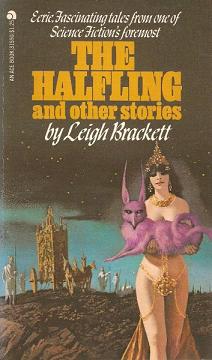
The Halfling and other Stories — Leigh Brackett

The Halfling and other Stories


The Halfling and other Stories
Leigh Brackett
351 pages
published in 1973

The Halfling and Other Stories is the sixth book I’ve read in the Year of Reading Women challenge I set myself after I’d noticed last year how few female written science fiction books I read. I had chosen this because it was something I hadn’t read before and I always liked Brackett. Unfortunately it turned out this was one of her lesser collections. The stories don’t fit well together, there’s no real theme to the collection and some are decidedly on the weak side.

It doesn’t help that the first two stories are basically the same. In both there’s the hardbitten protagonist falling for a mysterious beautiful alien girl who he knows is trouble yet can’t help himself but get involved with, who then turns out to be evil. Worse, in both stories this girl is shown to be representative of her race, their evil part of their biology. It’s a bit …uncomfortable… shall we say, but unfortunately these sort of assumptions are build into the kind of planetary romances Leigh Brackett wrote.

Read more…

Bringing back the midlist

Last week I wrote about the new Gollancz ebooks gateway which will launch “this autumn”. A week later and we’re slowly getting to see which authors will have books on this service, as they start to mention it on their blogs.

One of the authors I’m most excited about, who most unfairly has been out of prints for years, is Pat Cadigan:

It’s been busy around here but, yes, in case you haven’t heard me turning handsprings from wherever you are, Orion/Gollancz is bringing all of my work back into print. Synners is going to be in the SF Masterworks series and Mindplayers, Fools, and Tea From An Empty Cup will be published in a single omnibus volume. My collections Patterns and Dirty Work will be ebooks.

And all will be part of Orion’s SF Gateway program.

also back in print, Nicola Griffith’s first two science fiction novels:

Ammonite appeared in early 1993 (from Ballantine/Del Rey in the US and HarperCollins/Grafton in the UK). It won some awards. Slow River followed two years later (ditto). And ditto. But the books still went out of print in the UK. (That’s the UK publishing reality. It’s different in the US. Here both books here have been through a zillion printings and still sell steadily, if not spectacularly, in print and digital editions.)

So it’s wonderful to be able to announce that I’ll finally be a Gollancz author–back where I started all those years ago. Repeat Yodel of Triumph, add Nod of Satisfaction, and follow, as always, with beer.

I was already interested in seeing what Gollancz was up to ebookwise, but these two announcements make it much more likely that’ll will buy books through them. Much will still depend on price, easy of buying and the absence of intrusive DRM on the books. The price needs to be roughly in the range of what I would spend on secondhand paperbacks or it wouldn’t be worthwhile to me, though I am willing to pay a bit more for the convenience of buying online, certainly for authors like Nicola Griffith and Pat Cadigan.

As Pat Cadigan noted in her post, twenty-thirty years ago it was normal for most of science fiction’s back cataloque to be in print and easily available. In the last decades this backlist has been steadily eroded as it no longer made commercial sense to keep most authors in print. Epublishing changes this equation: once an ebook is created, selling more of them doesn’t cost more unlike with physical books, where new print runs are usually too expensive for moderately profitable books. The Gollancz intiative helps to re-establish the backlist, another good reason to support it.

(Edited to erase an incredibly stupid brainfart; see comments.)

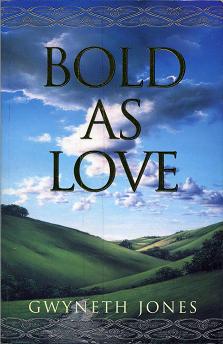
Bold as Love — Gwyneth Jones

Cover of Bold as Love


Bold as Love
Gwyneth Jones
403 pages
published in 2001

Bold as Love is the second book in my year of reading women sf challenge, chosen partially because Niall Harrison was also going to read it in February, for Torque Control‘s similar project. For a long time I wondered whether I had made a mistake selecting this book, picking it up and putting it down again, not getting to grips with it. Didn’t like the writing, didn’t believe the world building or plot, couldn’t care for the protagonists. Only the fact that I was reading this as part of a self imposed challenge kept me going. That, and the feeling that a novel which had won the Arthur C. Clarke Award and which was commercially succesful enough to span four sequels, must have something in it that I was missing.

Perhaps it was just that this was a novel I needed to immerse myself in fully, not read in bits and chunks here and there during the daily commute. Gwyneth Jones is not a writer who grabs you from the first sentence — at least she isn’t for me. She writes her characters from the outside in, rather coolly and hence it takes more time to get into her characters’ heads than it would with a more “warmer” writer. I had the same sort of problems with the future England Bold as Love predicted, which at first seemed dated and implausible, more sixties New Wave than early 21st century science fiction.

Read more…

Shuttlepunk

It isn’t ironic that the last flight of this:


Happens on the anniversary of this:


But it is the end of an era. I’m too young for the Apollo missions, but old enough to remember when the Space Shuttle was still the promised miracle ship that would get us into space properly, back before Challenger showed us how much of this promise was just wishful thinking. The Space Shuttle was the last gasp of the idea of manned space exploration as something analogous to the discoveyr and settlement of America, something that could be done just as long as we had enough willpower and enginering fortitute to pursue it. The end of the shuttle does not mean the end of space exploration, but with its retirement the science fiction dreams of L5 space colonies with millions of inhabitants, Helium-3 mines on the moon and asteroids being melted in low earth orbit for their metals has finally gone the way of all science dreams made obsolete by reality.

So in honour of steampunk (the faded dreams of Victorian era science fiction), dieselpunk (thirties), atompunk (fifties and sixities), I’d like to propose shuttlepunk as a new genre for all those stories that still think those seventies and eighties ideas about the colonisation of space can be made into reality. First candidate as proto shuttlepunk: Stephen Baxter’s Voyage. Science fiction being what it is, I’m sure we’ll see quite a few shuttlepunk novels coming out in the next few decades looking back towards an old, discarded future in preference to inventing new ones…

Science fiction linkage: Joanna Russ and the Gollancz experiment

Graham Sleight tells us about the book project he has been working on for the last couple of years, the collected short stories of Joanna Russ:

Perhaps I should explain. In, I think, 2006 or 2007, Farah Mendlesohn very kindly asked me to write a chapter on Joanna Russ’s short fiction for a book she was editing; this became On Joanna Russ (Wesleyan, 2009). At the time, Wesleyan were reprinting a number of Russ’s novels. Via Farah, a request came through. Wesleyan were interested in publishing a Collected Stories of Joanna Russ, but the bibliography seemed a bit complicated. Would I be interested in working with Joanna to sort it out? I would, I said, and began corresponding with Joanna. Over the course of several years and a lot of airmail post, we worked out the contents list, the texts to be used, and the scholarly apparatus. In addition to the published collections, the book would contain about another collection’s worth of unpublished material. (About a quarter of this Joanna referred to as “Ghastlies”, meaning early work she wasn’t that keen on; but most of it was astonishing, like the late hilarious story “Invasion”. Most is not from the sf field but rather from small literary/feminist magazines.) I sent the completed MS off to Wesleyan in late 2008 and waited.

This book is currently in limbo, but needs to happen, a fitting tribute to one of science fiction’s best writers. Sadly much of her work seems to be out of print now, while it’s not very easy to find secondhand either, at least not here. I’ve rarely seen her work in the secondhand bookstores I browse in.

This is not an unique position a sf writer can find themselves in of course; apart from the obvious classics, most of science fiction’s history is out of print. Gollancz aims to change this, by launching the Science Fiction Gateway. From their press release:

Gollancz, the SF and Fantasy imprint of the Orion Publishing Group, announces the launch of the world’s largest digital SFF library, the SF Gateway, which will make thousands of out-of-print titles by classic genre authors available as eBooks.

Building on the remarkable success of Gollancz’s Masterworks series, the SF Gateway will launch this Autumn with more than a thousand titles by close to a hundred authors. It will build to 3,000 titles by the end of 2012, and 5,000 or more by 2014. Gollancz’s Digital Publisher Darren Nash, who joined the company in September 2010 to spearhead the project said, “The Masterworks series has been extraordinarily successful in republishing one or two key titles by a wide range of authors, but most of those authors had long careers in which they wrote dozens of novels which had fallen out of print. It seemed to us that eBooks would offer the ideal way to make them available again. This realization was the starting point for the SF Gateway.” Wherever possible, the SF Gateway will offer the complete backlist of the authors included.

Gollancz has always been one of the most important, if not the most important publisher of science fiction and fantasy in the UK, both commercially and for the development of the genres. If any publisher can make this project work it’s them, but will all depend on how this gateway will work in practise. They’re getting at least one thing right, by going for volume from the start, rather than being cautious in what they’re offering and by going for the backlist as well as new titles. Now all they need to do is make sure all those minor little details like pricing, ease of purchase and how to handle territorial copyright, digital rights management, not to mention which formats to publish in and so on.

What I want from the SF Gateway is being able to buy all of Joanna Russ’ backlist, for about the same money that I could get them from a secondhand bookstore from — they should not be more expensive than a new mass market paperback — and do so hassle free, with no DRM or nonsense about not allowed to buy them because I’m not in the UK.