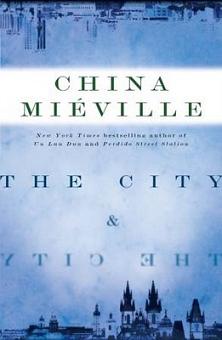
The City & The City — China Miéville

The City & The City


The City & The City
China Miéville
312 pages
published in 2009

Right. China Miéville is one my favourite writers, one of the few (together with Terry Pratchett, Iain M. Banks and Ken MacLeod) I’ll always buy in hardcover. I love the way in which he fuses science fiction and horror and fantasy together into what he himself has called New Weird, essentially a new genre that emphasises the grotesque and baroque sides of its parent genres. What I also admire in Miéville is that he keeps his imagination firmly grounded in a keen appreciation of political and economical realities, no doubt helped by his background as a proper socialist. That combination made Miéville’s creation of New Crobuzon one of the more fully realised cities in science fiction/fantasy. With Miéville there’s always the feeling that his heroes do have to work for a living, that the daily struggle for existence is just as important, if not more as whatever existentialist crisis they’re on the fringes of.

It’s this sense of realism that links The City & The City with Miéville’s earlier novels. Set on Earth in two fictional Eastern European cities with no fantastical or science fictional elements and written as a police procedural: The City & The City cannot be more different from its predecessors. Yet at the core of the novel are the same political and economical themes Miéville always write about. At its best the police procedural is a very political novel, just because policing itself is intensely political — just think about the decisions being made about which crimes to prosecute and which not, which investigations to support and which to starve of resources. There’s therefore a long tradition of writers using the police procedural as a vehicle for social criticsm and Miéville fits in well with this tradition. Of course Miéville being Miéville he does more than that but we’ll get to that.
Read more…

Gil Scott-Heron


Could there be any other poem to honour Gil Scott-Heron for a science fiction fan/space age believer than this?

Foreigner – C. J. Cherryh

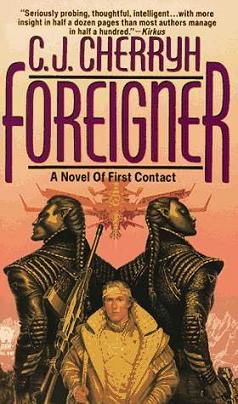
Cover of Foreigner


Foreigner
C. J. Cherryh
423 pages
published in 1994

Foreigner is the fifth book in my Year of Reading Women project. It is the first novel in one of C. J. Cherryh’s more popular series, yet until now I had never read any of them. She is such a prolific writer that it’s easy to miss a series or two. She also has such a wide range, writing anything from fantasy to space opera, that not everything she writes appeals to every one of her fans. The number of people I’ve known who hated her breakthrough novel Downbelow Station for example…

Yet, once you’ve read a few of her novels, you discover that there is one narrative trick all her stories have in common, no matter what the setting or the plot is. What she likes to do is to take her protagonists out of their comfort zone, get them at their most vulnerable and then put the pressure on. Every one of her novels I’ve read has the same structure. The protagonist is a young man (rarely a young woman) put in a position of responsibility but without power. Usually he’s an outsider in an alien culture, cut off from his own people, in the middle of some sort of political crisis he barely understands let alone can influence. She then let’s this crisis heats up, makes sure her hero gets little to eat and less sleep and is as far removed from the centre of the crisis as possible, yet still has a vital role to play in resolving it, even if he not necessarily knows it. To make sure the reader is as much in the dark as the hero, she usually makes sure they’re only looking at the story through his eyes.

Read more…

Cowboy Feng’s Space Bar and Grille — Steven Brust

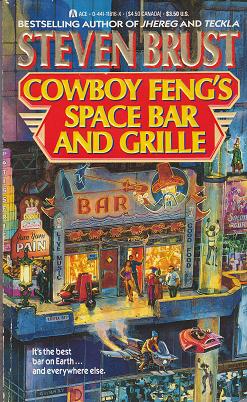
Cover of Cowboy Fengs Space Bar and Grill


Cowboy Feng’s Space Bar and Grille
Steven Brust
223 pages
published in 1990

Sometimes when I’m depressed I go on a book reading binge — I managed to read every Wheel of Time book up to Lord of Chaos in a week when I was at a low point during my time at college. Pure escapism, fleeing into a story to temporarily ignore the world around me. A few weeks ago I fled back in that habit when my wife was having a very bad night, the day before she had to go back to hospital again. I was sleeping on the couch to try and give her an easier night’s sleep but then couldn’t sleep myself, so I grabbed the nearest book at hand. This turned out to be Cowboy Feng’s Space Bar and Grille.

Which perhaps wasn’t the best book to keep the night terrors at bay. Cowboy Feng’s Space Bar and Grille is a strange book, if only because it’s one of Steven Brust’s rare science fiction novels, but also because it’s a light adventure story about a Strange Bar, set amongst a series of nuclear holocausts. Amongst Brust fans it’s apparently a bit of a controversial book with some hating it, but for me it was the right book at the right time. It may be strange to think of a book that has a succession of nuclear wars at its heart as comforting, but that’s what it was.

It’s comforting because Brust makes it so. The nuclear death is in the background, while in the foreground we get the story of the bar that has the best matzo ball soup in the galaxy, as well as some of the best Irish musicians. Whether or not Billy, the protagonist narrating the story in first person, counts himself amongst them remains unrevealed. This is the picture you get in the first few sentences and the cozy atmosphere it evokes neutralises much of the existential dread the nukes evoke. It reminds me of the urban fantasy people like Emma Bull and other of the Scribblies — a group Brust of course belonged to too — were writing in the eighties.

Read more…

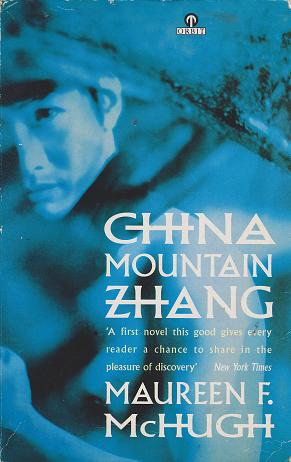
China Mountain Zhang — Maureen F. McHugh

Cover of China Mountain Zhang


China Mountain Zhang
Maureen F. McHugh
313 pages
published in 1992

China Mountain Zhang is the fourth novel I’ve read in my Year of Reading Women project. It had been on my shelves unread for over a decade before that, silently accusing me every time I walked past. Some novels are like that, shoved aside each time for a more interesting looking book. Which is one of the reasons I put it on my list of twelve science fiction novels written by women to read this year: to force me to finally read it.

Because I should’ve read this long ago. China Mountain Zhang was Maureen McHugh’s debut novel and was nominated for both the Hugo and Nebula awards in 1992, winning the Lambda Literary Award (best science fiction with LGBT themes), the Locus Award for best first novel, and the James Tiptree, Jr. Award (feminist themed science fiction). It also has always been a highly regarded novel in the fan circles I hang around in. Yet until now I never had even tried to read it, largely because everytime I looked through my bookshelves the cover repelled me. And of course you should never judge a book by its cover, but in this case the cover did seem to promise something worthy but dull I never was quite in the mood for. A bit dumb, because of course China Mountain Zhang turned out to be just as good as its hype had made it out to be.

Read more…