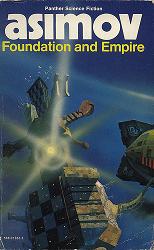
Foundation and Empire – Isaac Asimov

Cover of Foundation


Foundation and Empire
Isaac Asimov
172 pages
published in 1952

Foundation and Empire is the middle book in the Foundationtrilogy, to which no sequels were ever written and suffers a bit from being a transitional book. The trilogy had originally been written as a series of short stories, published in Astounding before being fixed-up into novel form for publication by Gnome Press in the early fifties to prove that there was a market for science fiction novels. This fixup worked well in Foundation, but Foundation and Empire could just as well been split up between the other two books. The first half follows on naturally from Foundation, while the second half is continued in Second Foundation.

As seen in the first book, Hari Seldon was a psychohistorian who predicted the fall of the Galactic Empire and set up the Foundation to help limit the period of barbarism that would follow to a mere 1,000 years, rahter thann the 30,000 it would take otherwise for a new empire to rise. Through various crisises, predicted by Seldon and manipulated by him so that there was always only one choice for the Foundation to whether the crisis, it became a regional power in the periphery of the Galaxy, second only to the old empire. Now the Foundation faces its first direct confrontation with the empire, in the last crisis Seldon predicted correctly, while the second half of Foundation and Empire tells the story of the crisis Seldon didn’t predict: the rise of the Mule.

Read more…

Seventyfive years of fabulous writers


Women? Writing science fiction? Editing science fiction? Even *gasp* reading it? Don’t let the blurb writer of Sign of the Labrys hear about it… Sandra McDonald has put together a periodic table of 117 women in science fiction, available at her website as well as a youtube video. Below is the list of featured writers, authors and others. I’ve bolded the ones I own books of, italicised, the women I’ve read something of (short stories count) and starred those I never heard of. How many of the following do you know? And who do you miss? Myself, just looking at my own books, I don’t see Liz Williams, Patricia Wrede or Josephine Saxton.

  • Andre Norton
  • C. L. Moore
  • Evangeline Walton
  • Leigh Brackett
  • Judith Merril
  • Joanna Russ
  • Margaret St. Clair
  • Katherine MacLean
  • Carol Emshwiller
  • Marion Zimmer Bradley
  • Zenna Henderson
  • Madeline L’Engle
  • Angela Carter
  • Ursula LeGuin
  • Anne McCaffrey
  • Diana Wynne Jones
  • Kit Reed
  • James Tiptree, Jr.
  • Rachel Pollack
  • Jane Yolen
  • Marta Randall
  • Eleanor Arnason
  • Ellen Asher
  • Patricia A. McKillip
  • Suzy McKee Charnas
  • Lisa Tuttle
  • Nina Kiriki Hoffman
  • Tanith Lee
  • Pamela Sargent
  • Jayge Carr
  • Vonda McIntyre
  • Octavia E. Butler
  • Kate Wilhelm
  • Chelsea Quinn Yarbro
  • Sheila Finch
  • Mary Gentle
  • *Jessia Amanda Salmonson
  • C. J. Cherryh
  • Joan D. Vinge
  • Teresa Nielsen Hayden
  • Ellen Kushner
  • Ellen Datlow
  • Nancy Kress
  • Pat Murphy
  • Lisa Goldstein
  • Elizabeth Ann Scarborough
  • *Mary Turzillo
  • Connie Willis
  • Barbara Hambly
  • Nancy Holder
  • Sheri S. Tepper
  • Melissa Scott
  • Margaret Atwood
  • Lois McMaster Bujold
  • *Jeanne Cavelos
  • Karen Joy Fowler
  • Leigh Kennedy
  • Judith Moffett
  • Rebecca Ore
  • Emma Bull
  • Pat Cadigan
  • Kathyrn Cramer
  • *Laura Mixon
  • Eileen Gunn
  • Elizabeth Hand
  • Kij Johnson
  • *Delia Sherman
  • Elizabeth Moon
  • *Michaela Roessner
  • Terri Windling
  • Sharon Lee
  • Sherwood Smith
  • Katherine Kurz
  • *Margo Lanagan
  • Laura Resnick
  • Kristine Kathryn Rusch
  • Sheila Williams
  • Farah Mendlesohn
  • Gwyneth Jones
  • *Ardath Mayhar
  • Esther Friesner
  • Debra Doyle
  • Nicola Griffith
  • Amy Thomson
  • Martha Wells
  • Catherine Asaro
  • Kate Elliott
  • Kathleen Ann Goonan
  • *Shawna McCarthy
  • Caitlin Kiernan
  • Maureen McHugh
  • Cheryl Morgan
  • *Nisi Shawl
  • Mary Doria Russell
  • Kage Baker
  • Kelly Link
  • Nancy Springer
  • J. K. Rowling
  • Nalo Hopkinson
  • Ellen Klages
  • Tanarive Due
  • M. Rickert
  • *Theodora Goss
  • *Mary Anne Mohanraj
  • S. L. Viehl
  • Jo Walton
  • Kristine Smith
  • *Deborah Layne
  • Cherie Priest
  • Wen Spencer
  • K. J. Bishop
  • *Catherynne M. Valente
  • Elizabeth Bear
  • *Ekaterina Sedia
  • Naomi Novik
  • Mary Robinette Kowal
  • Ann VanderMeer

Foundation – Isaac Asimov

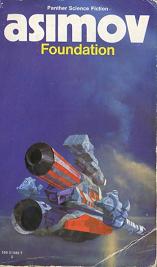
Cover of Foundation


Foundation
Isaac Asimov
189 pages
published in 1951

If you’ve ever been in the Netherlands on 30th April than you know we celebrate Queensday (the queen’s birthday party, held on the birthday of the previous queen but don’t ask) by holding massive flea markets/car boot sales. Ideal opportunities to pick up a lot of books fast and cheap. This year it included a lot of Asimov books, from a guy selling off his science fiction collection, including all the good Foundation series books: Foundation, Foundation and Empire and Second Foundation. These were orginally written as short stories in the forties, then reworked into novels in the early fifties, among the first science fiction novels to be sold as such. Much much later Asimov would write new sequels to these three books, but those were .. not good.

The originals though were, if not the first Galactic Empire stories, the ones who popularised it and set the pattern for a flood of imitators (see for example Brian Aldiss’ two anthologies, Galactic Empires volume I and volume 2). Influenced by Edward Gibbons History of the Decline and Fall of the Roman Empire, Asimov basically transplanted the Roman Empire to Outer Space and had it rule the Galaxy, a Galaxy devoid of any other intelligent life and in which it was axiomatic that humanity should be united under one emperor and ruled from one planet and anything else would be barbarism. Yes, these are all utterly clichéd and wornout concepts now, but don’t forget that this was first published in 1951 and based on stories from the forties, in other words, this is some seventy years old. You may therefore wonder if Foundation is worth reading for anything but historical value. Certainly Asimov’s reputation as a not very good writer doesn’t help — you don’t read his stories for his sparkling turn of phrase.

And yet…

Read more…

Once Upon a Time … Space


The local cable network is doing a promo for their kiddies channels package, which would not be of much interest to me, if not for one thing. One of the channels involved is repeating episodes of Er Was Eens… De Ruimte, (Once Upon a Time… Space) that was about the only proper science fiction on the telly when I grew up. I last saw this when it was first broadcast, in 1982/83, when I was already reading science fiction but Dutch television had little of interest; Battlestar Galactica was a few years ago, V would come a few years later. So it fell to an originally French cartoon series that was a sequel to a not very good series about The History of Man to fill the gap.

Which it did quite well.

Now compared to a roughly contemporary Japanese series like Gatchaman/Battle of the Planets (or Sj-force as it was also know in Holland) the animation quality was … not quite … as good and the characters somewhat on the stereotypical side (the main bad giuy actually being called “Generaal Naarling” (General nasty)), but it was also much more properly science fiction. Set some 1,000 years in the future, where a dozen or so races including humans have formed a peaceful union, the series follows the adventures of several new members of the union’s space police, as they have to deal with natural disasters as well as intrigues by the bad guys from Cassiopeia, a military dictatorship part of the union but constantly trying to gain ultimate power. The good guys are led by Omega and tend to go for peaceful solutions before grabbing for the laser.

The series lasted twentysix episodes, with the last six-seven or so forming one big story arc, featuring a new big bad manipulating Casseopia, a threat only resolved in the last episode. It was this that made the biggest impression on me, the first sustained space opera I’d seen. And what also made an impression was the music, both the opening theme as featured above, as the incidental background music, which is as burned in my memory as the Star Wars music…

Mean but accurate

Adam Roberts’ parody of Robert Jordan’s writing is mean but accurate:

Why did I fail? Oh, why did I fail to polish off wotviii this week, I thought to myself, creasing my brow and tugging my braids. Since the Age of Legends I have been reading this bu’u’ook, as the ancient bound codices were called. White streaking my beard and hair, I stroked the mindtrap upon my bedside table. I must be careful, I thought. Careful. To take care. Three different skills were in play, the ancient art of readin, the even more ancient and venerable art, of which only a few dozen in the world were true masters, of Turnian Pages, and, most difficult of all preventing the bitter, lethal brain num that inevitably pursued any man who dared to channel the antique magic of this kind of readin. It could be fatal, brain num. Fatal, it could be. I tugged my braid. The old Ar Selbow proverb came back to me: readin should be a chore, not a pleasure. I thought, oh, but I’ve read so much! To give up now would be … but I left the utterance an axe-handle short of completion. Was there room for any more? I tugged my braids. Hardly any hair left, I thought to myself. I wonder if tugging it all the time is responsible for it falling out? I wonder. I wonder.

But the parody quoted in a 1993 David Langford fanzine is more concise and just as funny, if not funnier. Which totally makes Adam’s version the more accurate, as Jordan, for all his virtues, was never adverse to use ten words when one would do, or seven sentences where two would suffice…

Adam is reading and reviewing the entire Wheel of Time series and not enjoying it much, hence the parody. He does so because, while he has read his share of epic fantasy, he’s “too ignorant of the 1990s and much of the noughties” which is why he “decided to give Jordan a whirl”. It’s been interesting to read his critiques, though not surprising that he finds Jordan hardgoing and not very good. Most honest fans of the series able to aprpeciate good writing will readily admit Jordan’s writing is not very good, workmanlike at best; much of the criticism Roberts levels at him was already talked about in rec.arts.sf.written.robert-jordan in the mid nineties. Where Adam gets it wrong is when he attempts to understand why people despite this keep reading the Wheel of Time books:

I get that for many people the deal is escape. Leave your worries behind; you enter this better world. It’s a world in which you don’t work in the accounts department of a mid-size educational supplies firm; where, instead, you live in a palace and command servants and have magic powers and enjoy exciting sex with beautiful people and are able to vent your repressed aggression in fighty-fight. Jordan’s twist on this venerable textual strategy is, partly, giving his readers much more detail than his market rivals; and partly, more cannily, creating the illusion of psychological depth. Simple wish-fulfilment gets old too soon; so Jordan’s Alexander-the-Great-alike is troubled by the fear he’s going mad. It’s not much, but it’s enough to separate him from the bulk of competitors.

[…]

And this is the part I can’t seem to get my head around: the fans know that it’s terribly written. They know and they don’t care. Why don’t they care? I don’t know why they don’t care.

[…]

What to say to such a review other than: don’t! Please don’t! The libraries of the world are crammed with beautiful, powerful, moving, mindblowing literature! Read some of that instead!

Adam gets two things wrong. Why people read The Wheel of Time when they know it’s not that good and that it’s possible to “trade in” the WoT series for better books and get the same pleasure out of it. It isn’t wish fulfillment that made me read the first book and then kept me reading: it was the story and the way Jordan told it. And I know the writing is workmanlike at best, the plot not all that original and the padding, oy, the padding! But as I said in my own review of The Eye of the World, Jordan had me hooked from that first scene. It’s not something you can really analyse and it has little to do with literay qualities: you get it or you don’t. If you don’t get it, that’s no big deal; the world is full with better books, but you can’t substitute them for the story Jordan told and the world he created.

It’s always difficult to explain why you enjoy something: in the end it all comes down to “I like it because it’s fun”. What I like in epic fantasy in general and Jordan in particular is a bit of escapism, of losing myself in a story, preferably a long story. The writing doesn’t have to be good to do this, as long as it isn’t so bad it becomes noticable. This isn’t at all comparable to the pleasure I also get from a good science fiction novel or something clever and literary; much more visceral, less intellectual perhaps. It’s also the pleasure in worldbuilding I got from Jordan, the way he which took standard fantasy concepts and remade them over the course of the series. The Encyclopedia of Fantasy agrees with me on that, noting the “ingenuity with which standard plot devices, backgrounds and charachters are subjected to constant and sophisticated modification”. That’s a pleasure that for others may not be enough to struggle through the series, or the kind of pleasure somebody like Adam is looking for, which is okay. It’s just that you can’t recreate this pleasure with a different set of books; certainly not with Nabakov…