Liking problematic writers

I don’t know when I first started reading science fiction, but it must’ve been no older than seven or eight years old, going to the library on friday evenings with my mum and browsing the children’s bookshelves (that is until, inevitably and like so many others, I’d read everything in them and went on to the adult stacks). The first books I can remember reading were by Isaac Asimov: Buy Jupiter, I, Robot and a bit later the Foundation trilogy. One of the first books I bought for myself was The End of Eternity. I read everything of Asimov I could get my hands on and thanks to his writer, got to discover Clarke and Heinlein and Bradbury and all those other sf writers I’ve read since.

One of the things that made his collections so great was how chatty he was in them, writing introductions to each story, talking about how his life was going at that time, how he got to write those stories etc. From those, especially those in his later books, I slowly got the impression he was a bit of, as he would also call himself, a dirty old man, a lecher, somebody who had an eye for the women, all those other things we’d used to call men who were a bit dodgy regarding women, a bit too randy but harmless, and really, what’s the harm in being hold down by two strangers so dear old Isaac can grab your breasts?

Now of course you always hear that you shouldn’t judge the work by the person, but the more I hear about how much of a serial harasser Asimov was, the less comfortable I become keeping his books on my shelves. Fortunately for me I can justify it for myself because a) he’s dead and b) every one of those had been bought secondhand, so it’s not like I’ve been directly given money to a harasser…

A more difficult example is Elizabeth Moon, who back in 2010 said dumb, xenophobic things about Muslims. Which was one of those things I didn’t pay a lot of attention about at the time, but since then I’ve been reading a lot of Elizabeth Moon and it worries me now. Partially because, you know, I’d rather not give money to wingnuts if I can avoid it but also because that sort of politics has a tendency to bleed into a writer’s novels. Case in point: Dan Simmons.

Luckily again, Moon seems to have behaved since that outburst and so far her politics, as far as they appear in her novels may be on the conservative side, but nowhere near wingnut territory. Therefore I can justify keeping her books, which is a good thing, as I like them. unlike say Orson Scott Card, who has awful politics and who doesn’t write books anymore I like anyway. For the most part I’ve been lucky that the writers I like aren’t arseholes and those that are I don’t like.
Hugo Awards: Editors and Retro Hugos

So I’ve said before that I wasn’t sure if I was going to vote for the editor awards. I’ve ended up not doing so for a couple of reasons, mainly because I haven’t the faintest what makes for a good editor and I would mean largely voting by name recognition. Even with the stories/novels provided in the voters package it’s hard to say how much or how little the editor mattered for the success of them.

The Retro Hugos on the other hand I did vote in, though only in the fiction and artist categories.I know too little about the fan categories to make an educated choice there:

Best novel:

  1. The Sword in the Stone by T. H. White (Collins)
  2. The Legion of Time by Jack Williamson (Astounding Science-Fiction, July 1938)
  3. Galactic Patrol by E. E. Smith (Astounding Stories, February 1938)
  4. Carson of Venus by Edgar Rice Burroughs (Argosy, February 1938)
  5. Out of the Silent Planet by C. S. Lewis (The Bodley Head)

Best novella:

  1. “Who Goes There?” by Don A Stuart [John W. Campbell] (Astounding Science-Fiction, August 1938)
  2. “The Time Trap” by Henry Kuttner (Marvel Science Stories, November 1938)
  3. “A Matter of Form” by H. L. Gold (Astounding Science-Fiction, December 1938)
  4. “Sleepers of Mars” by John Beynon [John Wyndham] (Tales of Wonder, March 1938)
  5. No Award

Best novelette:

  1. “Werewoman” by C. L. Moore (Leaves #2, Winter 1938)
  2. “Pigeons From Hell” by Robert E. Howard (Weird Tales, May 1938)
  3. “Hollywood on the Moon” by Henry Kuttner (Thrilling Wonder Stories, April 1938)
  4. “Dead Knowledge” by Don A. Stuart [John W. Campbell] (Astounding Stories, January 1938)
  5. “Rule 18” by Clifford D. Simak (Astounding Science-Fiction, July 1938)

Best short story:

  1. “How We Went to Mars” by Arthur C. Clarke (Amateur Science Stories, March 1938)
  2. “Hyperpilosity” by L. Sprague de Camp (Astounding Science-Fiction, April 1938)
  3. “Hollerbochen’s Dilemma” by Ray Bradbury (Imagination!, January 1938)
  4. “The Faithful” by Lester del Rey (Astounding Science-Fiction, April 1938)
  5. “Helen O’Loy” by Lester del Rey (Astounding Science-Fiction, December 1938)

Ubermawkish, sexist “Helen O’Loy” better not win.

Best Professional Artist

  1. Virgil Finlay
  2. Alex Schomburg
  3. Frank R. Paul
  4. Margaret Brundage
  5. H. W. Wesso

Damn, there were some great artists doing sf and fantasy illustrion back then. Any of them is a worthy winner.

Hugo Awards: Best Novella

The last major fiction award I still need to talk about: the best novella. A bit of a mixed bag this category, with stories that are in that awkward stage halfway between novel and short story. Indeed, at least one could’ve been published as a short novel in its own right. As with some other categories, the two struck through candidates I haven’t considered due to reasons described in my first post.

To be honest, the remaining three stories were good but not spectacularly so, not nearly as good as some of the entries in the short story and novelette categories.

  1. Six-Gun Snow White by Catherynne M. Valente (Subterranean Press)
    As the title indicates, this is a Wild West retelling of the Snow White fairy tale. Well done.
  2. “Wakulla Springs” by Andy Duncan and Ellen Klages (Tor.com, 10-2013)
    This is a great story about several generations of an African-American family living near the lake used to film Tarzan movies and the Creature from the Black Lagoon, but the fantastical element is minimal.
  3. “Equoid” by Charles Stross (Tor.com, 09-2013)
    A typically fun, manic Laundry story about unicorns.
  4. The Butcher of Khardov by Dan Wells (Privateer Press)
  5. “The Chaplain’s Legacy” by Brad Torgersen (Analog, Jul-Aug 2013)

Hugo Awards: Best related work

This was a relatively easy category to decide upon, though since it contains one blog post/essay, a podcast and three books, also one of the more confusing ones. My final vote was as follows:

  1. “We Have Always Fought: Challenging the Women, Cattle and Slaves Narrative” by Kameron Hurley (A Dribble of Ink): a great essay and an important essay, which is why it gets the nod over everything else.
  2. Queers Dig Time Lords: A Celebration of Doctor Who by the LGBTQ Fans Who Love It Edited by Sigrid Ellis & Michael Damian Thomas (Mad Norwegian Press): I’m not that interested in Doctor Who or its fandom, but this is a good book to show that at least some corners of speculative fiction indeed can be and are of special interest to queer people.
  3. Speculative Fiction 2012: The Best Online Reviews, Essays and Commentary by Justin Landon & Jared Shurin (Jurassic London): would’ve finished higher if they’d asked me to contribute, but they didn’t, so feck them.
  4. Writing Excuses Season 8 by Brandon Sanderson, Dan Wells, Mary Robinette Kowal, Howard Tayler, and Jordan Sanderson: a decent enough podcast but no more than that.
  5. Wonderbook: The Illustrated Guide to Creating Imaginative Fiction by Jeff VanderMeer, with Jeremy Zerfoss (Abrams Image): This was not for me.

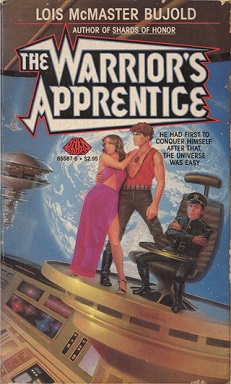
The Warrior’s Apprentice — Lois McMaster Bujold

Cover of The Warrior's Apprentice


The Warrior’s Apprentice
Lois McMaster Bujold
315 pages
published in 1986

As you probably know, Bob, The Warrior’s Apprentice is the second novel in the Vorkosigan Saga series of mil-sf adventures and came out in the same year as the first, Shards of Honor. Whereas that book starred Miles parents, this is the introduction of Miles Vorkosigan, the just under five foot crippled before birth by a neurotoxin attack on his mother, insanely charismatic, insanely hyperactive military genius who, at the start of the novel is trying to make it through the eliminations for officer candidacy in the Barrayaran Imperial Military Service. The written exam is no problem; it’s the physical tests that are a challenge for somebody who could break his bones just by sitting down hard.

His strategy is to take it slow and careful, but being seventeen he lets himself get goaded by one of his fellow candidates, takes an unnecessary risk and breaks his legs, with it shattering his chances to get into the military. Worse than his own disappointment is his grandfather’s, the liberator of Barrayar of the Cetegendans, who dies the next night — Miles convinced he killed him by breaking his heart. In his despair and sorry he’s glad to get away from Barrayar and, because of the political situation his father too would like to see him visit his mother’s family on Beta Colony, a nicely civilised part of the galaxy where aristocratic notions of honour are held for the anachronisms they are. He doesn’t travel alone; his bodyguard, sergeant Bothari, of course has to travel with him and he manages to persuade his mother to ask Bothari’s daughter, Elena, to come with him as well. He’s of course half in love with her and thinks a trip to another planet and perhaps the chance to learn more of Elena’s long dead mother, would get him into her good graces. Yes, Miles is somewhat of a nice guy but trust me, he grows out of it.

Read more…