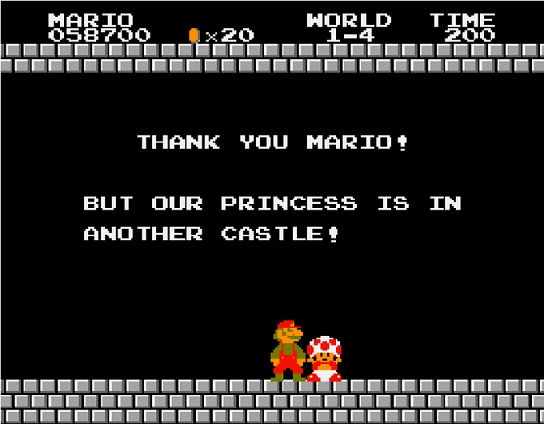
I’m sorry Mario, your harasser is in another castle

Thank you Mario! But our princess is in another castle!

Following on from this post, if we do want to change as fandom, want to make cons safe, what should we be doing? For a start of course cons need to do what Readercon and then Wiscon failed to do: not allow a known harasser back next year. Cons need not just a consistent, thought out policy against harassment, they also need to make it known to concom, volunteers and members alike and make sure that any incidents and harassers are known to next year’s concom and volunteers as well.

The key point to remember is that if a con doesn’t prevent know harassers from attending, it means excluding or even endangering their victims; while it may be harsh on a harasser to be ejected and banned, it’s much harsher to subject victims to potential new harassment. The other thing to remember is that for every victim of a harasser that comes forward, there are usually more who don’t for various reasons, especially in a climate where until very recently harassment wasn’t taken seriously.

But there’s a larger problem. Even if every con has its harassment policy and bans harassers, it of course won’t help much if they can just amble along to the next con to menace fresh victims. That’s the silo problem, where each con knows who their problem cases are, but the cons aren’t sharing that information. There therefore need to be some way to share information. You can’t rely on informal networks, as Deirdre Saoirse Moen’s comment on the previous post shows, because there will always be people and cons left out of it.

So there needs to be more formal ways of cons to inform each other about harassers, as well as its own members, volunteers and concom. This doesn’t necessarily mean making this information public, but there are back channels for con “professionals” where this sort of exchange could happen. We need to get this in place sooner rather than later, to avoid harassers just choosing new cons to trawl.

Conspiracy of silence: fandom and Marion Zimmer Bradley

Last year, in a post about that year’s harassment scandal at Wiscon Natalie Luhrs wrote:

I’ve also seen a handful of posts about how, at science fiction conventions, women will work together to let each other know who the serial harassers and creepers are. I find this extremely interesting because I have never been warned about anyone at any of the conventions I’ve attended.

Which I had to think about when reading about the revelations of Marion Zimmer Bradley’s (sexual) abuse of her daughter. It had been public knowledge since at least 2000 that MZB had enabled her husband, Walter Breen’s abuse, who would ultimately be convicted of it, but that she herself was abusive was news to me and a lot of other science fiction fans. The question is, as Agent Mimi put it why didn’t we know earlier, when all the evidence had been there. Why indeed did it take until MZB was dead for her covering for convicted abuser Walter Breen to become public knowledge and not just whispered amongst in the know fans. Why in fact was Breen allowed to remain in fandom, being able to groom new victims?

Breen after all was first convicted in 1954, yet could carry out his grooming almost unhindered at sf cons until the late nineties. And when the 1964 Worldcon did ban him, a large part of fandom got very upset at them for doing so. In the years and decades since, those who knew about Breen and MZB kept schtum and if you weren’t in the know, you didn’t get to know until Stephen Goldin put up the court documents.

But even after this, fandom hasn’t been open, hasn’t been willing to draw lessons from this horrible history, still by and large thinks it’s better to leave molestors in peace than to risk excluding people, is willing to stay silent. What MZB and Breen did and why they did it in fandom is the logical result of a culture that tolerated Asimov’s butt pinching, Randall Garrett’s propositioning or Harlan Ellison groping Connie Willis.

There’s a culture of harassment in fandom, mostly of women by men, which fandom has known about and tolerated (or evne actively encouraged) for decades, where those women lucky enough to have the connections were warned against those know to be harassers (everybody knew Jim Frenkel was one of them, but nobody was willing or felt able to say so out loud until Elise Matthesen did so. Because of that culture of silence, those who do get harassed, often those without the network, new to fandom or for some reason an outsider, feel they’re the only ones to have suffered and are less likely to report it, justifiably thinking that they won’t be taken seriously if they do report being harassed by somebody famous.

The “new” revelations about Marion Zimmer Bradley’s own actiosn therefore should serve as a wakeup call to fandom, not only to take harassment seriously, develop policies about it, but also to be honest and open about its (our) own history, acknowledge that we do have a problem providing safe spaces for everybody and that we need to change that.

Peacekeeper — Laura E. Reeves

Cover of Peacekeeper


Peacekeeper
Laura E. Reeves
324 pages
published in 2008

Peacekeeper is the sort of novel you pick up knowing full well it’s probably not going to be very good, but hopefully will be entertaining. It helps, if like me, you have a bit of a weakness for military science fiction and are willing to lower your standards. Once you’ve voluntarily read David Weber’s Honor Harrington series the chances are you’ll read most anything. And, to be honest, Peacekeeper wasn’t that bad. Very much the first novel in a trilogy, but decently paced and competently written. I’m not sure I’ll go out of my way to read the sequels, but wouldn’t pass them up either If I came across them.

Ariane Kedros is the pilot of the scout ship Aether’s Touch, which she runs together with her employer Matt Journey. She’s also a reserve major int he military of the Consortium of Autonomous Worlds, which has just fought a brutal war with the Terran Expansion League, until strong hints from the Minoans — the aliens who had uplifted humanity into space and faster than light travel — put both parties at the negotiating table. Though nobody but Ariane’s superior, colonel Owen Edonus of the Directorate of intelligence, knows, in the eyes of the Terrans she’s also a war criminal, having piloted the ship that destroyed an entire solar system using temporal distortian weapons. As part of the peace treaty both sides will have to stand down and destroy said weapons and colonel Edonus has tapped Ariane to be part of the team that will escort a Terran inspection team at one of the CAW’s facilities. He of course has a hidden motive for this: somebody is killing off the people involved in the mission that made Ariane a war criminal and she’s put out as bait…

read more…

Africa is a country — special SF edition

What struck me about Mike Resnick’s defence of being guaranteed a place in a proposed anthology about “alien encounters” that boasted about its dedication to diversity…

For the record, I have been to Africa 6 times on prolonged trips, I have won 4 Hugos for stories about Africa and have been nominated for 8 more, and my knowledge of the Kikuyu and Maasai peoples has been praised by Kenyan office holders. Are you suggesting that I -shouldn’t- write about Africa, or perhaps that no right-thinking editor should buy them?

… is the idea that having won Hugo awards for stories set in Africa is evidence that said stories treated Africa with respect and weren’t stereotyped, reductive or orientalist. I mean these are the same awards as voted on by American fans so unwilling to travel outside their own country they hold a special con on the rare occassions Worldcon moves outside the US, aren’t they? What makes these people knowledgeable about Africa?

Also, the idea that visiting a continent a couple of times makes you an expert, or that a (presumed) expertise on two Kenyan peoples makes you an expert on Africa as a whole or even the simple fact that Resnick’s stories about these peoples are labeled as “African” and discussed as such? Not helping his case.

Now personally I would prefer it if Resnick wouldn’t write at all, as he’s dull as dishwater and a godawful writer regardless of whether or not he gets “Africa” (sic) right, but nobody has actually been arguing he shouldn’t write about Africa or not get his stories published, just that, you know, to privilege an American writer over actual African science fiction writers like say, Nnedi Okorafor (who has just written a whole novel about alien encounters set in Lagos) isn’t actually being that committed to finding a greater diversity.

(For a more indepth look at why this anthology is problematic, Charles Tan and Natalie Luhrs have all the gory details.)

Too right

N. K. Jemisin’s guest of honour speech at Wiscon:

Arm yourselves. Go to panels at Wiscon and claim the knowledge and language that will be your weapons. Go to sources of additional knowledge for fresh ammunition — histories and analyses of the genre by people who see beyond the status quo, our genre elders, new sources of knowledge like “revisionist” scholarship instead of the bullshit we all learned in school. Find support groups of like-minded souls; these are your comrades-in-arms, and you will need their strength. Don’t try to do this alone. When you’re injured, seek help; I’ve got a great list of CBT therapists, for any of you in the New York area. Exercise to stay strong, if you can; defend what health you have, if you can’t. And from here on, wherever you see bigotry in the genre? Attack it. Don’t wait for it to come directly at you; attack it even if it’s hitting another group. If you won’t ride or die for anyone else, how can you expect them to ride or die for you? Understand that there are people in this genre who hate you, and who do not want you here, and who will hurt you if they can. Do not tolerate their intolerance. Don’t be “fair and balanced.” Tell them they’re unwelcome. Make them uncomfortable. Shout them down. Kick them out. Fucking fight.