Yeah, this needed to be made.
science fiction
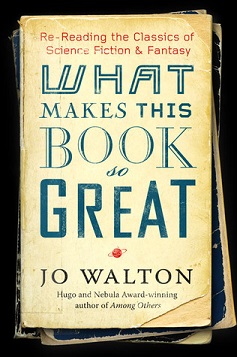
What Makes this Book So Great — Jo Walton
What Makes this Book So Great
Jo Walton
446 pages
published in 2014
What Makes this Book So Great is that it’s written by Jo Walton, who has a real talent for making you both reconsider books you know well or long for books you’ve never heard of before. I’ve known Jo for almost twenty years now, from when we both independently discovered internet, usenet and rec.arts.sf.written, where it didn’t take long for her to become one of the most interesting posters there. It was no great surprise that she became a professional writer, or that Tor would ask her to do the same thing she did on usenet on their website, the end result of which is this book. You could call it the non-fiction counterpart of Jo’s Hugo and Nebula award winning Among Others
What this is than is a collection of some 130 columns written for tor.com in 2008-2010, mostly discussing a single book, sometimes going into more general topics about reading books. As Jo makes clear from the start, she isn’t a critic and she’s not reviewing these books, she’s just writing about the books she’s reading and why she likes them. Because she’s been reading for a long time, because she’s a writer herself, because she’s been thinking and talking about books, about science fiction in the ways only an intelligent lifelong reader can, these columns are interesting whether or not you’ve read the books in question.
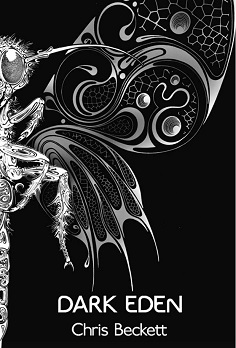
Dark Eden — Chris Beckett
Dark Eden
Chris Beckett
404 pages
published in 2012
Dark Eden won the 2013 Arthur C. Clarke Award and was also a finalist for the BSFA Award, which is why I got it from the library when I saw it there. It won against fairly stiff competition like Ken MacLeod’s Intrusion as well, so I was curious to see if it was worthy of the win. To be honest, I was slightly disappointed. This isn’t a bad novel, but it’s a bit on the slight side for my liking.
To start with the positives, the world Beckett depicts in Dark Eden, a planet far out in interstellar space, a rogue wanderer without a sun, with life only possible through the presence of geothermal energy, which the local lifeforms have evolved to make use off one way or another. Trees grow out of the heat channels running from the planet’s core, the basis for a complex ecology that luckily for the people that crashed into Eden, turns out to be compatible with human life. Five people landed on Eden, three people decided to try and leave again, two remained behind and started a family. Twohundred years later their descendants number roughly fivehundred, still living in the same valley their ancestors landed in, having degenerated into hunter gatherers, losing most skills and knowledge of their ancestors in the process.
Future so strange shades do nothing
So Mike linked to this yesterday, a remake of a 1955 Tom and Jerry cartoon featuring characters from a Japanese cult series of videogames, made through software originally developed for a virtual popstar.The actual future we’re living in is making people like Sterling, Cadigan, Stephenson or Stross look like pikers, isn’t it?
who chooses our required reading? We do
Ever since I read S. L. Huang’ post on who chooses sf classics I’ve been thinking about this:
I don’t understand how we can have a genre where “You haven’t read HEINLEIN (/Asimov/Clarke/Bradbury/Dick/etc.)??” are common and accepted refrains, and “You haven’t read BUTLER??” is almost unheard. Why aren’t we saying it? Why isn’t Octavia Butler considered “required reading” of the classics in order to consider oneself a True SF Fan? Why don’t people feel left out and incomplete if they haven’t read her?
I don’t really know what defines a classic, or who should get to say what one is. But I do know I find myself feeling deeply uncomfortable with any popular mentality that shames people for not reading influential white men while giving a pass to those who skip the influential black women.
Now ideally, as Damon Knight put it, “science fiction is that what we say it is when we point at it”, meaning that it’s an ongoing debate between writers, editors, publishers, critics, readers and fans that determines what the core of the genre is. Put simply, books that are written as science fiction, accepted by publishers as part of a science fiction line, reviewed as such and talked about as science fiction, are science fiction. And vice versa; The Handmaid’s Tale clearly is science fiction, but because Margaret Atwood has taken pains to deny this, it was published by a mainstream publisher and treated by critics as literature rather than sci-fi, it’s not part of science fiction in the same way “If This Goes On…” is.
Clearly if there is such a thing as a science fiction canon, a core group of novels, stories and writers that you should’ve read to be knowledgeable about science fiction, it should be determined in the same way, ever changing and evolving as science fiction changes and evolves, and yet it hasn’t much evolved beyond the holy “Heinlein/Clarke/Asimov” trinity and their fellow mostly male, mostly white, mostly dead Golden Age collegues. Why?
I blame it on the seventies.
The seventies was a watershed moment for (English language) science fiction. The genre as a genre was roughly half a century old and those who had grown up with it in the thirties, forties and fifties were now old enough to be nostalgic about it. Science fiction had grown up from paraliterature only found in cheap pulps into something halfway into respectability, for the first time getting sustained critical attention from outside of fandom. It was popular, but would only truly become mainstream in the wake of Star Wars and it was still barely possible in the early to mid seventies to read every science fiction book published in a given year. The seventies were also the decade where the centre of the genre switched from the magazines to the novel, with novels getting longer as they no longer needed to take into account serialisation.
Finally, there was also the backlash against the upheavals science fiction went through in the sixties and seventies. First there was the British New Wave, where writers like Aldiss, Ballard and Moorcock imported literary techniques into science fiction, which was exported by Judith Merril to the US leading to the American version, more explicitly taboo breaking and political, through Delany, Dick, Russ and LeGuin, to name but a few, which resulted in a new revelance in science fiction, a willingness to engage with the political, sociological and ecological issues of the day. For a lot of science fiction professionals and fans alike, these were not welcome developments and there was a strong, nostalgic backlash against it.
It’s in this climate that the science fiction “canon” got established, through a flood of popular histories and coffee table books, like Brian Ash’ The Visual Encyclopedia of Science Fiction or David Kyle’s A Pictoral History of Science Fiction, as well as through publishing programmes like Ballantines/Del Rey’s The Best of… series, reprinting short stories by the best science fiction writers of the Golden Age. The rough consensus therefore that emerged was conservative and nostalgic in nature, created by people who’d themselves been around science fiction for decades, well read and knowledgeable about it, but perhaps somewhat blinkered to everything that falls outside it.
We’re still living with that consensus, that canon, forty years later; it’s high time we re-evaluate it.