Trading in Danger — Elizabeth Moon

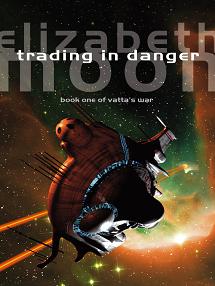
cover of Trading in Danger


Trading in Danger
Elizabeth Moon
506 pages
published in 2003

Reading Sheepfarmer’s Daughter gave me a taste for more Elizabeth Moon. Trading in Danger, the first book in the Vatta’s War series was what the local library had available. It’s science fiction rather than fantasy, but it’ll do. It’s still the same sort of adventure story even if the genre has changed. The other thing they have in common is familiarity, both are coming of age stories with few surprises, but sometimes familiarity is just what you want in a story.

Ky Vatta is a cadet at the naval Academy, an unusual career choice for a child of one of the great trading families. She’s an examplary cadet, but this doesn’t save her when an impulse to help a fellow cadet lands her in the shit. Expelled from the academy, she now has to face her family. Worse, because it’s a highly politicised mess she found herself in, she also has to leave Slotter Key, her home planet. Worst of all, the reputation she has in her family as a sucker for anybody with a sob story is once again confirmed, in the worst possible way. The solution to all her problems lies in an old Vatta family tradition, that sends any child wanting to join the family trade on a shakedown cruise first. She will captain the Glennys Jones, an old trading ship on its last voyage which will be sold as salvage at the end of it, as it’s too expensive to bring up to modern standards. This trading trip will take a couple of months and at the end of it Ky will be able to come home, having proven herself as a captain. As importantly, it will also get her away from her own humiliation.
Read more…

The one thing more predictable than dreadful Hugo Award winners…

…is the griping afterwards. Yes, I know, I know, I do it too. Nothing more fun for an old fashioned science fiction fan than having an old fashioned grumble, especially if you’re a British fan and can cast aspersions at the abysmal taste of the yanks. It doesn’t solve anything of course, but it gets rid of some frustration.

In defence of the Hugos is the idea that, if you want to change them, you can, if you’re prepared to pay to play. To vote for the Hugos you need to be at least a supporting member of this year’s Worldcon, which is a fifty dollar or so outlay, a small price to pay for people so upset by the bland mediocrity of the main Hugo awards, isn’t it?

A bit unfair perhaps and I’m not found of the idea that you can’t criticise anything if you’re not prepared to help make things better — else I would’ve been obligated to help make the War on Iraq better too. But I can’t help but think that some of the complaints are more sour grapes than constructive criticism.

What we need to keep in mind and I’ll keep repeating until everybody is sick of it, is that the sort of fans who do faithfully vote for the Hugos are a distinct subset of fandom, less likely to be involved online, more interested in old skool fanac like conventions and zines than blogging or twittering. They have their own standards and tastes and they don’t necessarily overlap with the tastes of bloggers. Had that been the case, Connie Willis would not have won the Best Novel Hugo again and James Nicoll had won the best fan writer award.

The tragedy of the Hugos is that once upon a time the type of fandom that it represents was all of fandom, therefore the kind of people voting for the Hugos was the same as the kind of people who read science fiction, their tastes fairly well representative of fandom as a whole. But fandom got bigger while the Hugos stagnated, which in my opinion started to happen from the mid-eighties. The end result three decades later is an award that still got its prestige, but lost its relevance.

Don’t worry too much about it therefore, unless you like to restore it to its former glory. In which case buy that membership and start campaigning.

Golden Witchbreed – Mary Gentle

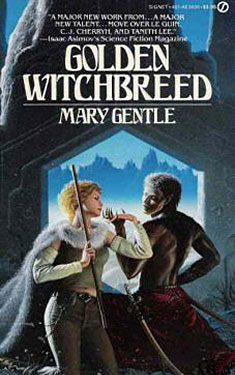
Cover of Golden Witchbreed


Golden Witchbreed
Mary Gentle
460 pages
published in 1983

It was the beautiful Rowena cover that got my attention, a long long time ago when I was browsing the English shelves at my hometown’s library. Showing a blonde woman in jeans and fur cape, armed with a stave and linking fingers with an obviously alien six fingered man, two swords at his side. That intriqued me, it promised both adventure and romance and it got me to pick up the book and that was how I got to know Mary Gentle. I’m not sure how old I was, but I must’ve been no older than sixteen-seventeen and Golden Witchbreed was arguably the best novel of hers I could’ve started with, much more easier to get into than most of her novels would turn out to be. But though I loved it when I read it and remember it fondly, I haven’t read it since. Which was why I put it on the list for my Year of Reading Women project. I wanted to know if the book I remember was still as good as I remember.

Golden Witchbreed I remembered as a planetary romance, emphasis on romance. It starts with the cover with the two lovers holding hands. The woman on the left Lynne de Lisle Christie, envoy from Earth to the primitive, medievaloid world of Orthe, there to represent both Earth to the Ortheans and to judge Orthe on its fitness to trade and partner with. The Orthean she holds hands with therefore should be her alien lover, Falkyr. I remembered their romance as central to the plot, the circumstances in which it took place ultimately forcing Christie to go on the run and having to travel through most of the civilised lands of Orthe. Apart from that recollections were hazy.

Read more…

UFO (Enemy Unknown)


Found at James Nicoll’s, the title sequence of the old Gerry & Sylvia Anderson live action series UFO. Three years ago Brad Hicks called this his favourite retro future, which was when I first heard about it. UFO is one of those series that, if you didn’t catch it when it was first aired, you’ll never know about and I was much too young (or even born) to do that. Since then I have managed to watch some episodes and seeing this title sequence reminded me of how much it resembles a similarly named classic computer game, UFO: Enemy Unknown. So much so the 1971 television series has to have been an inspiration for the 1994 video game; which the Wikipedia entry indeed says it was.

UFO: Enemy Unknown is one of the best games I’ve ever played and one of the few that actually scared me. A combination of strategy/god game and tactical squad combat, the player is the leader of the X-Com organisation defending Earth against UFO attack, having to set up bases and manage funds to equip his squads, improve weapons and ships and do research. Once an UFO is signaled you can try to intercept it and if you do you can send a squad to capture it and capture or kill any aliens it carries. There are also alien infestations you may need to combat etc. It had relatively good graphics and decent, atmospheric sound effects for a mid-nineties game.

It was when you went to actually fight the aliens that the game got scary. You could only see what was directly in your line of sight, especially in night missions you had little visibility and at literally ever corner some alien menace could hide. Add the music and sound effects, which though synthesiser based were quite spooky, then play late at night with the lights off not to wake anybody up and it could make you jump when you turned a corner and some nasty mo-fo was waiting for you…

I remember one time I had loaded my squad on a Shuttle, which had landed on the site of an UFO crash, I had moved my first soldier out, who had been armed with a grenade launcher, moved out the second one, then some alien fscker psionically possessed that first soldier and got her to launch a grenade right into the shuttle. Whoops, that was the squad gone…

Shorter me: I really should dig out my copy of this game again…

Book loot

Books bought yesterday, top to bottom:

bunch of books

The Dancers of Noyo — Margaret St. Clair
City of Illusions — Ursula Le Guin
The Dolphins of Altair — Margaret St. Clair
A Heroine of the World — Tanith Lee
Needle in a Timestack — Robert Silverberg
Planet Run — Keith Laumer & Gordon Dickson
Courtship Rite — Donald Kingsbury
The Martian Inca — Ian Watson

The last one I got because of Adam Roberts’ reviews of Ian Watson’s books over at Punkadiddle. Watson is one of those writers I read a lot of when younger just because the local library had so many of his books, then sort of lost sight of afterwards. The same goes for Tanith Lee. The Le Guin I had a long long time in Dutch, but never read as far as I know. One of her early works.

Margaret St. Clair is a writer who has been largely forgotten it seems like; what I’ve read of her I liked. I also got these books to review for Ian Sale’s SF Mistressworks site.

Finally I buy anything Silverberg or Laumer has done, though with the latter everything after 1971 or so isn’t very good. Sadly Laumer got a stroke that year, lost most of his writing abilities and never was the same afterwards. he had to keep on writing though to pay the bills, but that doesn’t mean you should buy them…