Exhume to consume

The good people of Crooked Timber are debating the replacement of human labour with machines as if the great robotisation/computerisation debates of the late sixties up to the mid-eighties never happened, nor for that fact the original industrial revolution, as if this has never happened before. But never mind that, at least Henry Farrell managed to get science fiction into the debate which in turn reminded me of Frederik Pohl’s great 1957 novella, “The Midas Plague”:

Frederik Pohl’s Midas Plague Equilibrium under which robots produce consumer goods so cheaply that they flood society, and lead the government to introduce consumption quotas, under which the proles are obliged to consume extravagant amounts so as to use the goods up (the technocrats fear that any effort to tinker to the system will risk reverting to the old order of generalized scarcity). This is a world of conspicuous non-consumption in which the more elevated one’s social position the less possessions one is obliged to have. Crisis is averted when the hero realizes that robots can be adjusted so that they want to consume too, hence easing the burden.

Frederik Pohl is a writer whose heart has always been on the left, having been a card carrying communist before World War II and the Hitler-Stalin pact, remaining a socialist/leftist afterwards, something that has always remained visible in his writing, both his solo work and his collaborations with C. M. Kornbluth in the 1950ties. Their novels The Space Merchants and Gladiator-At-Law are sharp social satires of aspects of 1950ties capitalism projected towards extremes, still relevant and recognisable today. The same goes for “The Midas Plague”. The idea of a world no longer defined by material scarcity is an old one in science fiction, from Iain Banks and his Culture novels all the way back to –as Henry’s post alluded to — E. M. Forster’s The Machine Stops. Where “The Midas Plague” differs from most other examples is that it does not show an utopia, false or otherwise, but a still recognisable capitalist society.

McMansions

It just flips the parameters of our own capitalist society: rich people live simple lives unencumbered by materialist possessions and get to enjoy the challenges of meaningful work, poor people are burdened by mountains of disposable consumer goods, having to spent more time using them up than doing any real work, spurred on by government rationing rather than advertising. The absurdity of this situation, in which ghettos consist of sixtyroom houses in a riot of loud, extravagant styles and poor people are forced to use up seven cars a year and dozens of suits a month makes clear the absurdities of real existing capitalism. The end result, of robots making an endless stream of consumables for other robots to wear out to make more consumables is the perfect endgame of capitalism.

And Pohl’s imagination is actually closer to our own reality than we might care to contemplate. We have after all a middle class that has loaded itself with debt to be able to afford the American dream of the big mansion, two point one cars, HDTV in every room and vacations in Europe, that lives a life that could be mistaken for that of a rich person, but is completely depend on keeping one step ahead of the next credit card payment. Meanwhile there are people genuinely making the argument that because poor people can afford colour televisions and Ipods they are no longer poor, even if they’re living in one bedroom apartments in suburban slums three hours away by bus from their lower than minimum wage job and working three of those to feed their children.

“The Midas Plague” cuts to the heart of that by showing that just having more and more possessions to use up does not make one rich or ruling class if you don’t actually have the power to accompany your “wealth”.
Absorption — John Meaney

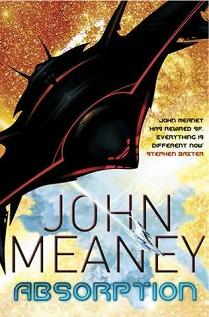
Cover of Absorption


Absorption
John Meaney
407 pages
published in 2010

Absorption is the first volume in John Meaney’s new Ragnarok trilogy. It seems to be set in the same future as most of his novels, from his first book To Hold Infinity onwards, have been set. You don’t need to have read those to understand this book, but if you have you’ll know roughly what to expect and will get certain references quicker than a new reader would. In general however it is enough to know that John Meaney is of the same generation of British writers like Richard Morgan, Alastair Reynolds and Neal Asher and writes the same sort of widescreen “hard space opera”, though a bit more cyberpunky.

But Absorption is more than just another space opera novel. You could in fact say that this is not science fiction at all, but fantasy dressed up as space opera. Because while one of the three main storylines is set in Meaney’s standard future of Mu-space pilots with jet black eyes and the computer upgraded Luculenti upperclasses of Fulgor around 2603 AD, the two other storylines are set in 777 AD and 1926 AD and both feature things that look a lot like magic… And with flashes of an even father future in which the main characters of all three storylines meet, as well as hints of magic in the main future storyline as well, who knows what’s really going on?

Read more…

Where the 2011 Clarke Award went wrong

Torque Control has posted the shortlist for the 2011 Arthur C. Clarke Award:

  • Zoo City – Lauren Beukes (Angry Robot)
  • The Dervish House – Ian McDonald (Gollancz)
  • Monsters of Men – Patrick Ness (Walker Books)
  • Generosity – Richard Powers (Atlantic Books)
  • Declare – Tim Powers (Corvus)
  • Lightborn – Tricia Sullivan (Orbit)

I have a problem with it.

The Clarke Award, for best science fiction novel published for the first time in the UK in the previous year, had fiftyfour submissions this time. I’ve read exactly six of them and not one of them is on the shortlist, though The Dervish House is on my to be read pile. But that’s not what bothers me: perhaps if I had read all fiftyfour submissions I would’ve come to the same conclusions as the jury has made. The problem I have is not with the list as a whole, but with one particular entry: Tim Powers’ Declare.

Not with the book itself, but with the fact that it was first published in the US in 2001. So what’s it doing on an Clarke Award shortlist a decade later?

Well, it was never published in the UK until last year, which is why it was eligible. But that doesn’t mean it should be put on the shortlist. Because doing so means that the jury thought a decade old novel was superior to all but four of the fiftyfour novels submitted, that the best British science fiction publishing can do is to republish old US sf novels.

Which can’t have been the jury’s intent, can it?

Unbearable whiteness of British science fiction

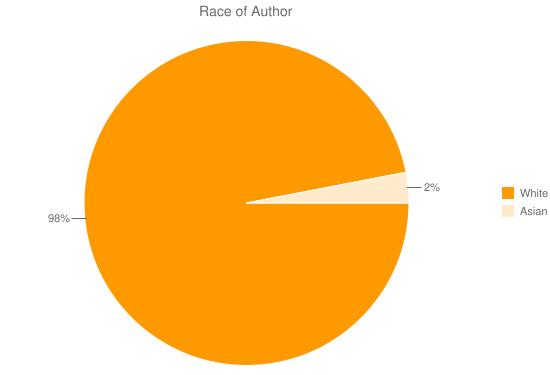
Pie chart depicting the race of 2011 Clarke Award submissions

Everything is Nice has some nice, juicy posts up analysing the eligible submissions for the 2011 Clarke Award. The Clarke Award is awarded annually for the best science fiction (or fantasy) novel published in the UK the previous year. It doesn’t have a long list but a short list is selected from all submitted novels; those submissions cover roughly 90-95 percent or so of new sf&f novels being published in the UK each year. Some works of course always slip through the crack, especially from non-sf publishers who don’t know or care about the awards. The Clarke Award submissions list than is a good, but not perfect indicator of the state of the UK’s sf publishing industry and as such Martin Lewis has analysed them, which resulted in e.g. the figure above.

In other words: sf publishing is only marginally less white than the group of writers the BBC thinks represents the future of British literary fiction. And worse, it has a much bigger gender imbalance: only 17 percent of the 54 novels submitted this year were written by women. Martin also looks at other identity markers (sexuality, nationality) and it all points to the conclusion that it’s largely straight, white British or American men that were published last year. (The raw data for all this can be found at Torque Control. )

The questions this inevitably puts to mind are a) is this analysis reliable when applied to the general state of the UK’s sf&f publishing industry as opposed to just the Clarke Award submissions b) is this a bad thing (imo: yes) and c) what can we do about it?

Assuming the answer to a) and b) are both yes, the question what we readers can do to change this situation is a difficult one to answer. You can only buy what’s being published after all and if only two books out of fifty-plus are by people of colour, how big an impact will it have when enough people buy their books? It’s easier to send a signal by boycotting a given company’s products, not so easy to express a preference through your buying habits. More projects and media attention to under represented people in science fiction as with the various “women sf writers” reading projects started this year would be a start, but are only suited to provide attention to this problem, not solve it. Suggestions?

Marvano’s The Forever War — Friday’s Funnies

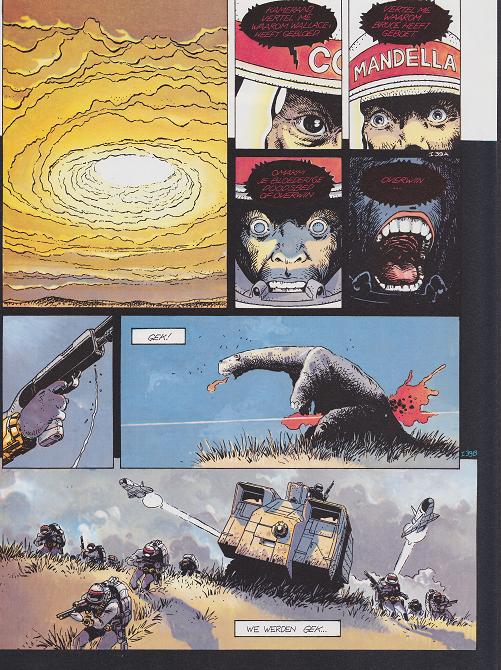
page from the Marvano adaptation of the Forever War

The first time I read Joe Haldeman’s The Forever War, it was in comics form, as a three part adaptation by Belgian writer/artist Marvano. The Forever War was Haldeman’s science fictional treatment of what he went through in the Vietnam War and was originally published in 1974; Marvano’s adaptation came out in 1988, a decade and a half later, yet it fitted the eighties like a glove. As he said in his foreword, what with the Falklands War, Grenada, Reagan talking about winning a nuclear war, a wave of right and leftwing terrorism paralysing Belgium and so on, it still seemed relevant. It seems so today too.

Which is largely due to Marvano’s own efforts, rather than Haldeman’s. Marvano had only three albums of 48 pages each to adapt a 230 page novel and like film, comics adaptations of novels need more room, rather than less. So he had to cut and choose what to keep in and what to adapt. In doing so he created the “good parts” version of Haldeman’s novel. He sharped it up, cut out the more awkward bits and kept the focus tight.

Haldeman’s original novel had two main themes. The first was the absurdity of war in general, as his hero, William Mandella, a reluctant recruit into the UN Expeditionary Force against the Taurans, the first alien race Earth had encountered and immediately went to war with, through the miracle of time dilation manages to be the only man to survive the entire war, from its start in 2010 to its end more than a millennium later, in 3177. In between the three campaigns Mandella fights in Haldeman explores his second theme, that of a soldier’s alienation on his return from fighting an unpopular war to his homeland when he realises it has changed while he remained in stasis. A popular because it was true cliche about the Vietnam War, Haldeman exagerrated these effects by his use of time dilation, having Mandella experience only a few years of war, then coming back to Earth to find decades have past and the world irrevocably changed.

Marvano could not do justice to both these themes in his adaptation and concentrated on the first. He kept the plot lines relating to the second theme as well, but compressed them greatly, spending much less time detailing the ways in which Earth changes during Mandella’s war. In Mandella’s first return to Earth for example, Marvano emphasises the way the UN bureaucracy censored his television interview over his adventures adapting to his new world, where a third of the population is now homosexual. Which is a good thing, as these are the parts of the novel that had dated the most: by making them less explicit, more generalised they keep their relevance. It’s enough to know things have changed enormously without needing to go into detail.

A similar pairing down is done all through the comics series and it works. What Marvano does very well, extremely well in fact for what was his first major comics project, was to let the artwork and narration speak for themselves, each conveying part of the story He lets Mandella tell the reader anything that can’t be put in pictures and let the art carry the action, not needing text to tell you what you can see in the art yourself. Mandella’s narration is almost constant, but Marvano is not afraid to silence him when needed. He’s a good artist, with a good eye for both creating realistic looking future technology and weapons, as well as for creating subtle and not so subtle facial expressions. It’s an eighties future, but still holds up today I think.

Sadly, the Forever War comic is long out of print in English, though can still be had in French or Dutch. It’s my candidate for best sf adaptation in comics ever. Marvano would do more adaptations of Haldeman novels, including The Long Habit of Living for his series Dallas Barr.