The New Solar System

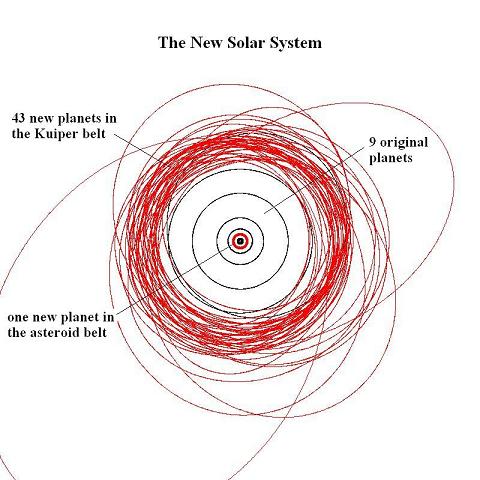
the new solar system. Credit to Mike Brown/Caltech

Over at Centauri Dreams, from which the above image was taken, they’re talking about missions to the outer planets, specially to Haumea. What struck me was how different our understanding of the Solar System is from the classical image of nine planets and some rubble I grew up with. It’s not until you get it all laid out like this that you realise just how different and how much more interesting the Solar System is. So where’s all the science fiction set in it? There’s Paul McAuley’s The Quiet War, now in a nice new US edition, but apart from that I can’t think of any other newish book set in our own system…

Adam vs the Hugos

It’s such a pity that whole discussion Adam Roberts kickstarted about the Hugos got derailed so quickly into the usual fannish defensiveness. While Scalzi set the tone, his readers took it up to eleven. Some extracts:

Pardon me, Mr. Roberts, for being an knuckle-dragging mouthbreather not sufficiently advanced enough to recognize True Art, but I’ll stick with books I enjoy.

[…]

I think the last person whose advice I would seek on literary merit is an English professor.

[…]

This guy’s rant is exactly why I think so many artists are leftists. They find it utterly distasteful that their financial success is dependent on fandom – the unwashed, uneducated masses who are allowed to love Transformers and hate challenging art. So much better if art were completely state-supported so “true artists” would be free of the clamorous demands of the hoi polloi.

[…]

McAuley’s The Quiet War? That’s my point with ego-flexing academics like Adam Roberts. They always go with obscure writings.

[…]

There’s something about being tenured that warps minds and turns readable prose, poetry, and non-fiction into turgid, wordy dreck. And in academia, the masses are always wrong, everything popular is to be shunned, and literary criticism is serious business even when it’s forgotten what the fuck it’s supposed to be criticizing.

[…]

I guess what I’m saying is that Mr. Roberts seems to think of himself as the wolf and the Hugo voters as the sheep. Well, just because you have a fancy education doesn’t mean you’re more intellectually enlightened.

Now here’s the rub. Adam Roberts is a professor of English literature, turned science fiction writer and critic. He’s the living evidence of how far science fiction has become an accepted part of literature, has moved out of the (self-imposed) ghetto it had been in from the thirties to the seventies or so. He’s the living embodiment of everything science fiction fans have wanted from “the literary establishment”, somebody who values science fiction for its intrisic values as well as its literary ones. Unlike earlier generations of literary champions of science fiction like Kingsley Amis, who enjoyed science fiction as a superior sort of low culture, in the same way as they enjoyed jazz but still ranked it as an inferior art form to classical music, Roberts takes science fiction seriously enough to be as critical of it as he would of any other genre. What’s more, he’s more than willing to engage both fandom and academia. So what more does he need to do before sf fans like the ones above lose their cultural cringe? Does he need to fellate the corpse of Heinlein before he’s accepted, or what?

It’s no secret that the Hugos have often been awful, rewarding writers for name recognition, sticking to the known and familiar regardless of quality. The novel category often in fact suffers the least of this: does Dave Langford really deserve the amount of best fanwriter Hugos he has won or is his just the only name the voters recognise? To get all nowty because this time it’s an English professor voicing these concerns is just silly.

It all obscures the real debate between Adam and the Hugo voters. In his original post, what Adam is arguing for is a shortlist “to draw people out of their comfort zone; to challenge and stimulate them, to wake and shake them; to present them with the new, and the unnerving, and the mind-blowing. […] For what is the point of SF if not to articulate the new, the wondrous, the mindblowing and the strange?”

But what Hugo voters are looking for, setting aside the quality of the books they chose to nominate, might be something else entirely. From my point of view, what a lot of people are looking for is not innovation, but affirmation, as argued as well by a lot of the people from the Scalzi thread. They want good books that fit their own world view, not necessarily agree with them, but which have a shared set of (meta) values. This need for affirmation is often looked down upon; we tend to overvalue the new and unknown and especially for critics and other professionals this can be a danger. There can be pleasure at seeing something familiar done very well, just like the quest for “the new, the wondrous, the mindblowing and the strange” can degenerate into mindless sensawunda.

Oh John Scalzi No!

Don’t tell me you pulled the “summon science fiction fandom’s barely repressed inferiority complex spell” as a response to Adam Roberts’ criticism of this year’s Hugo shortlist?

Fandom, look at the 2009 Clarke novel shortlist. Do you know why that list is better than yours? It’s not that its every novel is a masterpiece—far from it (although it seems to me regretable that you couldn’t you vote books as good as The Quiet War, House of Sons or Song of Time onto your shortlist.) But some of the books on that list fail, no question. Martin Martin’s on the Other Side, for instance, is a mediocre novel. But (and this is the crucial thing) it’s a mediocre novel trying to do something a little new with the form of the novel. It’s an experiment in voice and tone, and ambitious in its way. The novels on the Hugo shortlist—except Anathem, as I mentioned—try nothing new: they are all old-fashioned: formally, stylistically and conceptually unadventurous.

Oh, you did…

Now, I assume Mr. Roberts didn’t intend to come across as arrogant and hectoring to his primary audience, because very few people so willfully attempt to ankle-shoot their own career, even the ones with an academic aerie such as Mr. Roberts possesses. I suspect he believed he was being stern but fair. However, I also suspect that science fiction fandom, not in fact being comprised of students who have to sit for a lecture in order to graduate, may have its own opinions on the matter. In the real world, people don’t like being told, while being gently and paternalistically patted on the head, that they’re goddamned idiots. Especially from someone who then turns around and hopes to sell them a book.

Dear. As Niall says, I know which author I want to read more based on these posts, though both in their own way are rather on the annoying side. Scalzi’s for the pandering, Roberts for the somewhat patronising form he puts his complaints in.

Which, as complaints go, aren’t all that new or interesting. That the Hugo Awards are conservative and often go to mediocre works is a complaint I’ve heard as long as I’ve been online and following sf newsgroups and blogs — which is — blimey — almost fifteen years now. Look back at the history of the Hugos and it’s always been that way, going for the Heinleins rather than the Disches. However, the awards did used to have a much better track record of getting both the popular and the criticially acclaimed works. So what changed?

My theory, which is mine, is that science fiction got too big, while the Hugo voters stayed largely the same. For a striking example, compare the 1977 and the 1992 edition of the Encyclopedia of Science Fiction and see how much the genre had expanded in less than fifteen years, how much bigger, complex and diverse it had become. Even for professional critics or reviewers it’s almost impossible to keep up, let alone for “mere readers”. Sure, you can filter to a certain extent, select for books with “buzz”, well known authors, promising newcomers undsoweiter, but you can’t really expect this from people who read for pleasure, not work. The Hugo after all is voted for by everybody who has a Worldcon membership, not a professional jury. And there’s the rub.

You see, the nominations for the 2009 Hugo Awards were voted on by just 799 voters. The People’s Choice Awards this is not, the price of a supporting membership being a high barrier to entry. What we got then with the Hugos is a self-selecting group of people, many with the same sort of tastes (which in many cases were formed some time ago…). This group simply isn’t big enough or representive enough of the sf readership as a whole to accurately represent the sf zeitgeist, nor the kind of jury that would see it as its remit to look for the sort of experimental, cutting edge works that Adam Roberts want it to be.

The Hugo Awards represent the tastes of a certain kind of sf fan, nothing more and nothing less. The novels it selected for the shortlist are exactly the kind of novel it likes and not at all that different from the kind of novel it has been rewarding from the start. Which is the biggest flaw in Roberts plea: he might find the works selected this year mediocre or want the voters to vote for better, more innovative novels, but are the Hugo voters actually looking for this? My guess would be not.

There are better ways to “improve” science fiction’s image in the wider world than to harass the Hugo voters. Ironically, Roberts himself is doing that already, through his work as a critic and author, engaging readers and potential readers of science fiction outside of its traditional venues. So in a way is Scalzi, through his blog. It’s just a pity they’re working at crosspurposes…
Beyond Apollo

Two perspectives. Larry Niven’s:

We went to the Moon, and returned, and stopped. There was no moment of disappointment. It just grew over the decades. We were promised the Moon.

James Nicoll’s:

What the US didn’t do in space since the end of Apollo:

Put a human on the surface of another planet.

What the US did do in space since the end of Apollo:

Place a variety of advanced telescopes in space

Sent fly-by missions to every planet.

Put orbiters around Earth, the Moon, Venus, Mars, Jupiter and Saturn.

Put landers in or on Venus, Mars, Jupiter, and Titan.

Mapped numerous bodies in the Solar System.

(The list continues)

Classical science fiction really believed in space exploration, as humanity’s destiny, as the final frontier we needed to keep ourselves sane, as a way out of the Hobbesian struggle of all versus all. It promised that it would be easy, that it only needed a maverick scientist and his adventorous young nephews to build a rocket in his garage and go to the Moon, that space travel would be an untroubled linear process: from the first satellite to the first men in space to a trip to the Moon followed by a Moonbase, permanent space stations, a Mars colony….

Up until Apollo reality seemed to conform to this fantasy of easy travel to other planets. But then reality set in and all the ambitious plans foresee in the pulps of the forties and fifties and formalised in the classic space books by Willy Ley and von Braun and others were put on hold and then cancelled. For a while there were still the Viking (thirtythree years ago yesterday) and Voyager missions to be excited about, but with the eighties and the disastrous space shuttle programmes and “Star Wars” the dream seemed to die.

Meanwhile, unnoticed by this “old guard” of space enthusiasts, we got a real space research revival in the nineties, one that didn’t fit the neat space race template of the sixties, but which did reveal a Solar system much stranger and more interesting than the boring old “nine planets, a coule more moons and some junk” the old guard grew up with. What’s more, while space colonisation seemed to grow more and more difficult and distant, it turned out you can do a lot of interesting research from right here on Earth, up to and including the discovery of planets around other stars. The Campbellian idea of three men in a scout rocket having to find out if Gliese 581 has habitable planets or not turned out to be unnecessary, which is a pity if you wanted to be a scout, but less so if you’re interested in what the universe looks like.

So now we got a bifurcation in science fiction: on the one hand those who are disappointed that we won’t “Inherit the Stars”, on the other those who argue that “Earth is Room Enough”. And on the gripping hand there are of course those that don’t really care one way or another but just like to read “Of Time and Stars” without having it be anything more than entertainment.

Forty years ago today

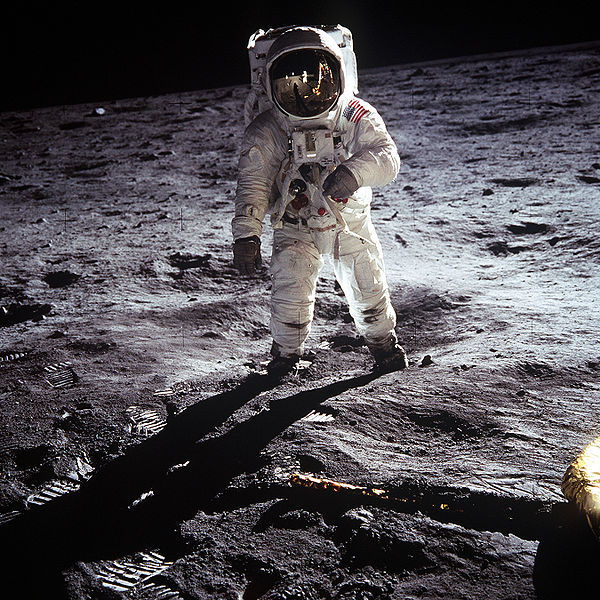
Buzz Aldrin on the Moon

And only fifteen years after Tintin, Snowy and captain Haddock, Neil Armstrong and Buzz Aldrin walked on the moon, as the first non-fictional characters to do so. All skepticism about what Apollo accomplished aside, it was a hell of an achievement, to get human beings walking another world in less than a decade. that Apollo then didn’t lead to a permanent presence on the moon is a pity, at least for this science fiction fan, but it should not distract us from this triumph.

To rate “the space programme” on what it did for us back on Earth, as they’re doing over at Charlie’s, may be interesting but missing the point. Most of those socalled spinoffs always turn out to be not invented for the space race, much of the rest never needed manned spaceflight to get them going. If we’re looking at space exploration from a purely “economic” point of view, we don’t need more than communications, weather and GPS satellites; certainly not manned space flight or space exploration.

Who cares about what Apollo did for us? People walked the fucking moon!