Books read March

Six books read this month. Not too many.

De Februari-Staking — B. A. Sijes
This is the history of how, on 25 and 26 February, 1941, workers in Amsterdam went on strike against the increasing persecution of the Jews by the nazi occupation forces. It was the first openly, massive act of resistance against this persecution in occupied Europe.

The Riddle Master of Hed — Patricia A. McKilip
A classic fantasy story I hadn’t read before. Interesting, somewhat strange in places, feeling as if I stepped into the middle rather than the start of a trilogy.

Selling Out — Justina Robson
The second book in Robson’s science fiction/fantasy mixup starring Lila Black, who almost died on her first mission and was remade in a nuclear powered killing machine

Bloodmind — Liz Williams
The sequel to Darkland, as Vali Hallsdottir once again has to work together with those who’d normally be her enemy to stop somebody worse.

Dragonsong — Anne McCaffrey
The first novel in the Harper Hall trilogy of Pern novels, this pretty much is a young adult power fantasy of an unappreciated young woman running away from home only to find her talents appreciated for the first time.

Dragonsinger — Anne McCaffrey
The second Harper Hall novel, continuing the adventures of Menolly, as she struggles to adjust to life in Harper Hall.
Foster parents: not freaking saints

This post about being a foster parent resonated with me:

We hate being told we must be saints or angels, because we’re doing something really ordinary and normal – that is, taking care of kids in need. If some children showed up dirty and hungry and needing a safe place on your doorstep, you’d care for them too – we just signed up to be the doorstep they arrive at. The idea of sainthood makes it impossible for ordinary people to do this – and the truth is the world needs more ordinary, human foster parents. This also stinks because if we’re saints and angels, we can’t ever be jerks or human or need help, and that’s bad, because sometimes this is hard.

Back in 1980 my parents, who already had two children and a third on the way, took the decision to make themselves available as foster parents as well, out of a mixture of leftist idealism and Christian sense of charity. At first they were looking for younger children in the same age range of me and my brother, but instead their first placement was sixteen year old, the first teenager they had to learn to deal with. It actually worked out pretty well: he stayed a couple of years, moved out when he got his first job, is still part of the family and that was that. Over the years our family took in a half dozen or so children of different ages and personalities, some staying only a short period as things improved with their biological families, some staying for years, becoming part of the family.

As a kid growing up with at least one or two foster brothers or sisters living with us, all this seemed normal, even though we were aware that it was not common to do. There were problems and conflicts of course, but no more so than with your biological siblings. Certainly we never thought of our parents of saints or angels, nor can I remember other people thinking that way about them; they got praise for what they did, sure, but nothing as absurdly over the top as that.

Being a foster parent, like being any parent is hard work; it’s far from well rewarded monetary and of course there are some special challenges you won’t have to deal with if you stick to just raising your biological children (if only because of the whole necessary bureaucracy surrounding fostering) but it’s not a profession for a saint. Saints don’t raise children.

So how many female writers do you review?

Over at Lady Business, they’ve looked at the coverage of female writers on science fiction and fantasy blogs:

Project thesis: when looking at a sample of bloggers reviewing SF/F, a majority of men will skew toward reviewing more men. A majority of women will skew toward a more equal gender parity, or the opposite in which they review a majority of women. There will be a handful of outliers.

Which meant it was time to check my own reviewing, to see whether or not I’m an outlier or not. A few years ago I re-examined my reading habits, coming to the conclusion I read too few female writers, then set out to correct this. However, though I strive to review each book I read, the reality is that I largely don’t succeed in doing so. Last year I read 91 books, but reviewed only forty.

Luckily I keep track of which books I review each year, so it was easy to do the math. I reviewed forty books, of which twentyfour were written by men, sixteen by women, for a very clean division of sixty to forty percent male vs female writers reviewed. That’s better than how the average male reviewer is doing in the Lady Business study (74 to 25 %), worse than the average female reviewer (42 to 58, slightly more skewed towards female writers) and still not gender balanced.

The numbers are somewhat skewed by my Pratchett rereading project, which accounts for eight of those twentyfour, or a third of my male writers. Without those, the ratio switches to sixteen male to sixteen women, or a perfect fifty/fifty split. All done by accident though.

And I can’t remember the sound that you made for me


In a Metafilter thread about losing cats and other pets, somebody linked to the above Weakerthans song about the death of a cat, as sung from the cat’s perspective. Hence “and I can’t remember the sound that you made for me” as she no longer recalls the name her owner called her. It goes to the heart of what makes dealing with the death of a loved pet so different from dealing with losing people. Pets can’t understand what’s happening to them, not like humans can and it feels more like you are abandoning them, than that they’re leaving you.

There’s this dream I have occasionally, where Sandra turns up still alive and I accept in the dream, though at the same time in the dream I still know she died, but something happened that had made it all a misunderstanding, she was alive all that time, I just had not been seeing here. That’s that same feeling of abandonment, of having let her down.

Sixteen months on

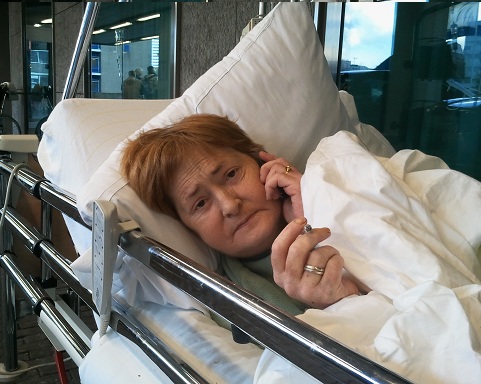
Sandra smoking in bed outside the main entrance of VUMC

That photo right there sums Sandra up to a t. Stubborn enough, determined enough that she would go and get a fag even if it meant getting wheeled outside in her bed to the small smoker’s cubicle next to the main entrance of the VUMC hospital she stayed in. That picture was taking just a month before she would die, roughly around the time that she had decided she was going to die and I was going to have to come to terms with that. It’s how I want to remember her, as somebody who always stayed true to herself, who kept trying to lead her own life as well as could, until she could no more.