Seven months on


So I was idly browsing Youtube videos, as you do, when I found the video above, which I’d first seen at the Mighty Mighty Godking last year. It was one of the last youtube videos I’d shared with Sandra; correction, one of the last that didn’t annoy her, as I always liked to wind her up (and she me).

Last Thursday it has been seven months already that she died; sharing videos with her is one of the more trivial things I miss. She more than me had a knack of finding funny/interesting/weird videos on Youtube, as well as more interesting shit in general. Of course, the last fiv-six years, with her being home fulltime; not particularly sick, but not always in the best of health either, she often had more time than me to surf and blog. Every now and again I dive in the proggold archives to find something and are reminded of just how good she could write — like here e.g.. It’s no wonder that that particular blog is in a bit of a coma at the moment…

Books read May

As with last month, I didn’t read much in May, opting for reading two large, difficult(ish) books instead. Other interests also cut down on my reading time, so I’m nowhere near Michel’s output for the month.

The Children Star — Joan Slonczewski
An author I’ve heard a lot of the last year, due to her latest novel, The High Frontier. As James Nicoll has often said, in science fiction biology is the redheaded stepchild that comes to school covered in bruises; Slonczewski is one of the few sf writers who can create believable, workable alien biologies and her skill is on display here.

The End — Ian Kershaw
A history of the German experience in the last year of World War II , which tries to answer not why Germany lost, but why it took so long, until after Hitler’s death, to realise it had lost. Why did it keep fighting on for so long when it was clear in late 1944 that they couldn’t win?

Kamikaze: History’s Greatest Naval Disaster — James Delgado
A pop history look at the two attempted Mongolian invasions of Japan and why they failed. Interesting and I could do with a more indepth history to read about this. Any suggestions?

Divided Allegiance — Elizabeth Moon
The second book in The Deed of Paksenarrion sees Paks dissatisfied with life in the mercenary company she was in in the first book, leave and land herself in a very D&D-like dungeon crawl and hook up with the Fellowship of Gird as a paladin candidate. My copy annoyed me greatly as the cover was completely flaked away before I’d even finished reading it.

The Earth — Richard Fortey
Richard Fortey was Sandra’s favourite science/evolution/geology writer and geology being her favourite science. As far as I know she hadn’t read this particular book, but I bought it in honour of her memory. Fortey explains the geological processes that drive the Earth and the history of how we got to understand, through the process of visiting some of the “holy” places of geology, starting with its birthplace in the Bay of Naples at the Vesuvius.
Everything in the garden reminds me of Sandra

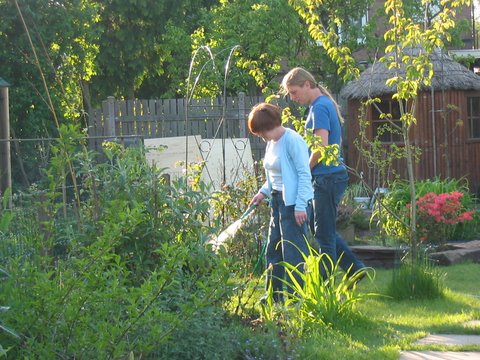
Sandra watering the garden

If you’re a gardener, especially if you’re an English gardener, you know of course that the Chelsea Flower Show has been on all week. I’m not much of my garden enthusiast myself, though I can enjoy a nicely turned out garden as much as the next bloke, if the next bloke isn’t Alan Titchmarsh, but Sandra was always very keen. She was never as happy as when she was puttering around in our postage stamp garden, patiently nursing plants to health, providing hiding places for solitary bees and laying it out in such a way to pack as much green and flowers in it as humanly possible. Like everything she put her hand to, she made it look easy, even after she became ill; she made sure that before she went into hospital, her garden was in the best possible shape.

So of course we watched the BBC gardening shows, with Gardening World on Fridays being a staple, as was Gardening Question Time (for which we managed to attend one taping when they were on tour in Amsterdam) on Radio 4 on Sunday afternoons. There was something very comforting about these programmes, something very English in its middleclass niceness and preoccupation with improving hobbies. In this the Chelsea Flower Show was the annual highlight and Sandra always talked about how much she would’ve liked to visit there. We’ve sort’ve made plans that, when she was out of hospital and back into “normal” life, we would do just that, but we never got that far…

With the weather finally making a turn to the better this week and the Chelsea Flower Show back on, it’s been hard not to dwell on Sandra’s death these days. Hwer garden after all is also part of her heritage I have to get to grips with somehow; luckily my father is just as keen a gardener as Sandra was and more than willing to help out; he and Sandra had always bonded over their gardens.

But this, as well as talking about her death on MeFi has made me realise something important: I’ve made my peace with her decision to die. I didn’t really at the time, though I could understand it intellectually and although I had spent the last two years living in fear that she could die at any moment, or might make that decision. In my heart I wished she hadn’t chosen to end her suffering, if in my head I understood she had to. But now, a half year after her death, I’m beginning to make my peace with it.