Hanebado! — First Impressions

We usually played volleyball or basketball in high school, but occasionally we had to try badminton as well. I was never good at it, unlike these girls:
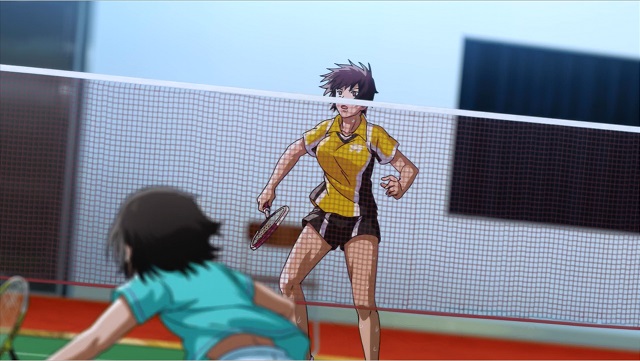
Hanebado!: badmintoning intensifies

This is in the establishing flashback with which the episode starts. Aragaki Nagisa, the intense girl in the background will lose this match 21-0 to the badminton monster that is Hanesaki Ayano, the girl in the blue shirt, driving the former to ‘git gud’, in the process driving her club mates to despair, while the latter leaves badminton altogether. That is, until she enrolls in the same high school as the first girl and is challenged to a match with her. This takes the whole episode to set up, but that wasn’t a problem for me.
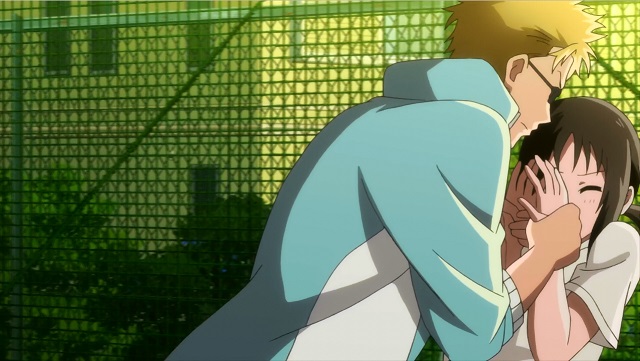
Hanebado!: a coach with grabby hands. Original

What was a problem was coach grabby over here, who actually climbs over a fence onto the tennis court to fondle her hands when he sees Ayano protect her friend from a stray ball hit by the tennis club’s ace player. Which is supposed to show he’s a badminton savant but which comes across as creepy, as it always does. The second problem is that there was little badminton on offer here after the flashback, but that can be excused by the need for character establishment. Less excusable is that the point of the whole episode is to force Ayano into a match when it’s clear she doesn’t want to play badminton anymore. It’s an old, tired trope to have an ace player fed up with their sport being forced to return to it only to rediscover their love for it.
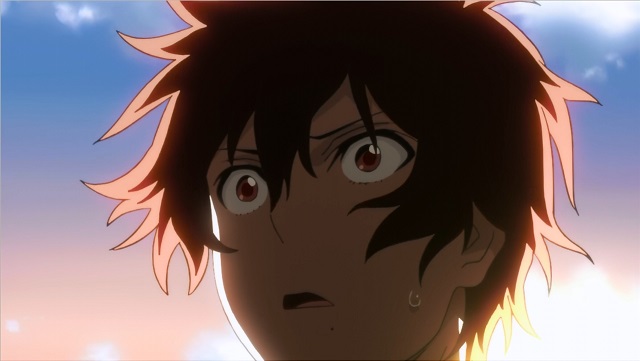
Hanebado!: Nagisa finds out her rival goes to her school now

Much can be excused for intense faces like this though, Nagisa after she finds out that the rival she’s determined to beat is at her own school, playing tennis instead of badminton. In general the animation and design quality of this first episode is quite high, especially in that badminton match and I like that none of the characters look particularly ‘anime’ but a bit more realistic. This has good potential. I like a good sports series, as long as it doesn’t faff about too much.
Watching pretty boy anime can be pretty relaxing

Yes, it is incredibly hypocritical of me to watch any halfway decent cute girls doing cute things series but only give the equivalent pretty boys series a chance because of a favourable Anime Feminist review of the first episode.

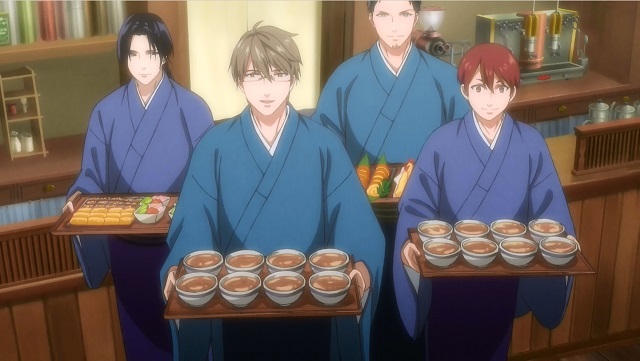
Rokuhoudou Yotsuiro Biyori: pretty boys bringing soup

But I’m glad I did, having skipped it originally because nine time out of ten these series just don’t hold my interest. I’ve tried a few, usually gave up after a few epsiodes, but this one kept me engaged throughout. There’s something very comforting about four sweet boys doing their best to keep their customers happy by feeding them good food and help them solve their problems. A good, diverse cast beyond the four primary protagonists too. I could’ve done without the subplot of the glasses wearing dude having an estranged brother who’s some big businessman, but on the whole this was a nice way to unwind every week.

There are two other pretty boy series I watched this season. Devils Line was a confused mess, about vampiric “demons” as second class citizens and how hard it is to be in love when being in love makes you want to drink the blood of your woman. Kakuriyo no Yadomesh is better, but started rough and isn’t finished yet. A young woman is kidnapped by a ogre who claims she was the collatoral for her deceased grandfather’s debt and now she has to marry him. It’s gets better, as she establishes herself at the inn the ogre runs and starts her own restaurant. Again, a pretty relaxing series to follow, with low stakes problems being overcome easily as our protagonist wins the hearts and mind of all the ‘monsters’ she comes across.

Island — First Impressions

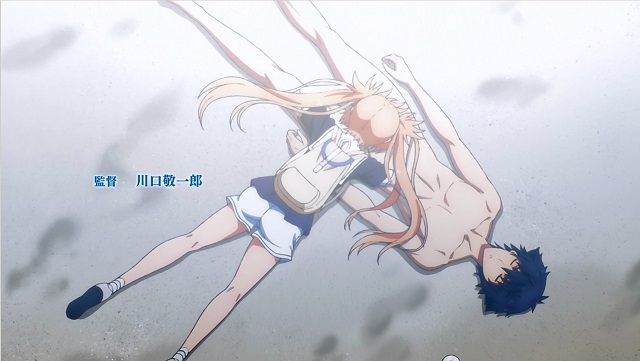
Twin tailed heroine stumbles and faceplants straight into our very naked protagonist’s crotch. Even without knowing anything else about it, you know this is going to be based on a visual novel. It’s as if the early 2000s have never left.

Island: Face full of alien wing wong

Naked boy here lost his memory but knows he was sent back from the future to save the past and keeps having little flashbacks/forwards about the girls he interacts with. Said girls so far include the blonde sporty twintailed tsundere above, the silver haired weirdo who can only leave her house at night and the flat chested priestess who looks significantly younger than the other two. Lots of buildup and mysterious allusions so far, not much plot and a little bit of the usual smexy comedic antics any self respecting visual novel adaptation has to has. Enjoyable, but I’m under no illusion this may turn out to be good. As long as it doesn’t turn out to be actively obnoxious I’ll keep watching.

Harlan Ellison

Really, all you need to know about Harlan Ellison’s legacy is that he trademarked his own name and he’s the guy who did this to Connie Willis:


Harlan Ellison was that guy who used to be an important writer and editor but now was just some old guy with anger management issues (and grabby hands as it turned out) for as long as I’ve been reading science fiction. And I’ve been reading science fiction since at least 1982. As a kid devouring anything about science fiction I could get my hands on back then, mostly from the somewhat out of date local library’s collection, he was omnipresent in books about esseff, not so much as a writer in his own right. A few stories scattered here and there among anthologies, but I’ve never read all that much about him. And what I read of his I sometimes ended up hating.

Ellison’s importance to me, as he seemed to be presented in fanzines and sf history books and such, was as a model for how to be a certain type of fan turned writer, a template for whole generations of baby boom/gen X fans. Well but narrowly read in science fiction and adjacent genres, argumentive, elistis, bit of an asshole and proud of it. Ellison campaigned for the Equal Rights Amendment, but as it turned out, had a bit of a history with harassing women that didn’t make it into the sf history books or fanzines.

With the news of his death came of course the eulogies, which touched off something that I think Jasmine Gower put it best:

As someone who was only 16 when Harlan Ellison sexually assaulted a colleague on stage at WorldCon, I have only ever known him by that reputation.

It’s very concerning to see my community today celebrating this sexual predator as someone who made our field stronger.

If you’re the same age as me or younger, Ellison always was somebody who had been cutting edge and radical once but now was a sour old coot; even ignorant of his sexual assaults, he came across as an asshole and celebrated for it. But there also a great many fans and writers to whom Ellison was and is still important because they were there when he was in the vanguard of the American New Wave, freeing sf from its self imposed shackles. Then there are people like Tananarive Due, who remembered Ellison for supporting both Octavio Butler and herself. And, as mentioned above, Ellison championed the ERA. In other words, the not at all rare example of a progressive man being awful in private. It’s a mixed legacy indeed, you can’t deny his good parts, but as I said eight years ago already, who would want to be Harlan Ellison now?

Amanchu Advance: what a waste

I wasn’t quite sure why so many people who’d liked the original series were so down on Amanchu Advance until this happened in the penultimate episode:

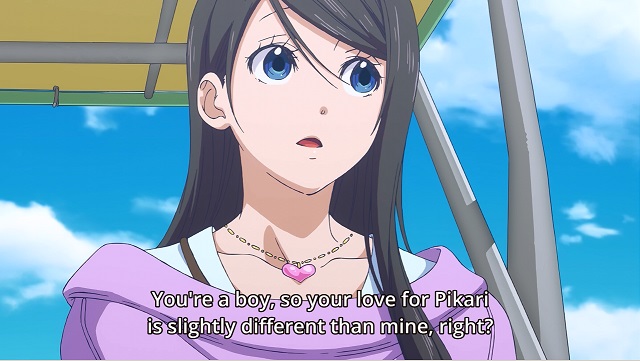
Amanchu Advance: heteronormativity for the win

The original series was all about the blossoming relationship between Teko and Pikari. Teko was the shy, timid girl who had to leave her home town and friend behind as her parents had to move for their jobs, who found a new friend in the exuberant and outgoing Pikari, getting introduced to the wonderful world of ocean diving. The focus was firmly on their friendship, with a bit of a lesbian undertone to it that surely wasn’t just my imagination. It had a good supporting cast, but the centre remained Pikari and Teko.

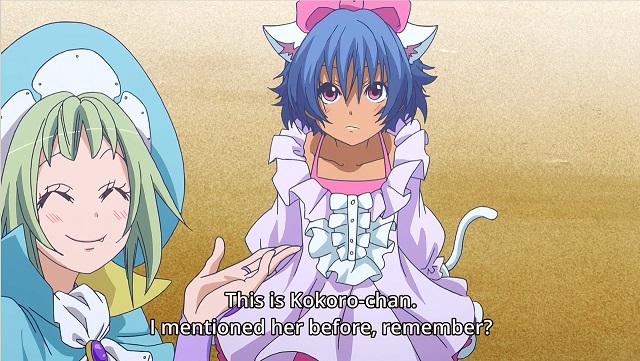
Amanchu Advance: Kokoro-chan

Amanchu Advance changed that. It started off by introducing Kokoro-chan, a twelve year old girl as Teko’s rival for Pikari’s love, with a similar but slightly older girl as the same for Teko, though the latter featured much less. This in itself wasn’t bad, but it did eat up screen time that could’ve been spent on Teko and Pikari. What was worse was that for three episodes, both were completely ignored in favour of the story of Peter, a school ghost who on special nights would attempt to seduce a girl to join him in his dream. This was the same plot line that got me to drop the original manga and it wasn’t much better animated. And then, in the penultimate episode, it was revealed that Kokoro-chan was actually a boy and Teko immediately started rooting for him to romance Pikari. Again, something out of the original manga.

All of which means that all of the slow buildup of the first series and the first half or so of this one, all the little signs we’ve had about how Pikari and Teko felt about each other, didn’t matter. Because here is a twelve year old boy with a crush on Pikari, so let’s make sure the audience know that this is the approved relationship for her. What a waste. What a disappointment.