Green around the gills — Yorimoi ep 8

This is about the last time the girls will look healthy this episode.

Sora yori mo Tooi Basho: looking healthy

Because this is the episode in which the ship finally sets sail from Fremantle and as the title –Howling, Maddening, Screaming— indicates, it will not be plain sailing. To get through Antarctica you have to pass the Southern Ocean, one of the largest stretches of unimpeded open ocean in the world, which means the ocean streams are unbroken by continents, which in turn means waves and storms have free reign. Which means our girls spend a lot of time this episode doing this:

Sora yori mo Tooi Basho: feeling sick

I really feel for the poor girls here, having once had a truly miserable time crossing the Channel during a storm on a catamaran ferry while my friends were not bothered at all. The episode really manages to capture the misery of being seasick without being too graphic, the sheer exhaustion of not being able to keep anything in you, how the mere thought of food makes you ill. I actually felt a bit ill myself watching this. Not that scenes like this aren’t funny of course, even if you do sympathise with Shirase and co at the same time. Being that sick is miserable.

Sora yori mo Tooi Basho: not nice to laugh at sick people

Even without being seasick all the time, the girls have some difficulty adjusting to the realities of life onboard the ship as they’re put to work as members of the expedition. They had been warned they would be treated as adults and they are. It’s not like they have a problem with this either, it’s just that the differences in skill and stamina between them and the adult expedition members becomes clear. The latter after all have been there before, are used to the extreme conditions of the Southern Ocean and Antarctica, have trained themselves to be able to deal with them. For the girls, at their worst as the weather conditions worsen and the ship starts moving even more, they might as well be a different species altogether. Yuzu especially gets a bit despairing, wonder if they can actually be useful in Antarctica, to which Shirase replies that they have no choice. Kimari disagrees:

Sora yori mo Tooi Basho: we chose this ourselves!

I really like this scene. You got Yuzu, usually the unflappable, professional one voicing her doubts of not being good enough, to which Shirase offers the conventional answer of just having to try and do it because they have no choice. Hinata, already established as more comfortable withdrawing in herself rather than seeking a confrontation, remains silent. Kimari meanwhile gets to be serious for a chance and reminds everybody that they’re here by choice, that they’ve made their choice to be here. It doesn’t solve their sickness, but it breaks through the fears. And ultimately they get through it.

Sora yori mo Tooi Basho: seeing Antarctica for the first time

Crisis passed, gotten used to the rolling and swaying of the ship, storms over for the moment, they are rewarded with their first evidence that Antarctica is just ahead, as they see the first icebergs floating past. It’s a good moment to end the episode on. Next time: Antarctica!

Ship Ahoy — Yorimoi ep 7

It’s episode seven of Sora yori mo Tooi Basho and the four girls have finally caught up to the expedition at Fremantle, Australia only to discover the adult members of the crew are bigger goofballs than they are.

Sora yori mo Tooi Basho: goofing off

This series has such good comedic timing it surprises me every time I watch another episode. Probably because the dramatic elements stick in my head more. This episode is a case in point. If you ask what it’s about, it’s about the four girls finding their way around the ship. In the process they learn that the expedition may not be as well funded or crewed as it might have liked to be, as well as that there are secret plans for when the expedition will arrive in Antarctica. Finally, there’s also the ongoing subplot involving Shirase and expedition captain Tōdō Gin, who was there when her mother disappeared on the expedition three years ago. All rather serious.

Sora yori mo Tooi Basho: useless

And yet. This is the first scene after the opening song and it’s Shirase screwing up her video report again because she’s so stiff and embarassed. It’s funny because seeing somebody this stiff in front of the camera is always funny, but especially so because it fits Shirase’s character so well. Throughout the series she has shown to be incredibly driven, but often awkward and clumsy and embarassed about it and this has been shown mostly through scenes like this. That’s what I like about the humour in this show, it’s largely character driven, it isn’t your average anime comedy and much of it is the characters joking with each other, just like real people do with friends or co-workers.

Sora yori mo Tooi Basho: sense of direction

Even in a still shot like this you can see each girl’s character shining through. Kimari on the left and Hinata next to her are the more goofy of the four, but Hinata is a bit more sensible than her. Shirase at the back is serious but confident, while Yuzuki is serious and a bit anxious. She’s the youngest but also the most professional of the four thanks to her idol career. Sora yori mo Tooi Basho keeps using gags like this to flesh out each girl’s character, whether a recurring one like this, or a background joke like Shirase stealing Kimari’s penguin plushie.

Sora yori mo Tooi Basho: Antarctica People

As the girls catch wind of how understaffed and underfunded the expedition seems to be in comparison to others, they also hear about mysterious plans for what to do in Antarctica, having listened in to a few conversations among other crew members. When they get back to their cabin and wonder what those plans might be, this happens. Again a brilliant bit of comedic timing, showing how much Kimari and Hinata are on the same wave length, as opposed to the more serious and easily startled Shirase and Yuzuki.

Sora yori mo Tooi Basho: Gin, Takako and Kanae

One of the delights of this episode is getting more flashbacks to when Shirase’s mother Takako, together with Gin and Kanae set up the first private Antarctica expedition. It’s so nice to see them have the same rapport and comradery among themselves as Shirase has with her friends and so sad to know how it will all end, with Gin and Kanae in that snowcat as Takako gets lost in a snowstorm. This sadness is not very far from the surface throughout the series, but it’s never content to remain sad. After the emotional scene with Gin talking to Shirase about Takako and the expedition’s determination to go back to where she was, we therefore immediately switch to comedy again, with Kanae introducing the four girls to the rest of the ship.

Sora yori mo Tooi Basho: real school girls

It’s another example of using humour to reveal character and it leads in to the climax of the episode, with the four of them introducing themselves. With a helping hand by Hinata, Shirase comes out of her shell enough to share her dream with the crew, of wanting to go to the Antarctica her mother wrote about. It’s a poignant scene only made possible by the buildup over this episode and the ones before it.

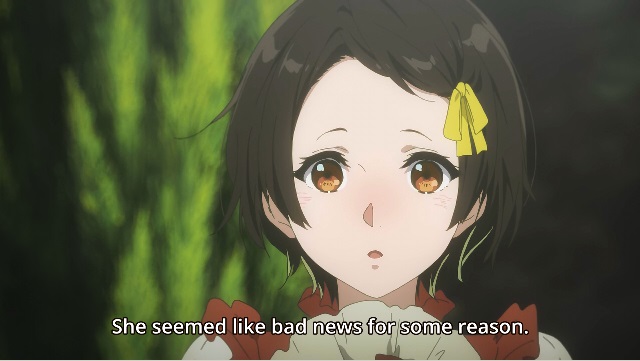
She seemed like bad news — Violet Evergarden ep 10

Ann is right, Violet Evergarden coming to her house is bad news, though not in the way she thinks it is.

Violet Evergarden: bad news

Violet Evergarden, for all the hype it had gotten beforehand, has been somewhat disappointing to me from the start. Violet is an orphan raised as a living weapon, until she came under the command of major Gilbert Bougainville, the first to treat her as a human being. When the series starts she’s in hospital, having had both her arms replaced by mechanical ones as a result of an enemy artillery bombardment in her last mission, which left major Gilbert missing in action. An old friend of the major comes to discharge her from the hospital after peace has broken out and through various circumstances, she comes to work for his Auto Memory Doll company, to learn the meaning of the major’s final words to her: “I Love you”. Auto Memory Dolls write letters for those who can’t write them themselves, because they’re illiterate or need the specific talent of a Doll to write the perfect. Violet, being more doll than human at the start of the series needs to learn how to write in such a way that not just the literal content of the message is conveyed, but the actual emotions behind them, so that in turn she herself becomes more human. It’s not the most original of premises, but a good foundation for an interesting story.

Unfortunately, despite all the technical prowess Kyoto Animation brings to the series (hand animating the letter being typed in this promo video took a month!), emotionally it has fallen a bit flat. The first two episodes establish Violet and her problems with communicating in a way other people can understand, because she fails to understand herself how to word things other than literally, or when or when not to say something. The next five episodes are all one shots, in which Violet travels to meet a client and gets involved in their problems while writing letters for them, featuring as a sort of emotionless shrink who helps them solve these problems. I didn’t find any of these particularly interesting and in the case of episode four, actually infuriating. Therefore the supposed emotional climax of the series in episode eight and nine, where Violet learns that major Gilbert is presumed dead, did little for me. It was predictable, clumsy and contrived. Violet Evergarden was a disappointment, in short.

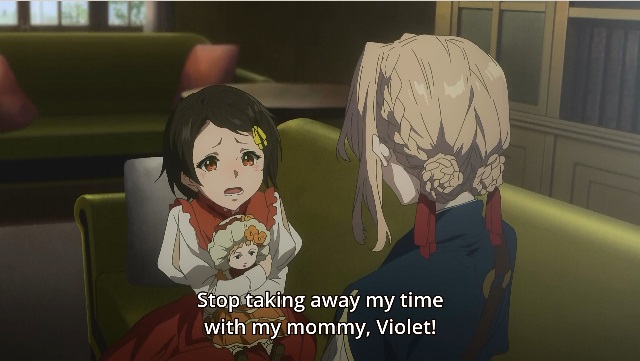
Violet Evergarden: stop taking away my time with my mommy, Violet

But then came episode ten. Another simple story, of Violet being hired for a full seven days, so an ill war widow can write the letters she needs to write before she, well, you know, while Ann, her seven year old daughter who’s already a bit lonely, resents Violet from taking away her mother’s limited time with her. As a viewer, you know how this story will end almost from the moment you see the mother in bed fending off grasping relatives. There will be no happy end. You don’t know why these letters need to be written until the very end of the episode, but you can see the desparation of Ann’s mother in trying to get them finished in time even as it eats away at her energy, at the same time sympathising with Ann for being left alone and not comprehending what’s happening, though she understands more than she admits to. It all comes to a head when Ann can’t take anymore and breaks down admitting she knows her mother is dying, running away and finally finding some comfort in Violet’s arms.

Violet Evergarden: you are not crying, I am crying

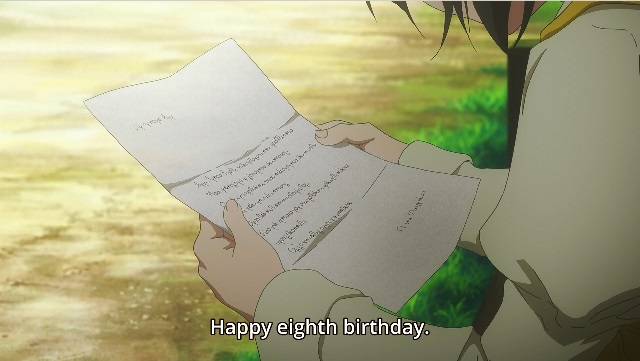
But the real payoff comes in the epilogue, after Violet has gone and Ann and her mother are alone again. We get a quick montage of scenes with the both of them at play, with her mother vanishing from the scene, a quick succession of seasonal cues, the inevitable funeral scene in one quick shot and then Ann alone, as she receives the first of the letters her mother wrote for her. And that’s when the tears started. For the first time in the series, the emotional content matched KyoAni’s technical excellence, the latter in perfect service to the former. We see the entire episode through Ann’s eyes, so we sympathise from the start and we are kept as much in the dark as her about the purpose of the letters her mother is writing, so the arrival of the first letter is almost as big a surprise to us as it is to her. This could’ve been pure schmaltz had it been done wrong, but the series does it perfectly. Because we do see everything through Ann’s eyes, we’re not getting spoiled for the payoff and sharing Ann’s grief and happiness at receiving the letter doesn’t feel voyeuristic this way.

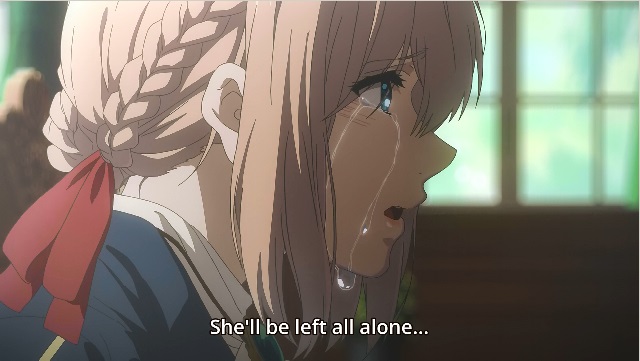
Violet Evergarden: empathy

Violet’s own response, when she’s back at company headquarters and a co-worker congratulates her on writing fifty letters for Ann and how happy she’ll be to receive them, is excellent as well. She’s overcome by empathy and starts crying, imagining how lonely Ann will be, how her mother will be dead by the time she’ll get her first letter, how young she still is. Having just come to grips with the loss of major Gilbert herself, the one person she herself could call family, she knows exactly what Ann will go through, which is why she gets so upset about it as well. The same goes for me: my wife died some six years ago and that grief and sorrow is still very real to me. Disappointing though it has been in general, episode ten of Violet Garden therefore justified all the hype for me.

Inventing problems to appease islamophobes is the VVD way to win elections

Currently we have fortytwo mosques in Amsterdam, none of which actually issue the call for prayer because the people running it aren’t idiots, so it makes sense that for new mosques being build here the city council should put clauses in their contracts forbidding the call for prayer?

It’s all thanks to it being local elections month in the Netherlands, which means that the background noise of islamophobia that has continued unabated since 9/11, gets turned up a notch. This time it’s the notoriously criminal VVD that wants to put the boot in. Until a decade and a half or so ago this was supposed to be a serious, centre right party that could go into coalition with social democrats and left of centre liberals, though in reality it was always the tax dodgers party. But then it discovered that a more polite form of the islamophobia pioneered by Fortuyn and Wilders was a vote winner, so you now you get idiots like local Amsterdam weird^w wethouder Eric van der Burg promising hard measures to solve a problem that doesn’t actually exist.

It would be funny if it wasn’t so sad. Christian churches are free to ring their bells every bloody Sunday, but mosques aren’t free to do the same thing. I find it understandable that a mosque would voluntarily decide not to use their legal right to do this, for the sake of getting along with the neighbours and all that, but to not ever have this acknowledged, to always come back to this non-issue whenever a supposedly decent party wants some plausibly deniable Muslim bullying to win votes, is just sickening. It lends a veneer of respectability to islamophobia, it confirms actual racists in their beliefs and it keeps portraying the Muslim population in the Netherlands, who have been here at least fifty years and in some cases much much longer as foreign intruders who want to disturb the Dutch peace and quiet. It’s deeply cynical and disgusting.

Shadows of Fukushima

Go watch:


Pause and Select is not a channel that updates often, but when it does it’s always interesting. There are plenty of other Youtube anime critics I follow, but what’s different with Pause and Select is that it goes beyond anime and contextualises it in the experiences of real life Japan. Most other critics, being non-Japanese and often, like myself, not able to speak or read the language with any fluency, tend to restrict their commentary to what’s on the screen, with perhaps a little bit of industry inside baseball on the side. Videos like this — a deep dive into how Kimi no Na ha and Shin Gojira reflect, approach and process the Fukushima nuclear disaster — therefore are rare and much appreciated.