Ryuuou no Oshigoto! — First Impressions

Ryuuou no Oshigoto!: a sixteen year old shogi master takes on a nine year old girl as his disciple: Sangatsu no Lion, but trash.

Ryuuou no Oshigoto!: 9 year old discipline

Kuzuryu Yaichi is a sixteen year old shogi prodigy, who has won the ryuu title when he was only sixteen, but has entered a bit of a slump in the three months since. Returning home one day he finds the nine year old Hinatsuru Ai in his flat, who want to become his student. He plays a couple of games with her, gets called in by his own sensei who gives his blessing and enters her in a training group at the shogi hall. This episode was mostly setup then, introducing the main characters as well as a fair few of the supporting cast. It did however also have a satisfying amount of shogi show, done in a way that showed this series loves shogi. Not that I understand the first thing of shogi, but I could tell more attention was paid to the shogi playing scenes than it really needed to for the sort of heart warming slice of moe series this seems to want to be.

Ryuuou no Oshigoto!: sister vs student - who will win

A shame it has to ruin it by being so goddamn bloody anime. A nine year old girl who wants to become the student of a sixteen year old shogi master: that immediately rings alarm bells. The episode started off well and my fears seemed unfounded, until eleven minutes in, when we got an unnecessary shower scene, followed by a “hilarious” misunderstanding as Kuzuryu’s shogi “sister” Sora Ginko — two years younger than him but his senior in shogi — came to visit. At first it seems she’s concerned about why exactly he has a nine year old girl in his home, but that soon morphs into jealousy towards Ai-chan. That’s obnoxious enough when it’s two age appropriate girls getting jealous over a boy, but when one literally is a child…

Ryuuou no Oshigoto!: shiny knees

The thing what annoys me the most about this flirtation with pedophilia is that it’s so bloody cynical. Ai-chan is constantly glamourised,like in the shot above in a way that isn’t quite outright sexual, but that’s clearly meant to hint at it. The other female characters shown so far didn’t have the sheen to them that Ai-chan’s shiny, shiny knees have. Ai-chan getting jealous of Sora, Ai-chan casually walking out of the bathroom naked, Ai-chan talking about SM persons, all there to make her into a lust object for the viewer, but with just enough plausible deniability built in. This could be just an innocent nine year old having a crush on the boy she met once, but the show is constantly nudge-nudge wink winking at you. You know nothing will come of it, it’s just there to appeal to the lolicon tendecies of some anime viewers, because if you have a series costarring a nine year old girl, why not sexualise here and get that audience, hey?

But it didn’t have to. It could’ve skipped all that and justy focused more on Ai-chan discovering the wide world of shogi, of Kuzuryu rekindling his own love for the game through her enthusiasm. There are hints that the rest of the series may improve, as a few other elementary school shogi players were introduced at the very end, but I fear that the lolicon elements will continue to crop up whenever the writers run out of ideas or fall back on old anime cliches. Will I keep watching? For the moment yes, until the more unsavoury elements of this show will get too much for me.

Yuru Camp — First Impressions

A girl goes solo camping at the foot of Mount Fuji and could’ve saved herself a lot of trouble had she woken up this idiot the first time she saw her sleeping at the toilet building:

Yuru Camp: do not let sleeping girls lie

The plot is simple: Shima Rin is a short, quiet high school girl who likes to go on solo camping expeditions around the region she lives in, near Mount Fuji. After a short prologue/flashforward, we follow Rin as she bikes to the camp ground while the opening credits roll. Afterwards she sets up camp, gathers fire wood –during which I learned that pine cones make great fire starters — and settles in for the day. The main appeal of this first half of the show is watching the competence with which Rin accomplishes her tasks, not to mention the scenery porn. I was less sure about the educational voice over during the firewood gathering segment, having a male narrator explaining everything, rather than Rin herself.

The second half of the episode shifts into comedy, as Rin rescues Kagamihara Nadeshiko, the girl she saw sleeping at the toilet building when she arrived at the camp site. Nadeshiko overslept, now found it too dark to bike back home and to make things worse forget her mobile phone; nor could she remember her own phone number when Rin offered her own phone to use. Worse, she’s so hungry her stomach rumbles, which Rin solves with instant ramen. What follows is a ramen eating scene that should make the creative staff behind Ramen Daisuki Koizumi-san wonder why they even bothered. The animation in general is fluid and graceful, a step above expectations for a series like this. Combined with Sora yori mo Tooi Basho, this seems a strong season for slice of moe shows.

Yuru Camp: Nadeshiko and Rin

Character wise, Rin as the quietly competent, stoic one and Nadeshiko as the outgoing, cheerful, slightly goofy one are familiar archetypes familiar from dozens of other slice of moe series, but the difference is in the execution. As with the animation, there’s attention to detail paid that make Rin and Nadeshiko into their own characters, rather than stereotypes. They mesh well together, Nadeshiko drawing Rin out a bit more while the latter is amused by Nadeshiko’s exuberance. So far, this is a series that hits all my buttons for a slice of moe show: interesting characters, an interesting setting and concept to build the show around (rather than just some nebulous school club), all done better than it needed to be.


(Video above courtesy of Sakugabooru.)

Grancrest Senki: First Impressions

It’s not hard to pinpoint Grancrest Senki‘s appeal:

Grancrest Senki: belly button fetish

How good this series will turn out to be depends on how long she’ll be wearing that uniform, considering she herself lampshaded it as something awful she had to wear for her future employer.

The story begins as our heroine, Siluca Meletes, fails to stop a demon wreaking havoc at the wedding of the heirs to the two warring factions that divide the Atlantan continent, as a result of which the continent continues to be divided. She’s on the road to her new employer with the questionable tastes in mage uniforms when she’s stopped by the troops of a neighbouring lord, who wants her to break her contract or kill her. She’s about to show them a thing or two when a young knight interferes. After he dispatches the ruffians ans she puts him to the test by summoning a demon for him to slay, she sort of forces him into contracting with her as his mage. All because she likes Theo’s ambitions to the point that she ‘helps’ him overthrow the local lord that had sent his troops after her.

Grancrest Senki: Theo has ambitions

What I liked in this first episode is that Siluca is the driving force, with Theo being forced to go along at her pace. Hopefully this dynamic will continue for the rest of the series, rather than it devolving into the usual male hero / female sidekick relationship. Siluca and Theo have a decent rapport going and it all reminded me a bit of Maoyu. It’s not often you get the heroine in charge with the hero content to follow her lead, so you have to cherish it when a series does have it.

Apart from that, the setting feels like the usual medievaloid fantasyland mixed with Georgian elements where needed nonsense — I had to laugh at the faction names: “factory Federation” and Fantasy Alliance”. It’s unclear whether the whole continent is supposed to be one or more countries, how the whole system of lords having magic given to them which can be recalled if they’re back rulers actually works and what is the deal with the Chaos demons. For now this was a decent first episode and I’m interested to see how Siluca’s scheming will work out in the rest of the series.

Toji no Miko — First Impressions

School girls with swords are the only thing that can keep Japan safe from demons.


I rather liked this, having set my expectations low after last year’s Schoolgirl Strikers and Battle Girl High School which had similar premisses and were dull as dishwater. From the start, Toji no Miko looked much better from the introductionary battle on. I liked how slow and focused the episode was, keeping the spotlight on just a few characters rather than introducing everybody at once. The main storyline follows Etou Kanami & Yanase Mai, who represent their school at a national sword fighting tournament for Toji shrine maidens, who are the people that keep Japan safe from demons. We follow them as Kanami wins over Mai in their school tournament and they trave; to the finals, as well as through the tournament. The b-plot meanwhile is about Juujuu Hidori, who seems to harbour a grudge against the people organising the tournament. When she attacks the organisor (see above), she’s almost defeated when Kanami comes to her aid…

I liked the pacing of this first episode. The show took its time to let us get to know Kanami & Mai before in the last few minutes letting the plot kick in, while also giving us a look at the other bound to be important characters. (That is, everybody whose match got shown). The tournament was also a good excuse to show off the sword fighting as well as everybody’s fighting styles. In general, the animation and character designs were a cut above what I expected. Can’t wait for next week.

Why Peter Parker is the better nerd

I. Coleman has a point, comparing the hero of Ernest Cline’s Ready Player One with Peter Parker:

If you want a geek hero, look at Peter Parker. He likes Star Wars and obsesses over superheroes. He’s a nerd. He gets bullied for being a nerd. But his fondness for LEGOs isn’t what makes him a hero – that would be his heroism. His goodness. The fact that he’ll go out of his way to help an old lady cross the street. He knows what it’s like to get picked on, and instead of picking on others in turn, he chooses to stand up for the little guy no matter how hard it is. Peter Parker is what geek culture needs to strive to be every day. When we write an article or a videogame or a book, we should think “Would Peter Parker write this? Would he agree with what we’re saying?”

And conversely, I propose we should also ask “would Wade Watts like this?” And if the answer is yes, you should delete your draft, burn your script, drown the thing in white-out and start over. And it’s this test, more than anything else, that Ready Player One so catastrophically fails. Yes, it’s boring, poorly-written, and literally contains a ten-page list of titles of things the author likes. But it also fails the basic test of humanity, creating a character and a world so repugnant that I feel more than justified in saying it represents the absolute worst of nerd culture.

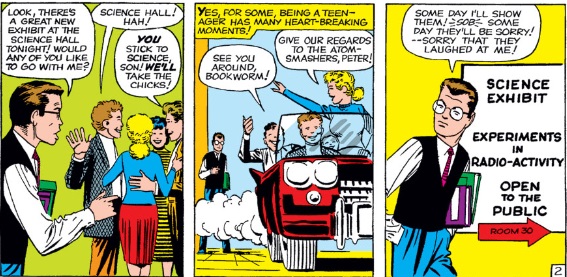
Peter Parker: science nerd

But there’s another way in which Peter Parker and Wade Watts differ, one that’s just as important as the one Coleman points out: what kind of nerd they are. It’s this difference that at least partially explains their moral differences as well. As we all know, Peter Parker got bitten by a radioactive spider that turned him into Spider-Man, but the reason he was bitten by that spider was because he went to a scientific exhibition, because Peter Parker was the kind of nerd who was really into science, who was studying to become a scientist. That’s why he was bullied, at a time when being a brainiac was not a good thing. There’s more than a hint of classism in the bullying, what with his principal tormentor being the popular, rich jock who could afford to tool around in a sports car, while Parker wore handme down clothes and thick nerd glasses. And that’s why he was bullied: he looked poor, he was a brainiac, he didn’t share the interests of the cool people nor felt the need to imitate them.

Wade Watts on the other hand is the worst possible sort of nerd, the one that thinks his (excessive) love of Star Wars and knowledge of eighties nerd trivia makes him special, gets him persecuted. He doesn’t create, he just consumes, never does anything original. He has a persecution complex but nobody’s persecuting him. His type is widespread among fandom, usually white men who’ve never had much hardship in their lives, but who’ve convinced themselves that a light spot of bullying during high school means the entire world is against them because of their brilliance. These are usually the same people who want to exclude anybody not like them — LGBT, women, PoC — from fandom, that only they are true fans though they never contribute anything. That’s the kind of fan who eat up flattering trash like Ready Player One.