The power of formula

I made the mistake of watching Masou Gakuen Hx H and Sacred Rider Xechs back to back last night and something struck me. Both are garbage shows, but Masou Gakuen Hx H still managed a level of coherence beyond Sacred Rider Xechs, even if it was borderline porn and in its broadcast form little more than an ad for the BD version. What the former did that Xechs didn’t, was sticking rigidly to the first episode formula for a “only boy in magic school” series. In his first day at school the protagonist runs across several girls, makes a bad impression on one of them, then saves her during an enemy attack as his power is revealed. Which in this case was molesting an unconscious girl, egged on by his sister, until her power meter was filled. It’s dull, predictable and you’ll have seen it dozens of times before, but at least it’s coherent.

Masou Gakuen: molest girls to save the world

Coherency isn’t something Scared Rider Xechs seems to believe in, if the jumble of scenes that makes up the first episode is anything to go by. There’s some guy with a guitar brooding on top of a ruined high school building, some scientists going down one of those elevator platforms from Akira where the lead scientist ends up murdering somebody because he disagrees with her decision to activate the dirigent, which is Dutch for conductor, but here obviously means something ominous. Then the opening plays, the scene shifts through some ditzy blond girl with Dutch flag hair ties missing her bus before running into broody guy. Another scene shift and we’re with a bunch of high school blokes excited that they may go to war, then the aliens attack the school (?), military base (!) and turn out to be a bunch of mud men, a military transport attempts to land, the guys from before transform into generic sentai dudes, while broody guys moves in on the dumbest looking bike I ever saw, he’s transformed to another world with the plane, opens the box and out tumbles a girl.
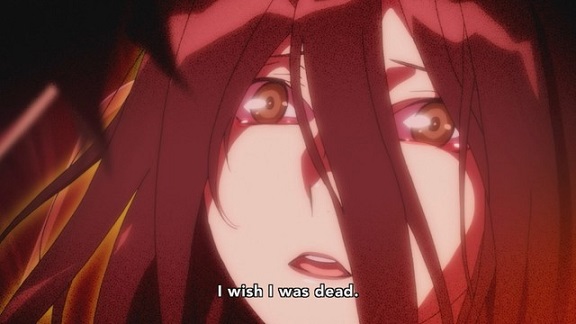
Scared Rider Xechs: me too after that painful episode

Whereas Masou Gakuen Hx H is dull and predictable and formulaic, Scared Rider Xechs manages to even screw up being formulaic. You can see what it wanted to do: provide a bit of setup for the rest of the episode before the opening, then cut back and introduce the characters before the threat from before the opening would materialise and the boys get to strut their stuff. But because it was done so cackhandedly, it failed. Mostly because it switched viewpoints too much and tried to introduce too many elements, some of which, like ditzy girl, ended up not mattering to the rest of the episode. Masou Gakuen Hx H on the other hand stuck to the protagonist’s point of view, which meant we got a good grasp of his personality (such as it is) and some hints on that of the girls he encountered. While both therefore are crapfests, Masou Gakuen Hx H at least shows the power of sticking to a formula. At least it got that.

Thirteen years later we finally know

Too late we get the establishment acknowledgment of what we knew already. There was a reason that two million marched in London against the war, millions more worldwide to try and stop it. We knew it was pointless and would only lead to more misery, that the reasons for it were lies, that it couldn’t stop, wouldn’t stop terrorism and –surprise surprise– it didn’t.

London antiwar protesters. From Wikipedia

When we marched we were told we were fools at best, naive idiots, complicit in Saddam’s crimes. The low end estimate of the excess deaths caused by the War on Iraq is in the neighbourhood of 1-1.5 million; considering what happened after the war and occupation ended, that is probably far too low. How much better would Iraq and the world be off right now had the sensible people not listened to and enabled the warmongering duo of Bush and Blair?

I blame Heinlein

It’s a day that ends in a “y”, so Sarah Hoydt must’ve said something stupid again. Yup:

The main reason I like first person singular is that for a moment it tricks you into that space behind the eyes of another person, relieving the loneliness of that narrative voice that can only ever describe your own life.

This is a universal and enduring quality. I’ve had teachers tell me — and to an extent they’re right — that first person is “less believable” because you KNOW you haven’t done those things.

Who believes that? Seriously, who believes that? Nobody, that’s who. First person singular is how you tell what you did this weekend to your cow-orkers around the water cooler on Monday. Nobody would confuse that with what they did that weekend. But that’s not the annoying thing about this quote. Rather, the tone of voice is what grates. I blame Heinlein for this. He was a master of selling total bullshit with a straight face, sounding authoritative even when it was clear he was talking out of his hat. But filter it through 3-4 generations of right wing imitators and it becomes what you see here: all the bullshit, none of the authority.

That Kuma Miko ending

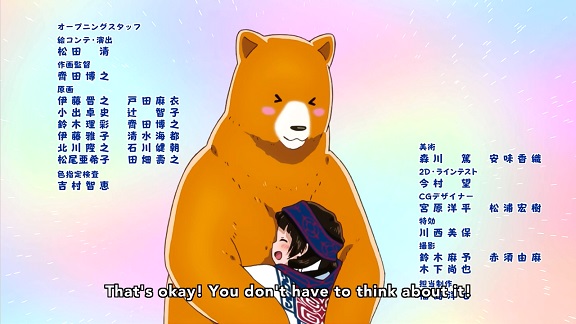
Kuma Miki: no thinking needed for girls

Kuma Miko was billed as a light hearted, cute comedy about Machi, a middle school priestess of a tiny little village out in the sticks and Natsu, her bear guardian/god of the temple she leads, as she wanted to start high school in the big city and he was doubtful about whether she was up to it. From the start there were hints of something nasty lurking in the show’s background: Machi was less of a protagonist and more of an object of suffering as Natsu sets her challenges while her uncle Yoshio ropes her into his schemes to revitalise the village. In the process what looked first like a typical anime foible turned into something more serious as it becomes clear Machi suffers from some sort of social anxiety disorder, not being able to cope well with anybody from outside her tiny and aged village. It all felt mean spirited as none of the adults in the series seemed to either take Machi or her obvious issues serious.

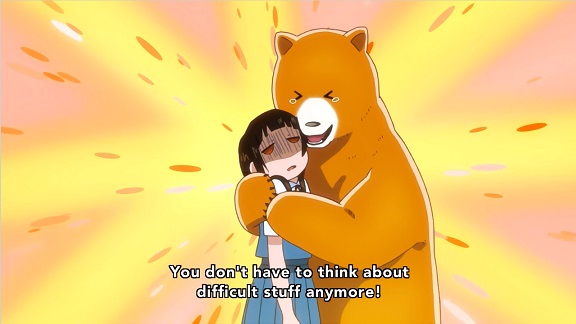
Kuma Miki: no thinking needed for girls again

It all came to a head in the series final. Episode eleven saw Machi entered into a local idol competition in Sendai, freak out and run away. You’d expect that the final episode would feature some sort of resolution, as everybody comes together and give Machi the strength to overcome her fears. Not the most original of endings perhaps, but it would’ve been decent enough. Instead we got Machi fleeing back home after she made her comeback to the stage and everybody delighted she did so. Ibless, among others, thinks this was a deliberate sendup on the part of the anime team:

from whatever motivation, the anime staff decided to manifest a certain perceived subtext within the original manga and highlight it through the show in a subtly deconstructive way designed to examine the disturbing implications of the source material’s setting.

I’m not so sure. It might’ve been deliberate satire, a rejection of the conservative and somewhat vile subtext in the original manga, but I never quite got the impression the animators disapproved of this subtext, unlike frex this Twitterer. Rather, it comes over a cackhanded attempt to craft an original ending to the series that re-established the status quo in the spirit of the manga. And even had it been intended to mock, Poe’s Law comes into effect, as clearly a lot of people including me did take it at face value rather than as satire. Moreso because its ideology isn’t that far removed from other anime series, just more open. That idea that community is more important than your own personal wishes, that girls especially are just happier and better off staying home, that’s not that far from the surface of other slice of life series. It’s just that Kuma Miko is especially nasty about it.

Not that I actually disagree with any of this


It takes a ten minute video for professional John Lennon crossed with Sasquatch impersonator/Youtube anime critic Digibro to grope towards the same idea as Damon Knight managed to express in one simple sentence: “science fiction is what we point to when we say it”. In other words, that on a certain level the quality of a given anime is determined by the sum of opinions about said anime and that as opinions shift, the critical consensus about this anime will also shift. Not the most stunning of insights, but anime criticsm is indeed roughly on a par with science fiction criticism fifty years ago.