I blame Heinlein

It’s a day that ends in a “y”, so Sarah Hoydt must’ve said something stupid again. Yup:

The main reason I like first person singular is that for a moment it tricks you into that space behind the eyes of another person, relieving the loneliness of that narrative voice that can only ever describe your own life.

This is a universal and enduring quality. I’ve had teachers tell me — and to an extent they’re right — that first person is “less believable” because you KNOW you haven’t done those things.

Who believes that? Seriously, who believes that? Nobody, that’s who. First person singular is how you tell what you did this weekend to your cow-orkers around the water cooler on Monday. Nobody would confuse that with what they did that weekend. But that’s not the annoying thing about this quote. Rather, the tone of voice is what grates. I blame Heinlein for this. He was a master of selling total bullshit with a straight face, sounding authoritative even when it was clear he was talking out of his hat. But filter it through 3-4 generations of right wing imitators and it becomes what you see here: all the bullshit, none of the authority.

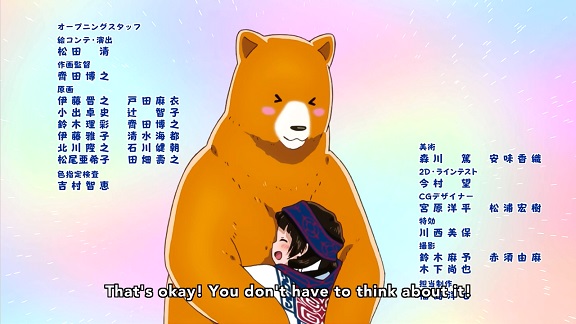
That Kuma Miko ending

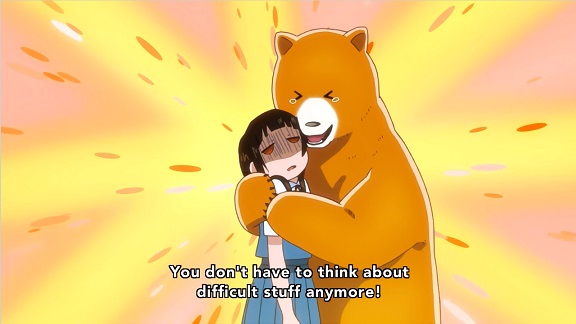
Kuma Miki: no thinking needed for girls

Kuma Miko was billed as a light hearted, cute comedy about Machi, a middle school priestess of a tiny little village out in the sticks and Natsu, her bear guardian/god of the temple she leads, as she wanted to start high school in the big city and he was doubtful about whether she was up to it. From the start there were hints of something nasty lurking in the show’s background: Machi was less of a protagonist and more of an object of suffering as Natsu sets her challenges while her uncle Yoshio ropes her into his schemes to revitalise the village. In the process what looked first like a typical anime foible turned into something more serious as it becomes clear Machi suffers from some sort of social anxiety disorder, not being able to cope well with anybody from outside her tiny and aged village. It all felt mean spirited as none of the adults in the series seemed to either take Machi or her obvious issues serious.

Kuma Miki: no thinking needed for girls again

It all came to a head in the series final. Episode eleven saw Machi entered into a local idol competition in Sendai, freak out and run away. You’d expect that the final episode would feature some sort of resolution, as everybody comes together and give Machi the strength to overcome her fears. Not the most original of endings perhaps, but it would’ve been decent enough. Instead we got Machi fleeing back home after she made her comeback to the stage and everybody delighted she did so. Ibless, among others, thinks this was a deliberate sendup on the part of the anime team:

from whatever motivation, the anime staff decided to manifest a certain perceived subtext within the original manga and highlight it through the show in a subtly deconstructive way designed to examine the disturbing implications of the source material’s setting.

I’m not so sure. It might’ve been deliberate satire, a rejection of the conservative and somewhat vile subtext in the original manga, but I never quite got the impression the animators disapproved of this subtext, unlike frex this Twitterer. Rather, it comes over a cackhanded attempt to craft an original ending to the series that re-established the status quo in the spirit of the manga. And even had it been intended to mock, Poe’s Law comes into effect, as clearly a lot of people including me did take it at face value rather than as satire. Moreso because its ideology isn’t that far removed from other anime series, just more open. That idea that community is more important than your own personal wishes, that girls especially are just happier and better off staying home, that’s not that far from the surface of other slice of life series. It’s just that Kuma Miko is especially nasty about it.

Not that I actually disagree with any of this


It takes a ten minute video for professional John Lennon crossed with Sasquatch impersonator/Youtube anime critic Digibro to grope towards the same idea as Damon Knight managed to express in one simple sentence: “science fiction is what we point to when we say it”. In other words, that on a certain level the quality of a given anime is determined by the sum of opinions about said anime and that as opinions shift, the critical consensus about this anime will also shift. Not the most stunning of insights, but anime criticsm is indeed roughly on a par with science fiction criticism fifty years ago.

Farewell Flying Witch

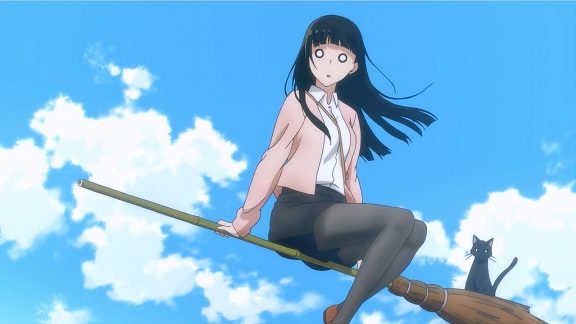
Flying Witch: flying for once

Flying Witch went out on a double bill last weekend, having kept up its high quality throughout its run. This was a show that if I had my way, would’ve run forever, the perfect way to start a lazy Sunday morning. Especially since one of my favourite gags from the manga hasn’t been used in the anime yet. It’s been funny, it’s been relaxing, a real balm to start the week with, as engaging in its everyday life scenes as in its more supernatural aspects.

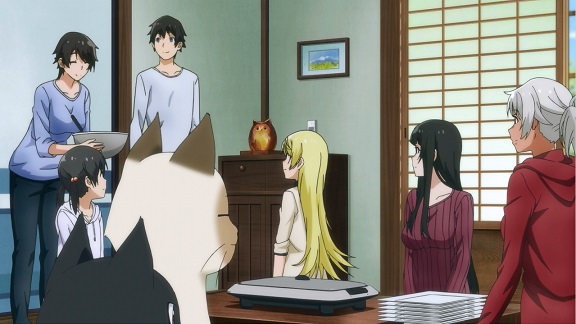
Flying Witch: flying for once

What I especially like about Flying Witch is the sense of family it has. You can see that five out of the six people in that screenshot above are related. Akane (extreme right) and her aunt (extreme left) have the same sticky out bits of hair, while they and the titular flying witch, Makoto, share a *ahem* similar build. Kei too, to the right of his mother, shares her hair style, while Chinatsu looks more like Makoto again. When they’re in motion these similarities are even greater and it helps set the series apart. Their interactions which each other too are natural in a way that you don’t see often in anime. Chinatsu is the most believable little sister/niece character I’ve seen in a long time in how she acts around her brother Kei and her two cousins Makoto and Akane. I hope we get a second season, or at least an OVA of it.

That time Englehart was Byrned

Byrned -- from WCA 51

Andrew Weiss is asked is there “A hated story or story line you like?” and answers with John Byrne’s run on West Coast Avengers

Without trying to defend that nonsense (because, honestly, I can’t), I will say it regrettably overshadows an fairly entertaining and mildly innovative run of comics. For starters, it was John Byrne’s return to Marvel after a three year stint at the Distinguished Competition. The significance of that might be lost on kids born after 1980 or so, but for my demographic peers it was a Big Deal. Our memories of his X-Men and Fantastic Four and Captain America work was recent enough to give Ol’ Crankypants another chance.

Byrne’s run happened just as I was branching out from reading Dutch translations of Marvel series to the originals, as the local comic shop had finally started to carry them. First priority lay of course with all the series that had not been translated and WCA was one of them. For a noob like me, Byrne’s dynamism and willingness to shake up the status quo was great, even if I didn’t like what he was doing to the Scarlet Witch, who already was a favourite of mine. It was only later, when I’d more context to place his stories in that it became clear all his change was for the negative.
Byrned -- from WCA 56

And it was only when I read an angry open letter Steve Englehart had send to Amazing Heroes that I realised that was probably deliberate. Byrne has always had a reputation for trashing everything he didn’t like in series he took over, prefering to strip continuity back to his own view of what Lee and Kirby did, rather than build on the work of other, lesser writers. As far back as 1982, when Byrne had only just started his Fantastic Four run, you had Len Wein and Marv Wolfman complaining about the changes Byrne made. In an interview for The Fantastic Four Chronicles special put out by Fantaco, Len Wein wrote: “I muchly resent what John is doing, I resent his implication that everything in the past 20 years hasn’t happened, that it’s still 1964.” Now on The Fantastic Four, Byrne created as much as he broke down, but on West Coast Avengers it was different. True, he brought back the original Human Torch and remade Hank Pym, Failed Superhero into Jump Suit Battle Scientist Hanky Pym, which was rather cool, but apart from that:
Byrned -- from WCA 44

  1. Tigra reverted to a cat like state
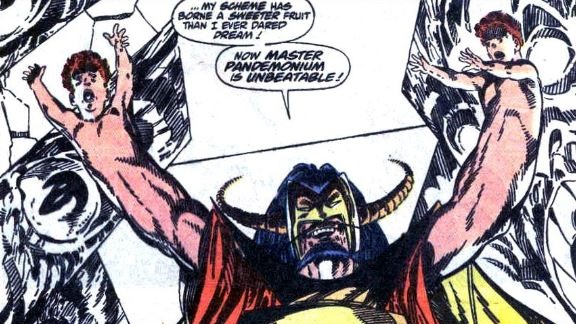
  2. Master Pandemonium, from independent villain to lackey of Mephisto
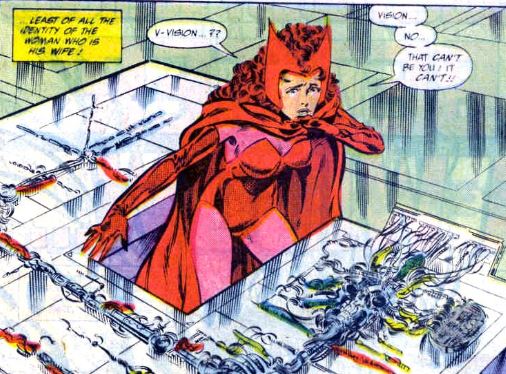
  3. The Vision went from a crying android into an emotionless, “logical” Data clone
  4. Vison got a new, fugly piss yellow costume
  5. Scarlet Witch went insane and joined Magneto for a bit
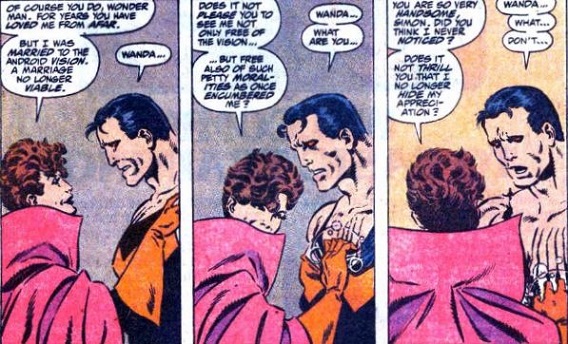
  6. Scarlet Witch went insane and molested Wonderman
  7. Wonderman meanwhile hat the hots for the Witch
  8. The Vision and Scarlet Witch’s babies? Never existed, just shards of the soul of Mephisto

Byrne started his run with issue 42 and left with 57 and from begin to end he set out to systematically demolish everything that Englehart had done with the Vision & Scarlet Witch. Personalities destroyed, marriage demolished, their kids retconned out of existence, etc. It’s hard not to see that as a deliberate vendetta against Englehart, especially in the light of the troubles he’d later ran into on his other two titles under DeFalco as editor-in-chief. Rereading it leaves a bitter taste in the mouth, seeing the creations of a writer who surely deserved better be torn down so brutally.