Spring 2016: the healing power of moe

The cute girls doing cute things (and occassional cute boys doing cute things) show is one of the staples of anime and this season is particularly rife with them. These slice of moe shows may all look alike, starring a bunch of high school girls going through their everyday lives having mild adventures, sometimes centered about school club activities, but as Digibro shows in the video above, there are clear differences in quality and aim between them.

When I started getting back into anime properly last year this sort of show wasn’t on my radar, but as I got in the habit of watching anime seasonally, I found myself watching them more and more. Not just cute girls doing cute things, but slice of life shows in general. This season about a third of the shows I follow are slice of life, not counting a show like Haifuri which is also cute things doing cute things, but with a bit of action thrown in. If I put them in order of how much I like them and how well they were made, this is the order I’d come up with.
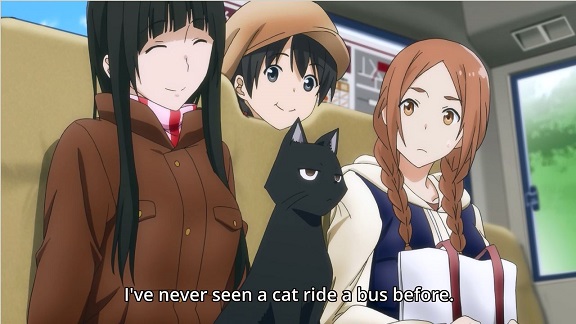
Flying Witch: a cat riding the bus

  1. Flying Witch
    This comes out late enough on Saturday night that I end up watching it on Sunday mornings and it’s perfectly fitted for that: calming and soothing, about the small trials and triumphs of an apprentice witch living with her non-witchy cousins in the countryside. The Japanese call this sort of show an Iyashikei or healing show, meant to calm you the fuck down and it certainly does for me. What I especially like about it is the natural way in which the various characters interact with each other, how much Chinatsu actually looks and acts like a young girl rather than an anime stereotype of a little girl.
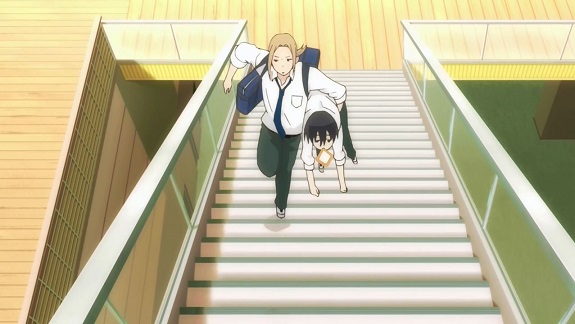
Tanaku and Ohta late for school

  1. Tanaka-kun wa Itsumo Kedaruge
    Tanaka-kun is a lazy sod; Ohta-kun is his enabling friend together they fight crime. The consistently most funny show this season, with great sense of timing, a lot of excellent supporting characters and nice twists on anime cliches. (Case above).
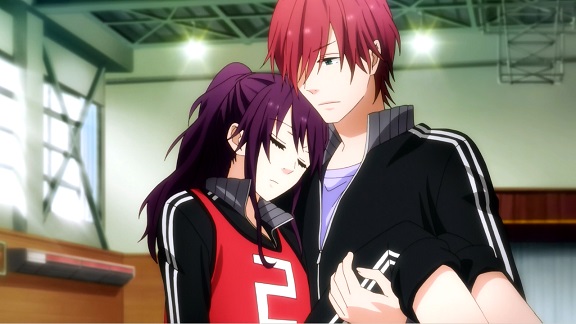
Nijiro Days is romantic

  1. Nijiro Days
    This actually started last season and at first I thought it would just be another obnoxious anime romcom, but turned out to be much better than its first episode would suggest. Centered around four high school boys and their romantic interests, each episode is only fifteen minutes long, which might be the ideal length for a show like this. It keeps things tight and moving fast, while still having room to flesh out the characters. One of those shows where each episode builds on the previous ones and is stronger for it. Each of the characters is also well rounded enough that you can see why they’d fall for each other, rather than have the series tell you that they did.
Chihiro and Madoka

  1. Shounen Maid
    When his mother dies, a young boy is taken in by his uncle and works for him as a housekeeper because his mother taught him that he shouldn’t be dependent on charity. That description was enough to kept me from trying the series, but after hearing somebody rave about it I gave it a second chance. I expected age inappropriate sexual tension between the primary school protagonist and his uncle, what I got was a show about family and grief. There’s an undertone of melancholy as Chihiro and his uncle learn to live with each other as a family, while each learns new things about their mother/sister; an undertone of regret at how things could’ve been.
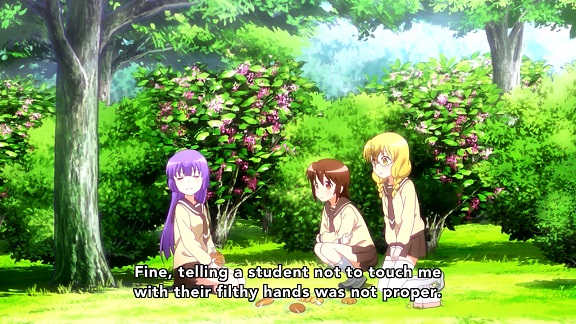
Sansha Sanyou: former rich girl, evil class rep, food hog

  1. Sansha Sanyou
    A show about “the black-hearted class representative, the poor girl on a daily bread-crust diet and the wlaking black hole” as the ending theme has it, this is the quintessential cute girls doing cute things show. Three main characters who are somewhat more fleshed out than needed, a host of slightly less rounded supporting characters going through daily life and familiar anime situations. It has a good sense of humour and some character growth which sets it apart from similar shows.
  2. Bakuon!!
    Cute girls riding big motor bikes. What sets it apart is that it gets rather deep into bike culture and doesn’t use it as just an excuse to have a group of cute girls hang around together. I know little about bikes, but the good natured trash talking between Onsa Amano, the Kawasaki fangirl and Rin Suzunoki, the Suzuki fanatic is very recognisable.
  3. Anne Happy
    Five girls each with their own particular unhappiness/misfortune hanging over them, are put in a special class to learn to overcome them and become happy. They mostly stick rigidly to their roles and there really isn’t any character development, but it’s funny and not a bad way to spend twenty minutes.
  4. 12-sai – Chicchana Mune no Tokimeki
    Twelve year olds in the last year of primary school learn to struggle with romance and friendship. This would be higher if not for the unconscious sexism on display in it. At one time the main protagonist is the love interest of two boys and then gets blamed for it as two timing by the rest of the class. This may be realistic, but missing is some pushback against this idea; instead the show seems to tacitly agree with this. In general, also the idea that you can’t be friends with boys if you’re in a relationship.
  5. Sakamoto desu ga
    Sakamoto is the perfect high school boy: cool, cooler, coolest, able to turn every situation to his advantage. All the girls want him, all the boys …find him somewhat of a prick until they’re won over by his perfection. This is humour so deadpan, so dry the Atacama Desert feels oppressively humid in comparison. When it works, it’s great, but it misses more often than not.
  6. Kuma Miko
    A slice of life comedy about a middle school priestess and her bear god living out in the boonies. She wants to go to high school in the big city, he continuously challenges her on that because she’s patently unsuitable for it. Hilarity ensues. Somewhat.
  7. Pan de Peace!
    As Digibro shows in the video, this is bargain basement moe stuff, with no depth to it and arguably made just to fill three minutes of dead air. But because it’s this short, I still end up watching it.
Re Zero: torturing the otaku hero

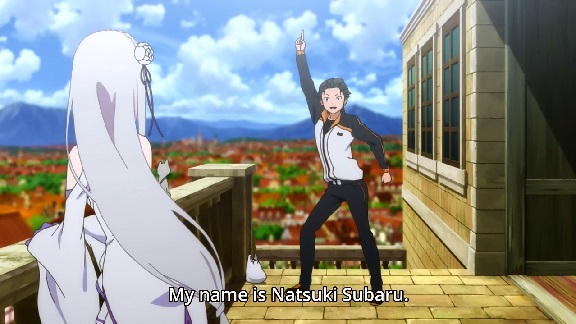
Re-Zero: Subaru strikes a pose

As you can tell by the way he walks, Natsuki Subaru is an otaku shut-in transported to a fantasy world, no time to talk. He takes it all in stride, sure he knows how the story will go as somebody will be there to give him an origin and magical powers. That doesn’t quite happen, but he does get involved with a silver haired sorceress who saves him from some robbers and who in return starts helping looking for her stolen badge. Genre savy and cocky, Subaru is a smart aleck and snarker, a familiar sort of hero, even his track suit is shared with KonoSuba’s protagonist. An otaku stand in, we’ve seen him before in other anime series where video game knowledge means the chance to become a badass in another world — though it takes Subaru far longer than it should to realise that every time he’s killed, he resets back to his starting point, “his last save game”.

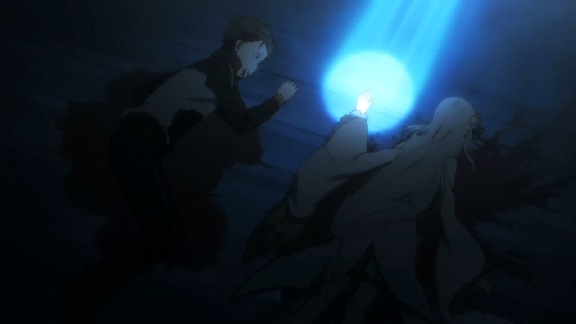
Re-Zero: death hurts. A lot

Pure wish fulfilment of course, that idea of being able to reset and replay your life to make all the right choices the second time around and this time save everybody, getting to be the hero in your own private fantasy game. What makes Re:Zero interesting is that the series is aware that this ability isn’t cost free. For a start, there’s the act of dying itself, with Subaru coming to a gruesome end multiple times even in the first (double length) episode: even if he is good as new the moment he wakes up, the trauma and remembered pain is still there.

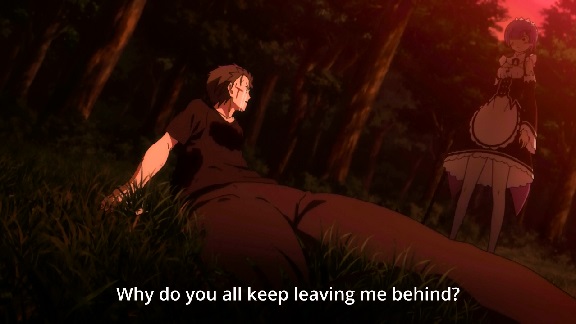
Re-Zero: death means being left behind

But that’s only part of it. The far worse part of it is what it does to his relationship with the people around him, after a few times being killed and resurrected. Because he becomes understandably focused on his goal of not dying, over time and a few cycles he starts behaving increasingly like a save scummer playing Dragon Age focusing on the most efficient path through the cycle, losing the emotional connection with what he’s doing. At the same time, all the history he builds up with his friends is lost after every reset, with only Subaru remembering it, having to rebuild it from scratch each time. Finally, from their view his actions must seem more and more irrational with each cycle, making him look more suspicious in a climate in which they’re already somewhat paranoid, making it more difficult for him to reconnect with them. No wonder he has a breakdown by episode seven.

There was a lot of criticism of Re:Zero precisely because Subaru was such a perfect cliché of the otaku wish fulfilment hero at first. Seven episodes in, it’s clear why this was necessary for the story Re:Zero wanted to tell. What it does is pulling the rug from under that fantasy of the otaku hero, by showing the cost hiding behind it. It’s an interesting subversion of the trapped in a fantasy game story, coming at it from yet another angle than KonoSuba or Grimgar did last season. This emotional journey is why I kept watching the series, even as some of the surface elements repelled me at first.

Macross Delta 7: Best Couple spotlight

Macross Delta: gay hacking with Reina and Makina

So we open the infiltration mission with a pre-opening song gay hacking scene featuring the series’ best couple, Reina and Makina. I know I’ve been hammering a lot on this, but I can’t help but like how the show portrays their relationship through little scenes like this. Reina’s first hacking attempt on the defence network fails, so Makina leans in and offers a hand before the two make the Walkure sign together, flipping off the viewer in the process. It shows how much they trust and like each other without you needing to be told this directly.

Macross Delta: Rei Rei is a cute kitty

The planet Voldor is populated with cat people, so that means dressing up with cat ears and lots and lost of nyanderful puns. Of course it would be Mirage who wants to spoil everybody’s fun, but it’s impawssible. You do have to wonder why the Walkure team would be sent in to infiltrate this supposedly not very strategic planet, but if it was logical it wouldn’t be Macross. And anyway, who cares when Best Couple is cosplaying cat girls?

Macross Delta: water and oil

We got a bit of their back story this time as well as to how their relationship got started. Guess what? It didn’t start out well, with them fighting to the point that Walkure had to cancel shows because of it. The picture says it all. There’s Kaname, Walkure’s leader, explaining how the two used to be oil and water, while the sexual tension comes through in the song lyrics even as they stand facing away from each other, arms crossed but one eye still on the other. You can feel their story from that one brief cut — and I do hope we’ll at least get an OVA out of the beginnings of Walkure at some point.

Macross Delta: Freyja loves them apples

Plotwise not much else is of importance. The main characters are fairly useless throughout, Best Couple gets to showcase their gay hacking skills twice, while singing two different new songs and Freyja still has the best reaction faces in all of Macross. So much so that it’s difficult to choose just one to show. A setup episode if there ever was one. One thing that has been constantly missing so far has been Mirage taking the spotlight, so I hope that will change next episode, when the main three are left on their own.

Flying Witch: timing!

You can only pose at night

So I’ve been reading the manga version of flying Witch today after being well impressed by the anime adaption. An adaptation always changes things and it was interesting to see how the anime had changed and improved on some the gags in the manga like the weed pulling gag or Makoto getting lost on the way to her own bedroom. Just by having more control over timing these jokes have a better comic beat. There’s only so much you can do in a manga to control the reader’s flow of time: it works better to see somebody go left, wait a second and two then go right than to see the same thing in two side by side panels. Nevertheless timing in a manga can be perfect as well, as we can see in the two pictures shown here. First we have the setup above, which comes a few pages before the payoff below, which takes up an entire page. By using full length, short panels the mangaka perfectly controls the reader’s timing: each panel takes about a second to read, gving you three seconds of build-up before the payoff in the last one.

impeccable timing in this sequence from Flying Witch

It works perfectly, but in the context of a monthly manga that has twentytwo pages per installment, it comes at a significant cost: the payoff itself is an entire page and including setup it’s five pages of story being used for a single joke. That’s a lot. It’ll be interesting to see if and how the anime adapts this scene, which may be a minute long, if that? A lot less costly in the context of a twentytwo minute episode. Which also explains why the anime could expand on these jokes whereas the manga couldn’t: it’s more efficient.

The magic of Umina Chika

A cozy panel from Sangatsu No Lion

Just look at that picture. Don’t you just want to join them under there? I love the detail Umina Chika puts in panels like this in Sangatsu No Lion. The crowded, cramped nature of the panel underscores the coziness of the living room at new year’s eve, everybody snug under the kotatsu, cats and all. It’s a bit of gentle humour to set the scene before the mood turns serious. A pity this series doesn’t have an official English translation yet.