I can’t help but hear this as a ska/2-tone type song. Must be the saxophones.
Macross Delta 3 – deculture and a half

It’s the third episode and it’s time for a trainings montage. As well as mercat antics. Hayate Immelman gets the pleasure of having Mirage Farina Jenius as his tutor, while Freyja Wion is starting idol training with the Walkures. in between their respective training sequences there’s a bit of light hearted slice of life starring an evil mercat stealing fish from the restaurant/lodgings Hayate is staying at. This will turn out to be more important than it first seems.

Hayate is trained on the VF-1EX, the trainer variant of the venerable VF-1 from the original Macross. Which took place in 2009 while Delta is set almost sixty years later, in 2067, giving the VF-1 a time in service rivaling that of the real world B-52 which first flew in the fifties and is still used today. Of course the plane is upgraded somewhat from its first appearance, going full CGI here. It also looks a little bit less a blatant F-14 knockoff than the original.

Both Hayate and Freyja are not doing too hot up until the former is in his final exam, a mock dogfight against Mirage, watched by Freyja. She wants to help him in some way and the Walkures leader reminds her that she has her own fight. Freyja takes this to heart and starts to sing while stretching out her hand towards Hayate’s plane. Which begs the question: if Hayate can only fly well when Freyja sings and Freyja can only sing well if she sees him fly, what good are they on their own? I do love how well they fit together though; an even nicer couple than Frontier‘s Ranka Lee/Alto Saotome. Whether the oneside belligerent (sexual?) tension between Mirage and Hayate can cope is anybody’s guess. Focus here was very much on Hayate & Freyja this episode: need more Mirage next time.

In the end of course Hayate’s raw talent and instincs win it from Mirage’s experience and guile, as inspired by how that thieving mercat evaded attacks, he finally manages to shoot her. Freyja meanwhile sings her heart out and gets appreciative comments from the Walkure team members. Two of whom were casually established to live together earlier in the episode btw, which is irrelevant but still nice to see. in other news, I can actually do that Walkure hand gesture, which puts it one ahead of the Spock sign.
FLCL is a harem show
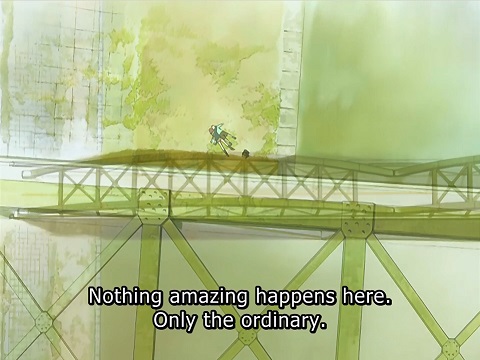
Obviously. It likes to pretend it isn’t by being all arty and deliberately incoherent, using pretentious dialogue and weird style shifts, but that trick doesn’t work anymore since everybody has seen Bakamonogatari by now. If you look at the story properly without being distracted by the trickery, what remains? A rather ordinary story of a boy at the cusp of adolescence falling in love with and being pursued by a trio of girls who each have their own reasons to involve themselves with him, in the end not ending up with any of them. A boy, Naota Nandaba, who lives in a town where nothing happens without goal or purpose, who is about to be dragged into strange adventures before he can get back to his normal life.
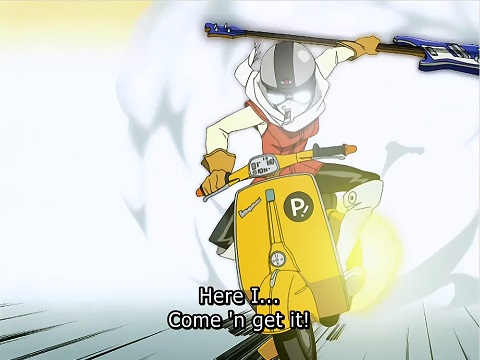
And it all starts when she comes to town, the strange and frankly terrifying alien girl riding a Vespa and wielding a guitar. The catalysor; every harem title has one, the one who sets the plot in motion, drives the hero from his cozy everyday life, brings chaos into order, the one being chased while the other haremettes try and catch up. Haruko Haruhara is the energetic meddling kind, unleashing Naota’s inner powers by bashing him in the head with her guitar. Older, unconventional and sexually aggressive, she’s the manic pixie dream girl.
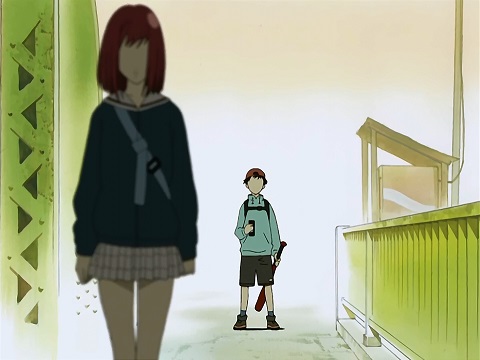
Meanwhile, pity the poor childhood friend, Mamimi Samejima, who has been hanging around with and taking care of him long before Haruko came around. Despite her again being older and a high school girl while Naoto is still in middle school, she hangs around him so much his friends call her his wife. She has no chance. She’s also an outcast, ditching school and being bullied, perhaps why she likes to mess around with Naoto, forcing her affections on him; not that he seems to mind too much.
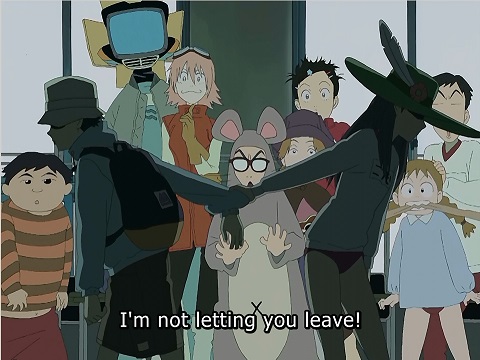
And finally there’s the class rep, Eri Ninamori, daughter of the mayor, who also has her eye on Naoto, though not to the point of molestation like the other two. She’s the one that has the most straightforward crush on him, a classic tsundere type from before it equalled continuous physical assaults. Eri is the one with the least screen time, but also the one who “wins”, remaining behind while the other two leave town. She deserves to win, because she’s the one who uses Naoto the least. While she does have an ulterior motive in letting him play the lead next to her in the school play — an attempt to get both her parents to come and see her as they’re embroiled in divorce — she also seems to like him for himself. Haruko only wants to use his powers to free the pirate king Atomsk while Mamimi used to be the girlfriend of Naoto’s older brother, who left for America to play baseball and is using Naoto as a substitute.
An ironic sort of harem series then, with Naoto not being pursued for himself but as a stand-in for somebody or something else and Naoto himself not being all that interested in love or girls anyway, more tolerating than happy about his circumstances. but a harem series nonetheless.
Ouran High School Host Club’s rape culture issues
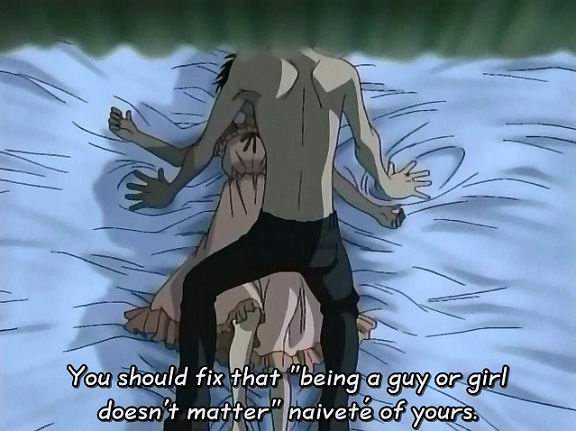
That was the moment I found the metaphorical turd in the punch bowl and realised that there was indeed a shitty taste to my refreshing harem rom com anime series. A pity, because up until then I had been enjoying the story about a scholarships tudent at a very elite highschool who is mistaken for a boy and financially blackmailed into working for the school’s host club after she broke an expensive vase –nobody in Japan has heard of insurance or the story would’ve been over before it could start. Until then I could sort of ignore the sexist subtext behind Ouran High School Host Club, but when you get rape threats (fake or not) used to “prove” to our heroine that she’s a girl and should be more aware of that, a line is crossed. Though a certain amount of sexist assumptions is a given in a shoujo manga and for the most part it’s not that noticable in Ouran High School Host club, this particular scene and episode made it hard to continue with the series.
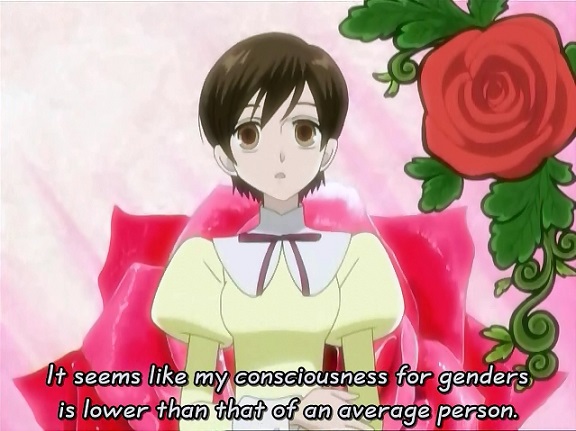
What made me keep watching was Haruhi Fujioka, the fish out of water at the very rich and very elite Ouran High School and also the one sane woman in a bunch of amiable idiots, often the unwilling centre of their plans. She’s interesting because she isn’t the usual blushing heroine existing only to be romanced. Not bothered by which gender people see her as, she passes as male in school and the club to be able to be a host and pay off her debt. And I uses “passes” advisedly, as there is something genderqueer about her, especially at first. What’s refreshing is that she doesn’t change that much over the series even when she becomes more lovey dovey.
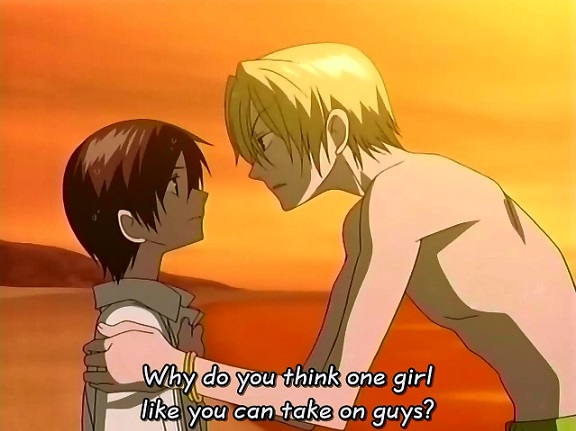
Is episode eight then just an isolated misstep, just a bit of awkward sexism, excused by the quality of the rest of the series? Not entirely. The idea that Haruhi should keep remembering she’s a girl and act like one crops up in other parts of the series as well and is one of those pernicious bits of gender essentialism that anime & manga, especially in the romance & harem genres, seems extremely fond of. In the context of the episode it also comes across as victim blaming, of Haruhi being responsible for being thrown off a cliff or of being threatened by rape because she trusted her friend and “wasn’t cautious enough”. That’s not something you can defend no matter how good the rest of the series is.
Erased is neither a time travel nor a mystery story
It seems nobody remembers Quantum Leap anymore, because otherwise fewer people would’ve complained about the time travel in Boku Dake Ga Inai Machi/Erased. The time travel mechanism isn’t important to the story it wanted to tell, it doesn’t matter how it works or where it came from; just as in Quantum Leap you might as well explain it as an act of god. The world needed to be put right hence Satoru travelled back in time. A tool, not a theme.
Similarly, the more I think about, the less I think that this was ever meant as a real mystery. Again, the serial killer aspect and the need to prevent his mother from being murdered is a tool to get to the real meat of the story, which is that Sataru gets to do over his life not only so that he can save his class mates and mother, but especially so he doesn’t end up in his mid-twenties as a failed mangaka. He learns to make friends, learns to trust people and learns to accept their help when before he tried to do everything on his own. That’s why the thriller aspects of the plot are the weakest and the heart of the story lies in how he learns to get along with his friends, not to mention his relationship with his mother.