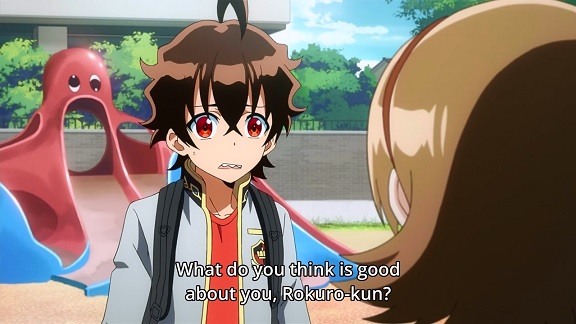
Twin Star Exorcists is not very good at this romance thing

There is nothing good about Rokuro Enmado from Sousei no Onmyouji

Twin Star Exorcists‘ Rokuro Enmado is your typical battle shounen protagonist: hot blooded and stupid with at first glance nothing good about him, which doesn’t stop him confessing to semi-strangers regularly only to be shot down just as regularly. Only his crazy shark like teeth set him apart from dozens of other bland, brown haired protagonists with tragic pasts. Because of course that’s the reason for his current uselessness: a deep seated trauma, something that happened two years ago and which he hasn’t been able to process. He used to be a hugely powerful exorcist until this happened but now refuses to have anything to do with it.
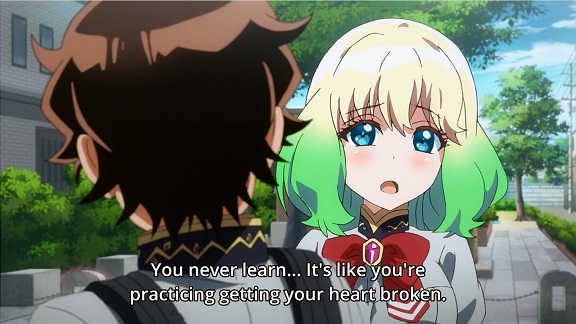
Doomed childhood friend Otomi Mayura from Sousei no Onmyouji

Otomi Mayura is his childhood friend. Beautiful, smart and outgoing, she seems everything Rokuro isn’t, so why does she hang around him so much? Because of course being a childhood friend, she both feels a bit responsible for him and loves him. She knows something about his trauma as well as his real character, which is why she sticks by him and tries to somewhat take care of him, though this last isn’t as pronounced as with some childhood friends. More than anything else she wants to keep Rokuro safe and for him to love her as much as she does him.
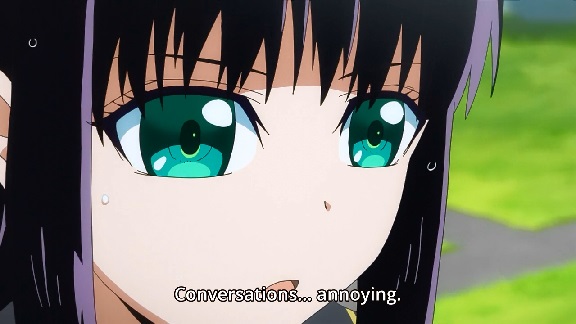
Benio Adashino from Sousei no Onmyouji

But Otomi is doomed to fail in getting Rokuro to love her because of this girl, Benio Adashino, superstar exorcist, completely devoted to her quest and almost emotionless outside it. She and Rokuro don’t quite hit it off, she seeing him as a slacker, he seeing her as the naive fool he was before his trauma, but of course this is only temporary. As much as they at first dislike each other, there’s also a mutual attraction as each starts to recognise the other’s virtues. Specifically, it’s Rokuro’s willingness to protect and fight for her that appeals to Benio, not so much his actual personality. Again, typical battle shounen behaviour.
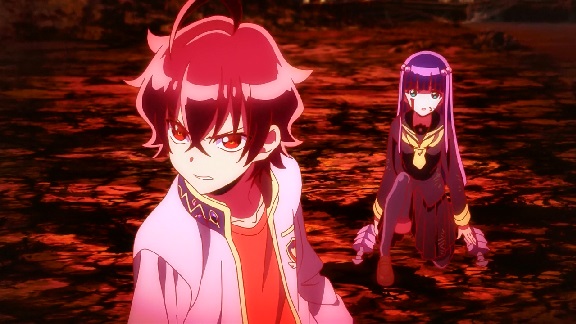
Rokuro shielding Benio - from Sousei no Onmyouji

Twin Star Exorcists is rather generic in its characterisation and plot, if well executed, and it’s this genericness that makes it easier to spot the problems with how its depiction of romance it has in common with many other battle shounen manga. Romance in these series is a matter of grand gestures, extravagant promises made by the male protagonist to the heroine, often as it is here, done before he knows anything about her. She meanwhile falls in love almost against her will, despite her initial impressions of him being less than favourable. Indeed, often the male lead remains a loser in everyday life, no matter how many demons or impurities he slays. He may not realise that she has fallen in love, but continues treating her (and everybody else in a skirt if it’s a battle harem series) the same as before; she certainly won’t tell him until she’s absolutely sure of him and her feelings both.
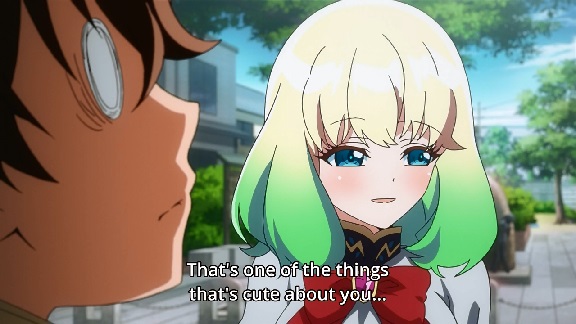
Mayura and Rokuro - from Sousei no Onmyouji

The poor old childhood friend meanwhile has seen the boy she loves confess to every girl he ever met, save her, while she stood there on the sidelines patching up his ego after the inevitable rejection, taking care of his domestic needs or helping him cope with his dark and troubled past. Either she lacks the courage to confess because she’s afraid of rejection, or the stupid fucker she loves is too dense to realise why she’s so friendly and kind. Superficially the childhood friend looks like a gender flipped Nice Guy, but in the end it’s still a very blokey fantasy to have a beautiful girl fuzz over you and do all the domestic chores for you without you having to invest anything in the relationship. No emotional labour necessary and you can’t fool me into thinking those dense protagonists don’t think of the childhood friend as the emergency backup girlfriend candidate.
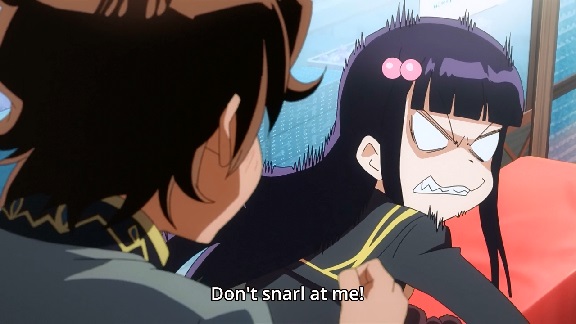
Benio and Rokuro - from Sousei no Onmyouji

The main heroine of course doesn’t have to engage in all that emotional labour. She’s free to be aloof or antagonistic, bad at household work, a dangerous cook, as long as she’s beautiful and almost but not quite as good as the protagonist at the demon slaying. She’s the unobtainable ideal up until the point that our hero either surpasses her through his innate talent at whatever magic thingy she needed years to train for (said innate talent manifesting itself mainly through LOTS OF SHOUTING) or because he’s the first man who wanted to protect her and sees her as a real girl. Because boy, gender roles are not very enlightened in manga/anime Japan and no matter how badass she is, secretly she wants to be a proper girly girl. Again though, the point is that our hero doesn’t have to invest all that much in the relationship; none of the tedious work required that a real relationship would entail

And all of that is perfectly acceptable in fiction, if it wasn’t so omnipresent in manga and anime stories (and to be fair, in a lot of western media too). If almost every story you read says it’s alright to not make an effort to be attractive and you can still get all the girls even if you’re a loser and a slob, just as long as you make the right noises about wanting to protect them, that’s not going to do wonders for your interactions with real women.

The smell of print comics gives me flashbacks now

Tabletop Gaming has a White Male Terrorism Problem (but don’t think your nerd hobby is any better):

White male terrorism is the white underbelly of the gaming community, meant to terrify and disrupt the lives of those who threaten the status quo by race, gender, or sexuality. It succeeds because the majority of men in the community are too cowardly to stand against the bullies and the terrorists. At best, these cowards ignore the problem. At worst, they join the terrorists in blaming their victims for the abuse. The point of online terrorism is that it is endless, omnipresent, and anonymous.

This is an absolutely disgusting story and sadly all too typical for many women/POC within fandom and nerd circles. I want to believe that this is an American problem and that we’re better here in Europe, but I fear that’s a lie.

How to run an accessible con: some notes

Did you know that hotel carpet can be a pretty big burden on wheelchair users? That it can take up to three times as much energy to move your wheelchair over carpet than over a hard floor and therefore wheelchair users are tired more quickly than normal? When you think about it, it seems obvious, but the trick is to think about it when you’re not somebody with actual experience in riding a wheelchair around a con…

Just one of the things we learned in Vanessa May’s “how to run an accessible con” workshop/demo at Mancunicon. An one hour panel is of course nowhere near enough to begin to understand the subject, but it did provide a good overview of the mindset you have to have to be able to make a con accessible.

And the first question you have to ask as a con is how you define accessibility. Vanessa May urged people to take the broad view, to take into account both physical access needs (for wheelchair users, visually impaired, auditory impaired, etc) and psychological needs (quiet spaces for people with social anxieties to be able to decompress frex) as well as folding in things like religious or ethics based dietary choices under the access umbrella.

That was the theme that ran through most of her discussion about access needs. It’s relatively easy to get the 101 stuff right, to make sure that the hotel can be entered by wheelchair users, but harder to take the broader picture into context of what is really needed to make a hotel con accessible for them. Not just entrances, but baths, toilets, rooms, accessibility of hotel bar & restaurant, capability to get on the panel stage unaided, etc. There are a lot of things you can only discover with the aid of somebody with practical experience of being in a wheelchair trying the hotel out; the same goes for other kinds of access needs.

The other thing May stressed throughout the panel was to keep in mind the big picture. Access should be central to the con, but the ideal convention does not exist. Improving access has costs, both monetary and opportunity wise and they have to be balanced against the other needs of the con. One example being the carpet mentioned above: hard floors everywhere would be better for wheelchair users, but much harder on those walking. Some people argue that access needs should be the first to taken into consideration, but May is wary of that as it can be its own form of privilege. Related to that is the requirement to make the con’s accesibilty known early: what is and isn’t there so people can make decision to come or not before they waste money on memberships and hotel rooms.

Some of the points made by May as well as the audience when talking about concrete examples of deciding accesibility:

  • The venue is the highest priority as infrastructure limits what you can do
  • Assess hotels not just a year before, but also shortly before the con as things may have changed. See not just the rooms picked out by the hotel, but one or two more so you don’t just get the very best of the hotel.
  • Beds: height, type of mattress.
  • Toilets should be higher in accessible bathroom
  • Mobility – Looking for things like doors, level access, lifts (back of house/freight lifts) and CARPETS as riding carpets takes more energy than hard floors
  • Visual: look for things hard to notice (overhanging plants) patterns & colours
  • Echoing spaces for people with hearing issues, hearing loops, alarms that have alternate modes for visual and hearing impaired people
  • Function space: quiet rooms for people to chill out other than your hotel room
  • Does the hotel reset the function rooms each night, because then you have to set them for access again in the morning.
  • Escape seats at the back of the rooms for people with anxiety
  • Mobility spaces in the back or middle so people in wheelchairs/scooters don’t block people behind them
  • Reserved spot next to mobility space for partners.
  • Reserve 1 spot at the front for people with combined issues
  • Involve the concom early to make sure both they and everybody else know access is important.
  • Brief the gophers and note that many abled bodied people do not quite understand disabled needs
  • Listeners: need to be trained, known and trusted because it’s the ideal position for a predatory person to abuse.
  • Audience: Tech team is almost always in the front line because they’re in the room as reps of the con and get the issues first hand
  • Audience: The whole team has to think access.
  • Ribbons as visible clues, rather than as requirement to get help.
  • Social media needs to emphasise access
  • Website: alternative website with big print, screen reading, big easy buttons

Rocket Girls — Hōsuke Nojiri

Cover of Rocket Girls


Rocket Girls/Rocket Girls: The Last Planet
Hōsuke Nojiri
214/250 pages
published in 1995/1996

Morita Yukari came to the Solomons Islands to look for her long lost father, who disappeared on his honeymoon seventeen years ago, leaving behind her pregnant mother when he went out on a walk to look at the moon. She has little hope of finding him, but feels she has to try after hearing rumours of a Japanese enclave on one of the islands, which led her to Maltide. What she doesn’t know is that the enclave is the Solomon Space Association which is attempting to create a manned rocket capability but having little success with their new booster which keeps going kaboom. So they decide to go back to their older design, but that has less weight lifting capacity so the race is on to shave off as much weight as possible, including from the astronaut. Who promptly flees. Various things happens, Yukari gets caught up in it and when the SSA director sees her, he has the bright idea to turn her into an astronaut — no weight loss needed for a high school girl weighting only fifty kilos.

Read more…