KonoSuba: how is anime fandom like a succubus dream?

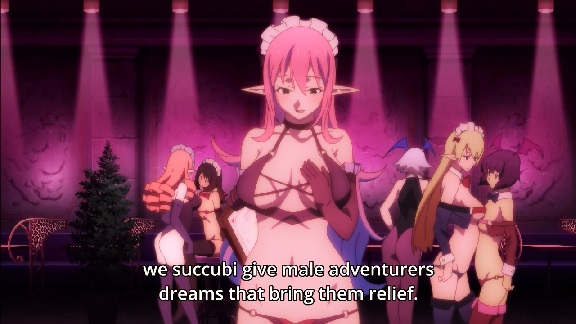
KonoSuba #9: for a small fee, a succubus will visit your dreams and give you relief

Episode nine of KonoSuba raises the question: what if you could pay a succubus to give you a wet dream, featuring the person(s), settings and deeds of your choice, with no worries about legality or morality, because after all it’s “only a dream”?
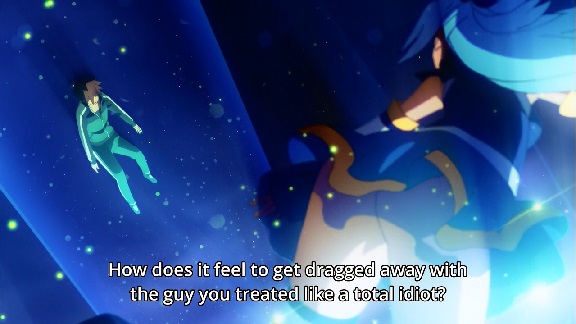
KonoSuba #1: How does it feel to get dragged away with the guy you treated like a total idiot?

Backtracking slightly: Kono Subarashii Sekai ni Shukufuku wo!, KonoSuba for short, is another entry in the ever popular “nerd gets trapped in a RPGesque fantasy world” anime genre and, like Grimgar, it’s a bit of a deconstruction. Unlike Grimgar though it does it not by amping up the reality of what it would be like to be dropped in a fantasy world where you have to kill to survive, but rather by taking the piss of the genre and RPGs in general. So our hero Kasuma is not all that likeable, mainly out for himself and stuck with the goddess that reincarnated him into this world, who he dragged down with him out of pure spite when she was slightly too amused about the dumb way he died. They’re joined by Megumin and Darknes, respectively a mage with a fantasy complex specialising in explosion magic who only has the stamina for one explosion a day and a masochistic paladin who sexually harasses her opponents by imagining the lewd and embarassing things they’ll do to her once they defeat her. KonoSuba has done very well in creating humour out of the characters’ own flaws: they get what they deserve, with everybody treated equally (un)fair. Nobody is perfect, nobody is the designated chewtoy and ultimately they’re stuck with and deserve each other.
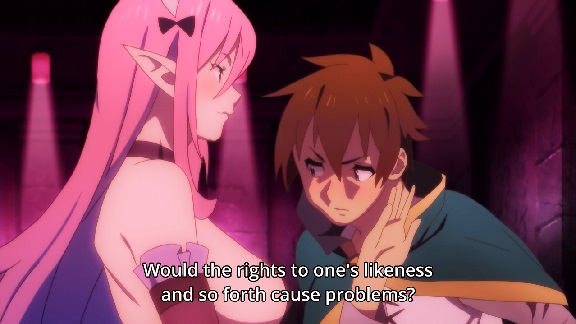
KonoSuba #9: no worries about legality or morality in dreams

Most episodes are loosely dedicated to mocking one aspect or another of this subgenre and episode nine takes aim at the venerable element of fanservice and sexual wishfulfillment — not just common in this particular anime subgenre of course, but found everywhere. It does so in a typical KonoSuba way, by taking the idea of the succubus to its logical extreme and have them set up a business providing nice dreams to male adventurers to relief stress, for a small fee and some of their vitality. Kasuma being who he is, carefully examines the bait held before him for its legal and moral implications, all of which the succubus counters with that it doesn’t matter, it’s just a dream. Now is this just me or does this hint at some of the more questionable defenses of dodgy anime or manga? “It doesn’t matter, it’s not real”?
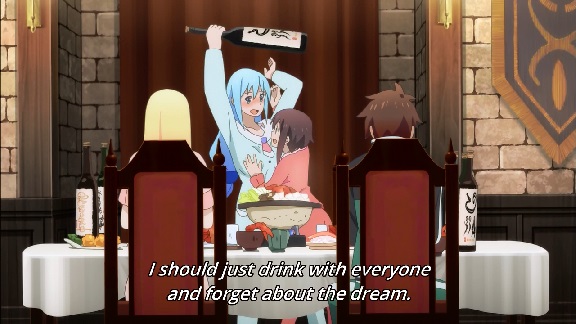
KonoSuba #9: of course Kazuma chooses dreams over reality

But if you thought that was a bit too on the nose, the next scene is worse. Kasuma returns home to find out the parents of one of his team mates have sent over a lot of high grade crabs and booze and the team’s having a party. He wants to join in, but comes to his senses when he remembers the warning the succubus had given him: don’t drink too much booze that you sleep too deep to dream. Yey as he looks at the happy faces of his friends, he considers giving up and join them — not. In the end, he rejects physical pleasure and companionship for the dubious comforts of a wet dream. If that isn’t direct commentary on a part of anime fandom that rejects the physical “3D” world in favour of “2D” fantasies, I don’t know what is.

KonoSuba #9: having your cake and eating it

But does it work? the problem with making fun of immature sexual fantasies is that the end product could look a lot like an immature sexual fantasy itself, the same way most anti-war movies can’t help but glamourise war at least a bit. And with all the jiggling butts and tits on display — ugly though the art is this episode — you can’t help but think KonoSuba wants to have its cake and eat it too. Once the plot moves to the inevitable confusion between dream and reality when Darkness walks in on Kazuma in the bath, any pretense at satire is lost in favour of bog standard fanservice. Especially since the series had a fair bit of fanservice in it already, if only by teasing about how Aqua doesn’t seem to favour wearing panties. In the end therefore this mocking doesn’t quite work, the show undermining its own argument. Yet being even willing to try and have this argument wins it points from me. KonoSuba is a show that caught me by surprise from the start and even this flawed attempt at social commentary confirms it’s one of the best shows this season.
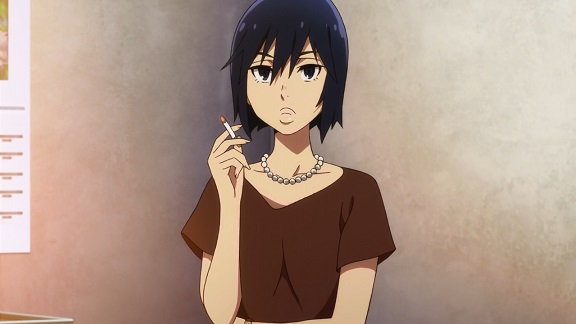
Best mother in anime

Sachiko Fujinuma - From Boku Dake ga Inai Machi episode 1

Boku Dake ga Inai Machi is a taut psychological thriller, about Satoru Fujinuma, a failed mangaka, who travels back in time to his childhood to stop a serial killer, but that’s not what makes it special. It’s what happens in the very first episode, after the protagonist used his involuntary time traveling powers to stop an accident from happening, only to get injured in the process himself. As he goes home from the hospital to his dinky one bedroom apartment, he finds his mother, Sachiko Fujinuma, waiting for him, having rushed over to take care of him while he’s on the mend. That’s rare; usually in anime, even obsessed with high school settings as it is, parents rarely show up, being conveniently dead, too busy with work or just plain ignored to take much notice of their children’s adventures. But here we have a mother of an adult son, who not only comes over to care for him when he needs her, but who also helps him a few days later when his powers kick in once again and it is she who, by virtue of just paying attention at the right time, who actually prevents a child abduction. Which in turn gets Sachiko wondering about those serial killings because she is sure she recognised the would-be abductor. Which of course gets her murdered quickly, with her son as the main suspect.

From Boku Dake ga Inai Machi episode 1

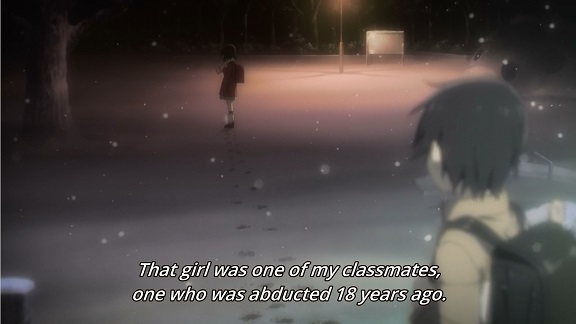
Don’t worry: she gets better. Or rather, as said, Satoru’s despair catapults his mind back into time from 2006 to 1988, when he was eleven years old, to just before the original serial killings took place. He now has a chance to make good the mistake he made back then, when he could’ve saved his classmate Kayo Hinazuki from being murdered, if only he hadn’t left her alone when he saw her in the park on the night of her abduction. For Satoru, his inadvertant leap back into time means a chance for redemption, a chance not just to prevent his classmate’s murder, but that of his mother as well. If he can chance the past, he can change the present he left behind. if he can change the past.

From Boku Dake ga Inai Machi episode 4

Satoru of course tries and hide the truth from his mother, but Sachiko isn’t the type to stay fooled for long. She knows her son is up to something when he suddenly starts befriending Kayo and quietly supports him from the sidelines. A single mother, she works as a news announcer and she’s smart enough to guess some of what’s happening, to be there when Satoru needs her the most. Even as he thinks he has to solve the problem of keeping Kayo save from both her killer and her own abusive mother on his own, she’s there to help. Which you could argue is the central theme of Satoru’s own character growth over the course of the series so far: learning to rely on others, especially his mother, when his problems are too big to tackle on his own.

From Boku Dake ga Inai Machi episode 8

More so than Satoru, Sachiko is the heart of Boku Dake ga Inai Machi, with her presence felt throughout the series even in those episodes she’s barely present for. It comes out in the little things, like how she greets Satoru and friends when they bring Kayo back in episode eight. Or the fact she’d already bought pajamas for her beforehand. Or more mundanely, how she and Satoru act around each other in their day to day lives, something you don’t really notice much until it’s driven home when Kayo’s there to see the contrast with her own home life. Not that you need that contrast to know that thanks to her, Satoru will always have a home to return to, a place he can be safe in no matter what happens. That’s why her murder has to be put right or the world itself isn’t right.

Gatchaman Crowds

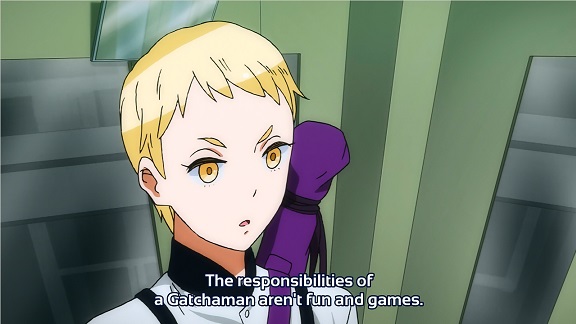
Sugane Tachibana is a bit of a stick in the mud

About two thirds of the way through watching the entire series of Gatchaman Crowds I started to realise that it was actually a classic Hegelian dialectic masquerading as a manic pixie dream girl rom-com, with the Gatchaman superhero team in the role of the dour salaryman shaken up out of their boring routine. In the grand tradition of Japanese superhero shows, the Gatchaman team is fighting a secret war against an alien menace, the MESS, computer generated LEGO blocks fond of abducting people, barely managing to keep the status quo. They’re super serious about following the rules for how superheroes should behave, none more so than this guy, Sugane Tachibana, who is the first to come into contact with our manic pixie dream girl.

Hajime Ichinose

Cast in that role we have Hajime Ichinose, the latest Gatchaman recruit, who of course goes to the same high school as Tachibana. Cheerful, energetic and much, much smarter than any of the Gatchaman first give her credit for, she blithely disregards all of the conventions that Tachibana and the others try to drill into her. It’s immense fun watching her stroll through the first two episodes, making contact with the MESS and revealing that the entire reason for the Gatchaman to exist was based on a misunderstanding, as the MESS apparantly never realised the people they abducted were sentient. Hajime gets them all back, leaving the team jobless, but not for long. There’s a new alien menace, Berg Katze, a renegade Gatchaman, who delights in murder & mayhem, wanting to see the Earth go up in flames as he manipulates a war of everybody against everybody, starting with the Gatchaman’s own Tachikawa City. But even this menace doesn’t cause hajime to change her outlook on life: she remains cheerful, optimistic and wanting to communicate, to understand Berg Katze.

Rui Ninomiya

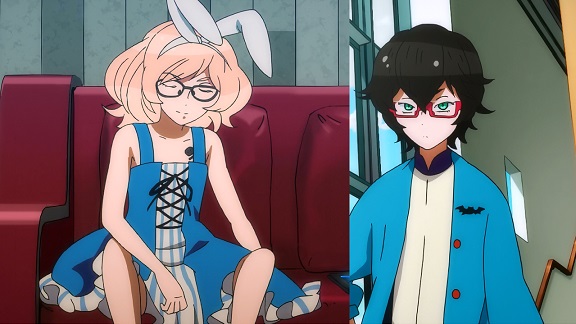
Of course what would a rom-com be without a love rival? That’s the role of Rui Ninomiya, the genius behind the GALAX social network that Haijime is a huge fan and user of. Rui is perhaps best described as an internet utopian, with their GALAX network enabling its users to help each other through the gamification of altruism, people getting points for e.g. assisting with a traffic accident. Rui believes that the world is flawed and wants to “upgrade” it through GALAX; they don’t believe in leaders or heroes. Judging from their appearance, they’re genderqueer, with the subtitles refering to them with both male and female pronouns, which the show presents matter of factly without drawing attention to it; that’s just how Rui is.

Paipan is not a panda

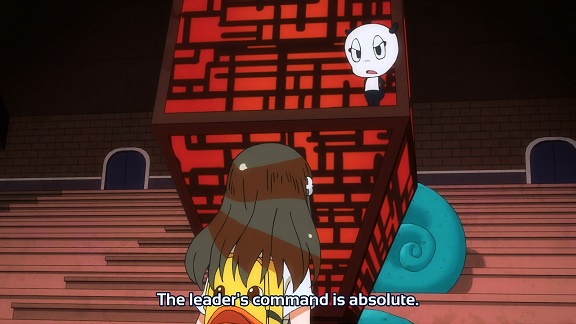
Getting back to the Hegelian dialectic, we have the Gatchaman team, with Sugane Tachibana as their spokesman, providing the thesis: the world needs heroes to protect it from alien threats and other menaces. These heroes need to keep their identities secret to be able to operate, as well as keep their battles secret not to worry normal people. You need rules, you need to be serious, you need to realise this is a life and death struggle and act accordingly. Saving the world is serious bizniz.

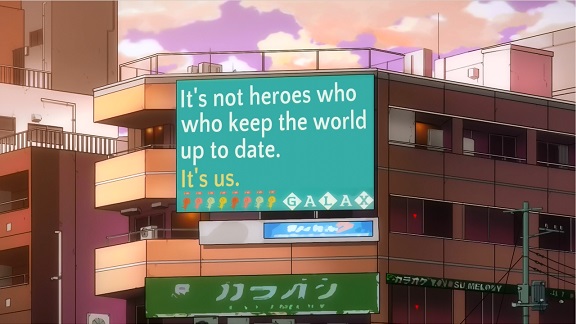
Rui Ninomiya's philosophy in one billboard

GALAX and Rui Ninomiya then provided the antithesis: we don’t need heroes or leaders, normal people are capable of solving their own problems, even an existential threat like this, as long as you give them the tools and trust them to use them. Be flexible, be creative, have fun and problems will disappear almost of their own accord.

Hajime and her collage circle

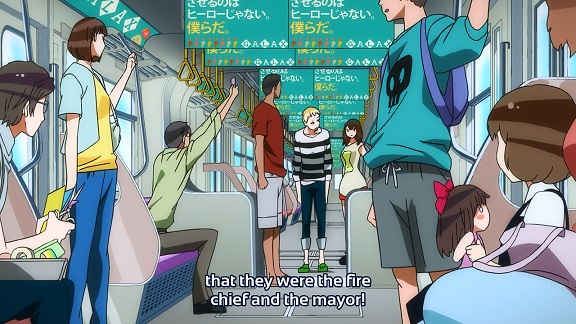
The synthesis comes of course courtesy of Hajime Ichinose, who from the start has been able to mash up those two philosophies and transcedent them. In the second episode she takes Tachibana to her collage group’s meetup, where to his surprise he learns the mayor and fire chief are part of it, while in the same episode we also see her noting how well connected and near to each the city’s various power centres are. It’s a subtle foreshadowing of the role she plays in the second half of the series, at home both with the flexibilty and grassroots power of GALAX and using more traditional power structures. For her it is self evident that if the world needs heroes, they should be public and not ashamed to use their real names, but also that if you want to trust ordinary people with the power of GALAX, you have to give them that power, not try and establish a new elite with it.

That’s what I like about Gatchaman Crowds and Hajime especially, that seeing straight through hypocrisy or contradictions to the heart of the matter. In the end this is a optimistic show, celebrating the ability of people to come together and work for a common goal, seeing the good in both tradition and innovation. Hajime Ichinose is the embodiment of this clear eyed but optimistic vision.

Friday Funnies: One-Punch Man

someone who is a hero for fun

Saitama was an ordinary, unemployed man until one day he decided that if he couldn’t find a proper job, why not become a superhero for fun. So began an intensive training routine of ” 100 push-ups, 100 sit-ups, 100 squats and 10 km of running every day”. Three years later he’s the strongest superhero in the world, somebody who can defeat any enemy no matter how strong with one punch: One-Punch Man. Which really puts a crimp on his plans: it’s no fun to be a hero if you can never have a proper fight. Though Saitama gets increasingly powerful heroes and villains to deal with, the end result remains the same. Nor does being the strongest hero bring Saitama fame or glory. At first his efforts go unrecognised, his victories attributed to those heroes who happen to be in the neighbourhood when he does his thing. Later on, when he gets registrered as a proper hero, he’s immediately suspected of cheating somehow. Because there’s no way a low class hero like him is actually capable of doing what does, is there. He just doesn’t look like a hero so he doesn’t get treated like one. It’s an old Marvel Comics trick: give the hero problems he can’t solve with his fists.

One punched again

Those are basically the two jokes that drive One-Punch man: he can neither get a good fight nor the respect he deserves. It’s a simple concept executed brilliantly, which is why it could make the jump from a self published web comic with ONE’s not very good artwork to a proper manga series, art now courtesy of Yusuke Murata. Saitama himself basically kept his look from the web comic, but the rest of the cast got a realism upgrade, though many of them are still grotesques, just with added shading and defined muscles. Murata is a great artist for a series that lives on its fight scenes, while ONE has a knack for telling absurd stories absolutely straight, taking the lunacy of your average superhero or shounen battle manga up to eleven without feeling the need to point out how absurd it all is. One-Punch Man works because it keeps that essential beat of a shounen manga, of introducing bigger and bigger menaces with each new storyline and it keeps things exciting by focusing as much on all those other heroes who can’t end their fights with just one punch.

Mumen Rider

Heroes like Mumen Rider, a hero whose power is that he rides a bicycle and wears biking gear. He first popped up getting the credit for one of Saitama’s actions in an early story, before he got his chance to shine taking on a villain that had already beaten the crap out of a dozen or so overpowered heroes. What looked like a joke character turned out to be a genuine hero, putting his life on the line against somebody he had no hope of defeating, just to try and protect the innocent, no matter how futile. It’s absurd to think that a suburban dad getting way too much into biking would make a superhero, but the character and the story both play it straight and in the end, for all the silliness, Mumen Rider is a hero.

the absurdity of Saitama

That I think is the core of One-Punch Man‘s appeal, having completely stupid, completely serious characters wander around a ridiculous world populated by idiots but never, ever coming out and admitting it, leaving them their dignity rather than depantsing them. You can read it as a straightforward superhero story and enjoy the fights even as you get amused at the names and powers thrown around. Saitama himself never notices the absurdity of his life; it helps that he’s an idiot. One-Punch Man therefore is one of the best superhero comics I’ve read in years, because it embraces the essential stupidity of superheroes.