Friday Funnies: One-Punch Man

someone who is a hero for fun

Saitama was an ordinary, unemployed man until one day he decided that if he couldn’t find a proper job, why not become a superhero for fun. So began an intensive training routine of ” 100 push-ups, 100 sit-ups, 100 squats and 10 km of running every day”. Three years later he’s the strongest superhero in the world, somebody who can defeat any enemy no matter how strong with one punch: One-Punch Man. Which really puts a crimp on his plans: it’s no fun to be a hero if you can never have a proper fight. Though Saitama gets increasingly powerful heroes and villains to deal with, the end result remains the same. Nor does being the strongest hero bring Saitama fame or glory. At first his efforts go unrecognised, his victories attributed to those heroes who happen to be in the neighbourhood when he does his thing. Later on, when he gets registrered as a proper hero, he’s immediately suspected of cheating somehow. Because there’s no way a low class hero like him is actually capable of doing what does, is there. He just doesn’t look like a hero so he doesn’t get treated like one. It’s an old Marvel Comics trick: give the hero problems he can’t solve with his fists.

One punched again

Those are basically the two jokes that drive One-Punch man: he can neither get a good fight nor the respect he deserves. It’s a simple concept executed brilliantly, which is why it could make the jump from a self published web comic with ONE’s not very good artwork to a proper manga series, art now courtesy of Yusuke Murata. Saitama himself basically kept his look from the web comic, but the rest of the cast got a realism upgrade, though many of them are still grotesques, just with added shading and defined muscles. Murata is a great artist for a series that lives on its fight scenes, while ONE has a knack for telling absurd stories absolutely straight, taking the lunacy of your average superhero or shounen battle manga up to eleven without feeling the need to point out how absurd it all is. One-Punch Man works because it keeps that essential beat of a shounen manga, of introducing bigger and bigger menaces with each new storyline and it keeps things exciting by focusing as much on all those other heroes who can’t end their fights with just one punch.

Mumen Rider

Heroes like Mumen Rider, a hero whose power is that he rides a bicycle and wears biking gear. He first popped up getting the credit for one of Saitama’s actions in an early story, before he got his chance to shine taking on a villain that had already beaten the crap out of a dozen or so overpowered heroes. What looked like a joke character turned out to be a genuine hero, putting his life on the line against somebody he had no hope of defeating, just to try and protect the innocent, no matter how futile. It’s absurd to think that a suburban dad getting way too much into biking would make a superhero, but the character and the story both play it straight and in the end, for all the silliness, Mumen Rider is a hero.

the absurdity of Saitama

That I think is the core of One-Punch Man‘s appeal, having completely stupid, completely serious characters wander around a ridiculous world populated by idiots but never, ever coming out and admitting it, leaving them their dignity rather than depantsing them. You can read it as a straightforward superhero story and enjoy the fights even as you get amused at the names and powers thrown around. Saitama himself never notices the absurdity of his life; it helps that he’s an idiot. One-Punch Man therefore is one of the best superhero comics I’ve read in years, because it embraces the essential stupidity of superheroes.
The fannish fallacy is alive and well

*Sigh*:

Multiple board members responded by saying that if we made the harassment policy any more concrete, we’d be tying the hands of any future chair of RainFurrest who wanted to work things out informally between the people involved, and we would enforce bans on socially awkward individuals who just didn’t know the rules. I heard from multiple people that making our harassment policy any more specific would cost us members, and they refused to consider that people who refused to show up because of our harassment policy were probably not the kinds of attendees we wanted.

Taken from a post-mortem on how furry con Rainfurrest got scuppered, this paragraph explains so much about how cons get bad. It’s the full on fannish fallacy in action: we can’t exclude people because exclusion is inherently bad, no matter what they do. In this case it went worse than usual as apparantly it empowered some part of the con to run rampant over multiple years, something the con seemed to condone as the cost of business, until the hotels it depended on had had enough. Whoops.

Of course the other side of the coin is that while it’s a sin to exclude people we know, people we don’t know or who are not quite like us, we’re happy to exclude, either deliberately or as a consequence of not dealing with harassers and other problem fans. Mark Oshiro found that out last year at ConQuest, where as a guest of honour he not only was all but ignored by the concom, but was harassed too.

It’s all so depressing to see the same problems crop up in con after con, when it isn’t rocket science to solve them. Plenty of conventions have managed to not only get a proper code of conduct assembled, but also provide the resources to deliver on its promises. All it requires is a mindset change, to understand that harassment is not a victimless crime or prank, but something that stops people from coming to your con, that will get your con into trouble sooner or later the same way it did Rainfurrest.

Grief in Grimgar and Kanon

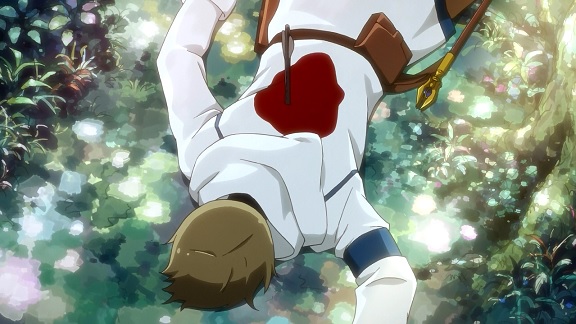
The death of Manato from Hai to Gensou no Grimgar #4

Hai to Gensou no Grimgar is the story of a party of (what we presume to be) amnesiac gamers trapped in a fantasty world and drafted in what’s essentially a race war against goblins and other monsters if they want to survive. And they’re not the ‘leet kind of gamers either, but rather the ones left over after all the capable people banded together and left them. inexperienced and incompetent at first, what keeps them together and alive is Manato, their leader and healer-priest. The heart and the soul of the team, he’s too good to be true and therefore keeps raising death flags for himself all through the first three episodes, particularly because he keeps going into the thick of battle and healing everybody the moment they get as much of a scratch. In episode four his flags come due, as the party attempts an ambush of a small group of goblins, they’re ambushed themselves instead. As they retreat Manato is shot in the back by a goblin archer, who deliberately aimed at a spot he can’t reach so he can’t heal himself, dying as the party reaches safety.

After the burial, from Hai to Gensou no Grimgar #5

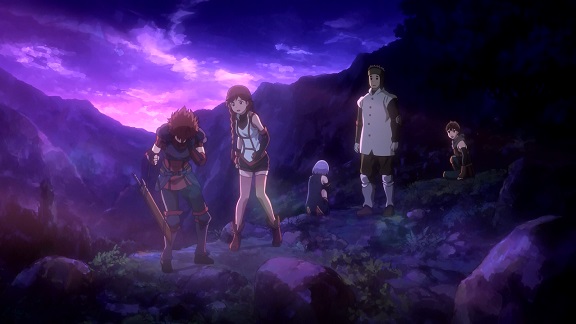
In a matter of minutes the party has lost their leader and friend, something which doesn’t fully sink in until they bring his body to the temple he was a priest of and heard the head priest officially pronounce his death. Unlike the audience, they didn’t see it coming, couldn’t prepare for it and therefore their grief is raw and sudden. At first there’s anger and denial, a refusal to believe he really is dead and it is only after they were forced to cremate him (so he wouldn’t turn into a zombie), that anger makes way for a dull acceptance. The party is splintered, robbed off its heart, each of them alone and lonely and only capable of thinking of their own grief, something the opening scenes of episode five make painfully clear.

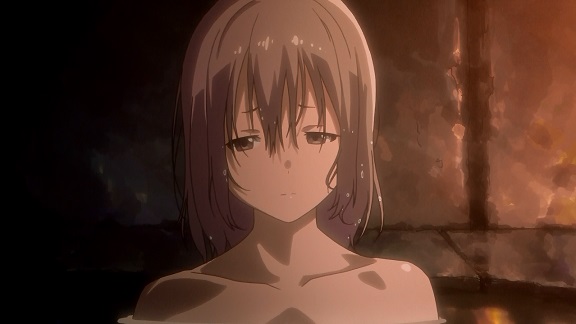
Shihoru grieving, from Hai to Gensou no Grimgar #5

Shared grief often brings people together, but it helps if you can prepare yourself. In Grimgar‘s case, the death of Manato instead worsens the already bad relationship between the two girls in the party and the three remaining guys. Things had been wrong for some time already, but with Manato as mediator the differences and mistrust were papered over. With him gone, the men retreat to the pub while the women are left on their own, with the silver haired Shihoru especially taking his death hard, having only opened up to him just before his death, leaving Yume having to deal with both their grief with no support from anybody else. For long stretches in the episode they even disappear, the narration following the boys to the pub instead.

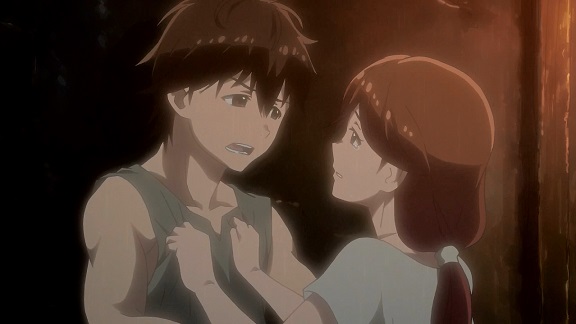
Haruhiro and Yume grieving, from Hai to Gensou no Grimgar #5

What makes Manato’s death especially hard to deal with is that it was avoidable: the party got caught up in its own hubris, became careless, took one too many risks. Manato himself wasn’t free from blame either, as his successor, Mary, makes clear. Brought in by Haruhiro only a day after Manato’s death, she’s a very different sort of healer: disinclined to fight in the front or heal every little scratch, prefering to keep her distance and save her strengths, something that’s objectively the better strategy. But it doesn’t make the guilt everybody feels about getting him killed easier to bear, nor does Haruhiro’s unilateral decision to replace him lessen the distance between him, Moguzo and Ranta on one side and the girls, Yume and Shihoru on the other. It’s only when he runs into Yume at their bathing house and for the first time several episodes actually sits to talk with her, that they start to heal and get some of their mutual trust back.

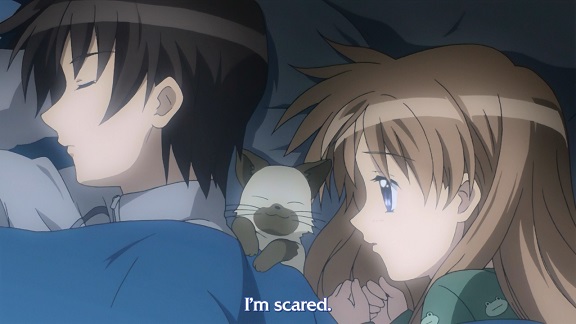
Makoto is scared. From Kanon #9

Because his death was so unexpected, because of existing tensions, grief in Grimgar hits hard and sharp, leaving the characters barely able to deal with it. Compare this with Kanon (2006), which also deals with grief, but of a sort we’re more likely to encounter than that of Grimgar: anticapatory grief, of knowing a loved one, a family member is terminally ill and will be dead soon. Most of us are more likely to die of an illness than by goblin arrow after all; most of us will have experienced such a death in the family at least once by the time we’re adults. Episodes eight and nine of Kanon feature one of the best portrayals of this kind of grief I’v seen, even if the illness causing it is of a mystic nature.

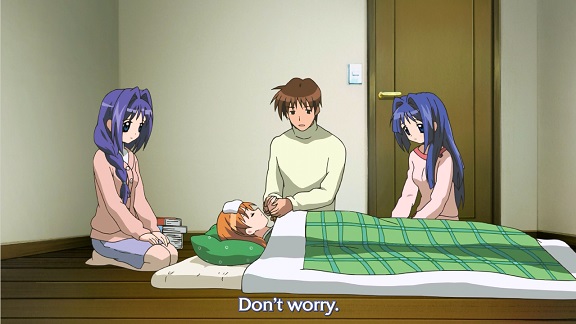
Yuichi comforts. From Kanon #9

As you probably know if you’re into anime, Kanon is a Kyoto Animation adaptation of a Key visual novel, which together with several other of such adaptations they made their reputation as one of the best anime studios with. The story revolves around Yuichi Aizawa, coming back to town after seven years of absence to live with his cousin and aunt, running into various girls he used to be close to when he lived there before, having forgotten about them in the mean time, now rediscovering their relationships and solving their problems. One such girl is Makoto Sawatari, who attacks him for now reason one day as comes out of the supermarket and who he brings home when she collapses. Most of the interaction between her and Yuichi is fairly lighthearted and rather funny, until things get serious from episode seven onwards, as Makoto starts to forget how to be human. It turns out she’s a fox spirit who turned human out of a desire to be with Yuichi, knowning that her time would be limited.


In the next two episodes we see her regress more and more, with Yuichi abandoning school and everything else to be with her as much as possible, trying his hardest to make her happy in the few weeks or days they have left together, culminating in the “wedding” shown above. At the same time, as her condition worses, we sees his horizons narrow, as the time left to her turns from weeks into days into hours. It’s a familiar grief to me, having gone through much the same with Sandra, eleventh hour wedding and all, much more familiar than Grimgar‘s. Each in their own way succeeded in making me feel the reality of their grief without sinking into melodrama.