Small differences matter

When Ayato met Julis

In Gakusen Toshi Asterisk, the protagonist is Ayato, a dark haired boy going to magic school to fight and win its annual fighting tournament for reasons. Due to circumstances, he ends up walking in upon a half naked, flame wielding pink haired tsundere girl, Julis, who calls him out for a duel to restore her honour. They fight, he wins, stuff happens and they fall in love while working towards the tournament together.
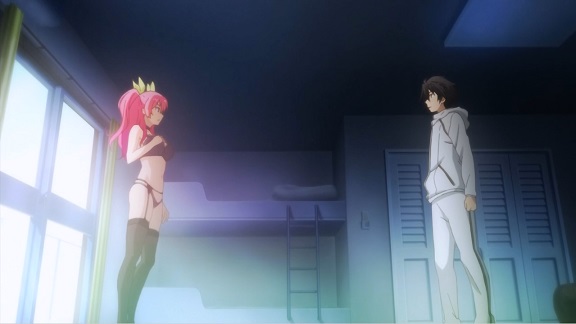
When Ikki met Stella

In Rakudai Kishi No Cavalry, the protagonist is Ikki, a dark haired boy going to magic school to fight and win its annual fighting tournament for reasons. Due to circumstances, he ends up walking in upon a half naked, flame wielding red haired tsundere girl, Stella, who calls him out for a duel to restore her honour. They fight, he wins, stuff happens and they fall in love while working towards the tournament together. Wait, where did I hear this before?


Yes, these two series, both of which were aired during the Fall 2015 anime season, at first glance look so similar it’s possible to set the ending theme of the first to a scene from the second and not look out of place. They’re so similar that even where they break from cliche, in resolving the sexual tension between the male and female lead, they do it in a similar way. A cynical person would explain this similarity by noting both are adaptions from a light novel series, light novels of this type being notoriously rife with cliches. Aimed at younger readers, they’re sort of a cross between fan fiction, illustrated stories and young adult fiction, with many of the faults of these media. Over the past decade or so they’ve become an important source for anime adaptations and every season has at least one fantasy/sci-fi light novel adaption starring a bland dark haired guy, usually teamed up with a red haired tsundere and one or more other potential hair colour coded love interests.
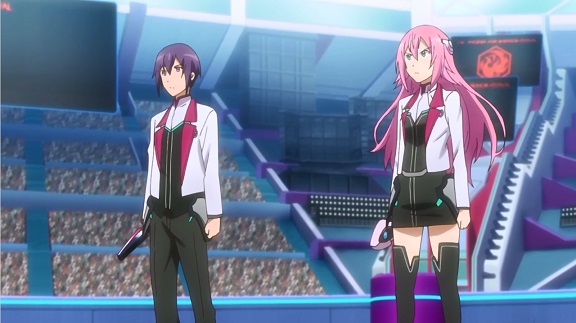
When Ayato and Julis ready to fight

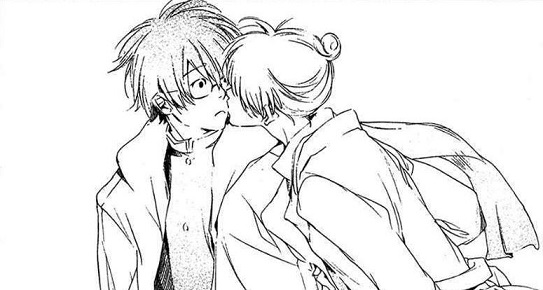
But there’s one small difference between the two series. In Rakudai Kishi No Cavalry the tournament is based around solo fights, which each participant having to fight their way towards the final alone, but in Gakusen Toshi Asterisk the fights are based around two person teams. A small difference, but it matters a lot for how its show treats its love interests. In Cavalry, Stella’s fights are never shown as the focus is squarely on how Ikki progresses; because in Asterisk Ayato and Julis are a proper team, she gets to do a lot more. She’s much less of a damsel in distress or trophy than Stella gets to be in the later half of Cavalry, more of an equal partner, making Asterisk ultimately the better series of the two.

(Post expanded from this comment over at Fantastic Memes.)
Your Happening World (September 24th through December 15th)

  • Bibliography | Chromatic Aberration Everywhere – As I tend to read a lot of more “academic” texts when it comes to studying anime, fandom, and interpretation, I thought it might be a good idea to throw up a list of all the things I’ve either read/seen so that anyone else interested in these types of ideas has a place to start.
  • Japan’s Cute Army – The New Yorker – This stressful, ongoing debate fuels the seeming paradox of an “endearing” military force. In Japan, where indirect communication is highly valued, cute illustrations have long played the role of tension-breakers and mediators in situations of conflict. Thus kawaii mascots, whether miniskirted girls or bunny-rabbit decoy launchers, are both a reflection of pop-cultural trends and a way to defuse the very touchy issues surrounding the military’s undeniable presence.
  • The Tyranny of Stuctureless – This means that to strive for a structureless group is as useful, and as deceptive, as to aim at an "objective" news story, "value-free" social science, or a "free" economy. A "laissez faire" group is about as realistic as a "laissez faire" society; the idea becomes a smokescreen for the strong or the lucky to establish unquestioned hegemony over others. This hegemony can be so easily established because the idea of "structurelessness" does not prevent the formation of informal structures, only formal ones. Similarly "laissez faire" philosophy did not prevent the economically powerful from establishing control over wages, prices, and distribution of goods; it only prevented the government from doing so. Thus structurelessness becomes a way of masking power
  • A Piece Of Toast – YouTube –
  • Otaku Philosophy | Public Seminar – Its origins are in cultural forms imported from the United States after the war. “The history of otaku culture is one of adaptation – of how to ‘domesticate’ American culture… Otaku may very well be heirs to Edo culture, but the two are by no means connected by a continuous line. Between the otaku and Japan lies the United States.”

“We got the Wagner CD all ready to go”


What happens when your protagonist and his men are caught in a siege of a medieval city somewhere in fantasy land and need help fast? You sent in the Japanese Self Defence Force’s airmobile brigage of course, complete with frame by frame remake of a certain scene from Apocalypse Now. From Gate, in which a dimensional portal opens up in the middle of Tokyo and a fantasy army straight out of Tolkien attacks through it and learns what it means to take on a modern military when the JDSF crossed the portal in the opposite way. Not as militaristic or rightwing as it could’ve been.

Unexpected treasures

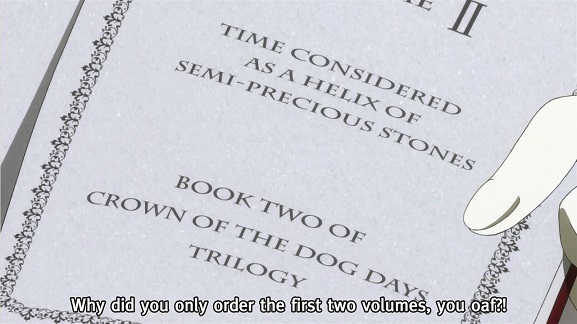
Time Considered as a Helix of Semi-Precious Stones reference in Dantalian no Shoka

Dantalian no Shoka is a 2011 well written weird mystery anime series with a decidedly bookish bent, set in the nineteen twenties. It stars an ex-World War i fighter pilot who inherits his grandfather’s title and estate, but in return has to take care of his mystical library, which this being an anime, comes in the form of a gothic lolita girl called Dalian. I’ve been watching it off and on for the last couple of days and episode four was a particular delight. Not only was it basically an adaptation of Misery, with a deranged fan keeping a writer prisoner, killing him each day to motivate him to write the proper ending to his trilogy, there was also the shipping war between her and Dalian about which of the characters should end up with whom and as the icing on the cake, a shoutout to Delany right at the start of the episode. Which you just don’t expect to see in an anime, even such a literary one.

My Girl — Yumeka Sumomo

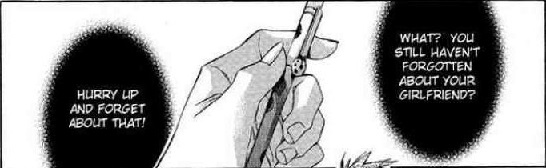
panel from My Girl

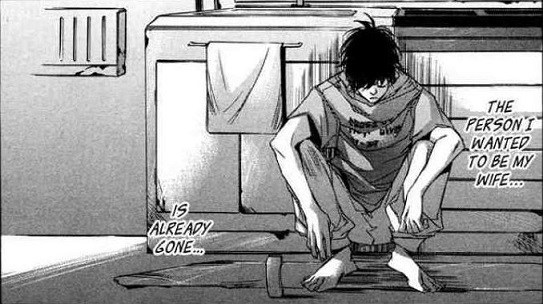
Somebody on the internets recommended My Girl as an underrated manga and from the description it sounded somewhat similar to Usagi Drop, which I’d marathoned a few weeks ago and wished I could’ve had more of. This however turned out to be slightly misleading, because while both stories are about young men just going with the flow suddenly coming into custody of five year old girls, the focus of both series is completely different. Usagi Drop is the story of becoming a parent, of learning to raise a child and overcoming all the every day challenges that come with it, while My Girl isn’t about that at all. Instead this is a story about grief and loss and coming to terms with it, of how this loss shapes and influences your daily life even as you struggle to overcome it and move on while remaining faithful to their memory. Needless to say this hit home for me.

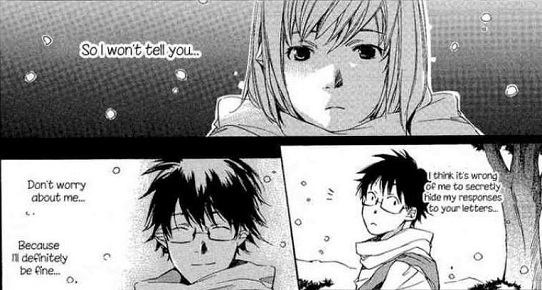
Panel from My Girl

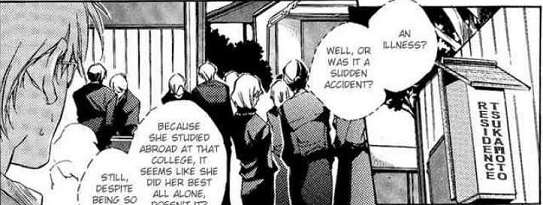
Here’s how the story starts. Kazama Masamune is a 23 year old salaryman stuck in a small town in the middle of nowhere, all because he promised Tsukamoto Youko, his high school love, he’d wait for her there if she ever decided to come back from her studies abroad. That was five years ago. And now he gets a phone call from Youko’s mother that’ll change his life. Youko has not only passed away, but it turns out the reason for her going abroad was that she was pregnant with his child… …and now he has Koharu, his five year old daughter to take care of, with both of them having to cope with each other’s grief over Youko’s death.

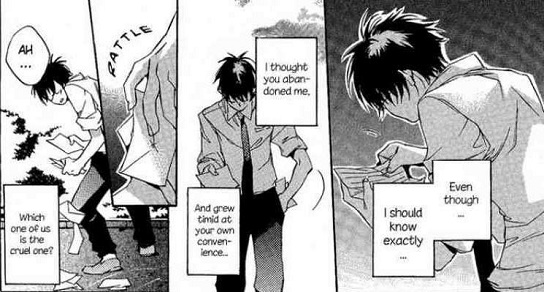
Panel from My Girl

And it’s an understated, realistic sort of grief My Girl portrays, free from melodrama, the kind of sorrow that creeps up on you in the quiet hours, when you’re not distracted by work or school. I recognised a lot of myself in the ways in which both Masamune and Koharu dealt with their grief. No grand, dramatic gestures and atmospheric weather, just memories you come across in unguarded moments. I recognise the desire to keep up a front, to not burden friends or family with your sorrow or loneliness.

Panel from My Girl

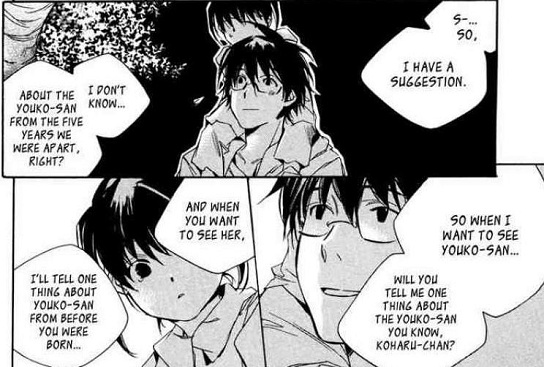
What saves is that they have each other to talk to, to share memories of Youko and discover her all over again. By sharing memories they can keep her alive a little bit, as each of them gets to see a new side of Youko through the stories of the other. All the while they’re also busy building a new life together, one that’s founded in their mutual love for Youko, which quickly transforms into love for each other. That transformation, of Masamume learning to be a father and Koharu learning to live with her father, is a delight to read about, a joyful counterpoint to the sorrow of Youko’s death.

Panel from My Girl

This is also a story about forgetting and not wanting to forget, about letting go and moving on and what this means. From the start, even before he learns of her death, Masamume is exhorted to forget about Youko, to move on from what his family and friends/co-workers see as a childish high school infatuation, to stop waiting for somebody who will never come back to him. Objectively speaking, they’re right to do so. Youko was never going to come back, while he was living his whole life in thrall to his memories of her, in the process also losing sight of the real Youko. And while at first glance his devotion might be seen as romantic, it’s ultimately more cowardice than romance that keeps Masumume waiting for Youko. In a sense it’s only her death that legitimises his choice to wait, as it also finally enables him to start thinking about letting go of his dream.

Panel from My Girl

However, that doesn’t mean that this criticism is wholly justified. As he rediscovers Youko through his life with Koharu, as he struggles to deal with her death, it becomes clear he has kept on loving her all those years apart, even though he didn’t fully understand her or her motives. And as he attempst to move forward in the last part of the story, even starts dating a co-worker who had been in love with him even before Youko died, it’s obvious that he can’t move on from her that quickly.

Panel from My Girl

Reading My Girl is an exercise in melancholy, leaving behind an overwhelming sense of regret and what-if. I’ve never quite had an off-screen death of a character reach me so as it did here. Yumeka Sumomo manages to not just convey the grief and sadness of Youko’s death, but also the wasted opportunities for Youko, Masamume and Koharu to have shared their lives. I couldn’t help but wonder what might have been had Youko not ran away abroad, not gone for the noble self sacrifice, or if Masamume had been slightly more proactive rather than just kept passively waiting for her to come back. In a sense both of them chose safety, of not being hurt over the chance at happiness. By not telling him about her pregnancy Youko avoided being rejected by Masamume at the price of any possibility of a true relationship, while by being passive and neither seeking her out nor moving on, Masamume could avoid a similar rejection. Very understandable on both their parts, but damn if that doesn’t hurt to read.