Books read June

Twelve books read this month as I took some effort to get my totals up. It brings my total number of books read in the first half of 2015 up to fortynine, putting me more or less on course for my goal of a hundred. As you can see below, now I just need to catch up with my reviewing too…

A Very British Genre — Paul Kincaid
A dated (1995) but still usable short introduction to the history of science fiction & fantasy as a British genre. As with a history, it gets slightly less usable the closer it comes to its present. Also interesting to see as a time capsule of what British SFF was like twenty years ago, before so many of the current giants had even started getting published, or had just begun to do so.

The Three-Body Problem — Cixin Liu
One of the three non-Puppy candidates for the Best Novel Hugo, a very Asimovian hard science fiction story. Asimovian because it’s all about ideas and characterisation falls somewhat by the wayside.

The First Fifteen Lives of Harry August — Claire North
Winner of the John W. Campbell Memorial Award. Harry August relives his own life over and over and he’s not the only one. The end of the world was always coming, but each new life it comes faster…

The Tropic of Serpents — Marie Brennan
The second book in the series of Faux-Georgian natural history fantasy memoirs of a lady dragonist. Great fun, intelligently written and well done dragons are always interesting.

The Renaissance at War — Thomas F. Arnold
One in a series of military history chapbooks I picked up, this is a very readable introduction to the topic of European warfare in the late fifteenth and sixteenth century.

Hero Complex — Sean O’Hara
Anime influenced superhero crack fic.

Warfare in the Seventeenth Century — John Childs
Followup to the Renaissance book. Interesting but of course Eurocentric.

Wave without a Shore — C. J. Cherryh
A short, early philosophical science fiction novel from Cherryh.

The Amoeba in the Room — Nicholas P. Money
A nicely readable introduction to the wonderful world of microbiotic life, sometimes marred with unfortunate attempts at humour.

A Man of Three Worlds — Mercedes García-Arenal & Gerard Wiegers
A very interesting biography/history of Samuel Pallache, a Moroccan Jew who worked as an agent, merchant, spy, arms dealer and more around the turn of the seventeenth century, working for the sultan of Morocco, the Dutch Republic and others.

At the Seventh Level — Suzette Haden Elgin
One of those somewhat forgotten and overlooked female authors, who sadly died earlier this year. This was the first novel of hers I’d read and it was an interesting one.

Throne of the Crescent Moon — Saladin Ahmed
Well done oriental fantasy that reminded me slightly of N. K. Jemisin’s Killing Moon duology.

Fandom is more than just puppies barking

Reading this comment from Ursula Vernon on File 770 made me sad:

And then we had Requires Hate and I was gobsmacked. I had no idea who most of these people were but holy crap, what an awful thing. And then SP3 happened and what the hell and then even more awful people come out of the woodwork and sure, Beale’s always been a whiny troll but who are these people like Williamson with those horrible insensitive jokes and all these sad little opportunists going “Notice me! Notice me! Let me hitch myself to this wagon! Notice me!”

And it’s all very discouraging. And the longer I stay, it seems like the more horrible things come out, and I wonder if there will ever be an equilibrium reached.

This is not what fandom should be like, but unfortunately assholes are everywhere, even in sf fandom. But though they’re currently the loudest and most visible part of fandom, they’re not the whole of it. It’s only human to talk more about outrage than about all the everyday kindnesses that pass unnoticed, which is why British fandom has its Doc Weir award. Most people you meet in fandom, online or real life, are just normal, decent human beings. Which can be hard to remember when all you read about is a small part being incredibly nasty about having to share fandom with people who are not like them and don’t like Nutty Nuggets.

But there’s also the point that much of the sound and fury generated by those Puppies is a reaction to the fact that fandom is changing and getting more welcoming to people who may not just dislike Nutty Nuggets, but don’t like breakfast cereal at all. It’s a backlash against the idea that fandom can improve, grow more diverse, not remain the playground of a bunch of paranoid, spoiled, rightwing brats.

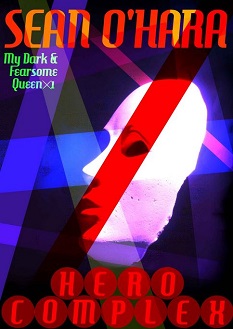
Hero Complex — Sean O’Hara

Cover of Hero Complex


Hero Complex
Sean O’Hara
394 pages
published in 2014

Whether or not you’ll like Hero Complex can probably be determined by whether not the following passage intrigues or annoys you:

Ryder leaps onto the wall of an apartment building and runs straight up the side. She’s almost to the eaves when she jumps again, this time somersaulting high into the air, coming to apogee several yards above the monster. She flings her arms apart and the night is illuminated by stroboscopic beams from her—I’m not seeing that right. There’s no way she’s shooting lasers from her boobs.

“Of course not. That would be ridiculous,” Jensen says.

I thought as much, but given how many ridiculous things have occurred lately, I wanted to be sure.

Ryder snags a tree branch with an outstretched hand like it’s a trapeze and flips herself around.

“Everyone knows laser beams are invisible in clear air. Those are charged particle cannons,” Jensen says.

Read more…

Privilege and Worldcon

I missed most of the kefuffle over the proposed Best Saga Hugo this weekend as I was busy being an apprentice SMOF having volunteered to help revitalise Holland’s oldest sff fan organisation. What happened was basically that a group of fans, inspired by Eric Flint’s thoughts on expanding the Hugos, proposed adding a Best Saga category for multiple volume books/series as well as eliminate the novelette category. People objected strongly to the second part and were somewhat skeptical of the first and the proposers reacted by amending their proposal to omit the axing of novelettes. All in all a great example of how fandom is supposed to work: debated out in the open, with people listening to justified, constructive criticism and acting on it.

The best criticism I read of the original proposal, though unfortunately published after it had already changed and slightly misaimed, was in N. K. Jemisin’s open letter to the WSFS about unintended consequences:

the novelette category has until lately been a good entry point for new and underrepresented writers to gain recognition. Why? For all the reasons “sagas” privileges established successful white guys, basically: short fiction must rely (usually) on quality rather than preexisting financial success to prove itself; it requires a much lower investment of free time to write; and short fiction in general is less about comfort food than challenging the reader with new ideas and perspectives. The competition is actually more fierce for short fiction than it would be for sagas; there are more markets willing to publish novelettes than there are publishers willing to grind out multiparters, and the short fiction markets pump out multiple stories, multiple times per year. It’s just that fewer of the barriers that make it hard for non-white non-men to compete exist here. Women, people of color, and other underrepresented groups usually do pretty well when they’re working with a level playing field.

Which got me thinking about privilege in fandom generally and the WSFS in particular, in the way its decision making processes are set up. As you know Bob, there’s always been this tension about Worldcon and the Hugos especially of having this ideal of being representative of all of fandom and the reality that only those that have and spent the money, time and effort to get involved in Worldcon, either supporting or attending get to vote. For the Hugos itself this is relatively straightforward and with a fairly low barrier to entry: forty bucks gets you voting rights plus the Voting Packet.

Where it gets awkward is with the site selection process for future Worldcons. You have pay a site selection fee (which also doubles as a supporting membership for whichever con wins) and you have to sent in a paper ballot, rather than being able to vote online. That’s somewhat of a disadvantage for lazy slobs like me.

Far worse is the business meeting. Any member can make proposals, but to defend and vote on them you have to attend Worldcon. And since any proposal needs to be affirmed by the next con as well, you have to do this at least twice. Which is rather a huge barrier to entry, overcome only by those with the time and money to spent two years or longer on it, or of course those who are so deeply involved with Worldcon that this isn’t a huge sacrifice for them.

And I don’t want to knock those people, nor Worldcon. There are good reasons why the current Worldcon structure was set up and these barriers just an unfortunate side effect, not as far as I know a deliberate attempt to exclude people. But the effect is the same and it does make it harder for those without the means to chase Worldcon each year to get involved.