
Bonus points if you can bounce the sledge hammer he’s holding off his skull.

Hero Complex
Sean O’Hara
394 pages
published in 2014
Whether or not you’ll like Hero Complex can probably be determined by whether not the following passage intrigues or annoys you:
Ryder leaps onto the wall of an apartment building and runs straight up the side. She’s almost to the eaves when she jumps again, this time somersaulting high into the air, coming to apogee several yards above the monster. She flings her arms apart and the night is illuminated by stroboscopic beams from her—I’m not seeing that right. There’s no way she’s shooting lasers from her boobs.
“Of course not. That would be ridiculous,” Jensen says.
I thought as much, but given how many ridiculous things have occurred lately, I wanted to be sure.
Ryder snags a tree branch with an outstretched hand like it’s a trapeze and flips herself around.
“Everyone knows laser beams are invisible in clear air. Those are charged particle cannons,” Jensen says.
I missed most of the kefuffle over the proposed Best Saga Hugo this weekend as I was busy being an apprentice SMOF having volunteered to help revitalise Holland’s oldest sff fan organisation. What happened was basically that a group of fans, inspired by Eric Flint’s thoughts on expanding the Hugos, proposed adding a Best Saga category for multiple volume books/series as well as eliminate the novelette category. People objected strongly to the second part and were somewhat skeptical of the first and the proposers reacted by amending their proposal to omit the axing of novelettes. All in all a great example of how fandom is supposed to work: debated out in the open, with people listening to justified, constructive criticism and acting on it.
The best criticism I read of the original proposal, though unfortunately published after it had already changed and slightly misaimed, was in N. K. Jemisin’s open letter to the WSFS about unintended consequences:
the novelette category has until lately been a good entry point for new and underrepresented writers to gain recognition. Why? For all the reasons “sagas” privileges established successful white guys, basically: short fiction must rely (usually) on quality rather than preexisting financial success to prove itself; it requires a much lower investment of free time to write; and short fiction in general is less about comfort food than challenging the reader with new ideas and perspectives. The competition is actually more fierce for short fiction than it would be for sagas; there are more markets willing to publish novelettes than there are publishers willing to grind out multiparters, and the short fiction markets pump out multiple stories, multiple times per year. It’s just that fewer of the barriers that make it hard for non-white non-men to compete exist here. Women, people of color, and other underrepresented groups usually do pretty well when they’re working with a level playing field.
Which got me thinking about privilege in fandom generally and the WSFS in particular, in the way its decision making processes are set up. As you know Bob, there’s always been this tension about Worldcon and the Hugos especially of having this ideal of being representative of all of fandom and the reality that only those that have and spent the money, time and effort to get involved in Worldcon, either supporting or attending get to vote. For the Hugos itself this is relatively straightforward and with a fairly low barrier to entry: forty bucks gets you voting rights plus the Voting Packet.
Where it gets awkward is with the site selection process for future Worldcons. You have pay a site selection fee (which also doubles as a supporting membership for whichever con wins) and you have to sent in a paper ballot, rather than being able to vote online. That’s somewhat of a disadvantage for lazy slobs like me.
Far worse is the business meeting. Any member can make proposals, but to defend and vote on them you have to attend Worldcon. And since any proposal needs to be affirmed by the next con as well, you have to do this at least twice. Which is rather a huge barrier to entry, overcome only by those with the time and money to spent two years or longer on it, or of course those who are so deeply involved with Worldcon that this isn’t a huge sacrifice for them.
And I don’t want to knock those people, nor Worldcon. There are good reasons why the current Worldcon structure was set up and these barriers just an unfortunate side effect, not as far as I know a deliberate attempt to exclude people. But the effect is the same and it does make it harder for those without the means to chase Worldcon each year to get involved.
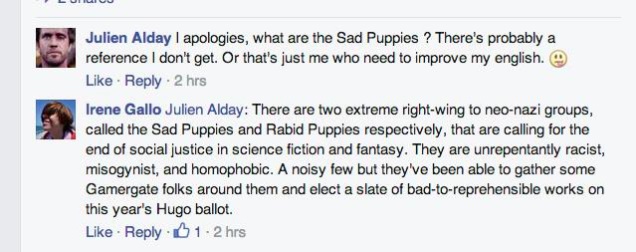
As I predicted, Tom Doherty’s public dressing down of Irene Gallo for her (correct) comments on the Puppies failed. Having scored one success Day and co have doubled down and unleashed the dreaded boycott threat on Tor. All the usual idiots are of course crowing about Tor tasting Puppy power while everybody else has at turns been slightly depressed about it and somewhat upbeat about the slim chances it has of succeeding. And they’re right that the chance of Tor giving in to ridiculous demands like this are small:
Tor must publicly apologize for writings by Patrick Nielsen Hayden, Teresa Nielsen Hayden, Moshe Feder, Irene Gallo, and John Scalzi that “demonize, denigrate, slander and lie about the ‘Puppies’ campaigns”
That’s not going to happen, nor is Tor going to fire anybody about this: there aren’t enough Pups to provide a proper boycott. At best they can hope for a similar “success” as the Southern Baptist boycott of Disney for being too gay friendly. At worst, they shoot themselves in the foot because Tor also publishes John C. Wright. But focusing on whether or not the boycott can succeed is missing the point. The point of the boycott is the boycott.
As I said before, Day is following the Tea Party/Breitbart Culture Wars playbook. Gin up outrage, energise your base, focus their attention on the designated enemy, then fleece the suckers. Vox knows how the game is played because he’d been working for Worldnet Daily one of the low rent rightwing clearing houses his daddy had set up until he became too loony even for them. What are the odds on the next instructions of Day, as “leader of the Rabid Puppies”, will next issue instructions that the only proper way to boycott Tor is to instead buy books by goodthink publishers like Baen or his own vanity press?
The key is not to win, the key is to keep the fight going and make some money doing so. That’s been the career path for whole generations of roghtwing bloviators: fart out articles and blogposts and books about the evil of libruls and blag your way onto wingnut welfare. But to do so you need that red meat to keep the suckers in line. Without the month late fauxrage at Gallo’s comments the Puppies wouldn’t have anything to talk about. But this? This they can spin out until long after this year’s Hugo results are revealed.
It’s hard to deal with this. Just ignoring it is one option, not giving the oxygen of publicity to these people, but can obviously backfire. You can’t deal with this thinking these are normal fans, and that just ignoring it will starve this “controversy” of the fuel it needs. People like Day (and Larry and Brad) are perfectly capable of keeping the fire stoked indefinitely. Not responding just cedes ground and helps them keep up the pretence that they’re speaking for some imagined silent majority.
Rather, their more noxious opinions and writings should be exposed to sunlight, because the natural response of normal people not obsessed with partisan politics like the Puppies is to run the hell away from the circus. That’s also why somebody like Hoyt is so angry at Mike Glyer for accurately quoting her on File 770. Somewhere she’s aware of how she sounds outside her little echochamber. And that’s why Natalie Luhr’s showcasing of Michael Z. Williamson greatest hits is important. It removes the pretence that these are just fans rather than collossal assholes.
Eric Flint, in the middle of another what’s likely to be an illfated attempt to talk sense into the Puppies, also talks about the way in which the Hugo Awards have overlooked or slighted some of the best authors working in science fiction & fantasy over the decades:
The Hugo voters, in their wisdom or lack thereof, decided that Christopher Anvil, Hal Clement, L. Sprague de Camp, Richard Matheson, Andre Norton, Fred Saberhagen, James H. Schmitz, A.E. Van Vogt and Jack Williamson were not very noteworthy. Of those nine authors, five of them are now in the Science Fiction Hall of Fame and two out of the other four—Anvil and Schmitz—have had their complete works reissued in modern editions. (Full disclosure: Okay, fine, I’m the one who edited those reissues—but they sold pretty damn well for reissue volumes.)
Quite clearly, the Hugo voters were… ah, mistaken. (That sounds more dignified than “full of crap.”) Those are not the only times that Hugo voters have been…. ah, mistaken. They certainly won’t be the last, either. In this, the Hugos are like all awards. You win some, you lose some, so to speak.
It would be nitpicking to complain that Jack Williamson and Richard Matheson at least did get some Hugo recognition, that Van Vogt wrote his best work before the Hugos got established, or that some of the examples aren’t actually all that good, there still remains the question of how so many writers with such long careers were overlooked (and Flint’s examples could of course be extended with dozens more). Is that really the fault of the Hugo voters, just bad luck, or perhaps the simple fact that not all deserving kids can win prizes every time?
Surprisingly, I think it’s the latter. The long and short of it is that in any given year, there are twenty places on the Hugo ballot for a fiction writer: five each for Best Novel, Novella, Novelette and Short Story, give or take the occasional tie. That’s a high bar to clear for any writer, to get one of those slots, never mind win. Especially since the seventies, when fantasy and science fiction have exploded in popularity and size, the chances are high some deserving novel or story is going to be overlooked. (I know that even without the Puppy shenanigans, I easily had six or seven candidates for five slots in the Best Novel category.)
I think Flint has made a category error in other words, in complaining that deserving writers have been overlooked when the awards are actually for stories. It’s no good saying that a given writer is good enough to get a Hugo Award, you need to prove that in a given year, any given year, their best work would stack up to or beat that of their competition. And of course you also have to back that up with more than just your own taste. Jo Walton attempted to do this, in a series for Tor.com a few years ago, comparing what was won and nominated to what wasn’t, but as I recall for the most part she’d been satisfied that each year at least had credible candidates for each category, with some notable exceptions.
Now my personal opinion, which I think I share with Flint up to a point, is that the Hugos did start to falter from somewhere in the late seventies or early eighties as the SFF field exploded but Worldcon stagnated and aged. So many of the novels winning the Hugos in the last thirty years to me are no more than decent rather than brilliant, occasionally awarded for who wrote rather than their own merits. This again changed for the better in more recent years, thanks in no small measure to the Hugo Voter Packet and the better promotion of supporting memberships, but then the Puppies happened.