Mistaken Hugo voters or just unlucky writers?

Eric Flint, in the middle of another what’s likely to be an illfated attempt to talk sense into the Puppies, also talks about the way in which the Hugo Awards have overlooked or slighted some of the best authors working in science fiction & fantasy over the decades:

The Hugo voters, in their wisdom or lack thereof, decided that Christopher Anvil, Hal Clement, L. Sprague de Camp, Richard Matheson, Andre Norton, Fred Saberhagen, James H. Schmitz, A.E. Van Vogt and Jack Williamson were not very noteworthy. Of those nine authors, five of them are now in the Science Fiction Hall of Fame and two out of the other four—Anvil and Schmitz—have had their complete works reissued in modern editions. (Full disclosure: Okay, fine, I’m the one who edited those reissues—but they sold pretty damn well for reissue volumes.)

Quite clearly, the Hugo voters were… ah, mistaken. (That sounds more dignified than “full of crap.”) Those are not the only times that Hugo voters have been…. ah, mistaken. They certainly won’t be the last, either. In this, the Hugos are like all awards. You win some, you lose some, so to speak.

It would be nitpicking to complain that Jack Williamson and Richard Matheson at least did get some Hugo recognition, that Van Vogt wrote his best work before the Hugos got established, or that some of the examples aren’t actually all that good, there still remains the question of how so many writers with such long careers were overlooked (and Flint’s examples could of course be extended with dozens more). Is that really the fault of the Hugo voters, just bad luck, or perhaps the simple fact that not all deserving kids can win prizes every time?

Surprisingly, I think it’s the latter. The long and short of it is that in any given year, there are twenty places on the Hugo ballot for a fiction writer: five each for Best Novel, Novella, Novelette and Short Story, give or take the occasional tie. That’s a high bar to clear for any writer, to get one of those slots, never mind win. Especially since the seventies, when fantasy and science fiction have exploded in popularity and size, the chances are high some deserving novel or story is going to be overlooked. (I know that even without the Puppy shenanigans, I easily had six or seven candidates for five slots in the Best Novel category.)

I think Flint has made a category error in other words, in complaining that deserving writers have been overlooked when the awards are actually for stories. It’s no good saying that a given writer is good enough to get a Hugo Award, you need to prove that in a given year, any given year, their best work would stack up to or beat that of their competition. And of course you also have to back that up with more than just your own taste. Jo Walton attempted to do this, in a series for Tor.com a few years ago, comparing what was won and nominated to what wasn’t, but as I recall for the most part she’d been satisfied that each year at least had credible candidates for each category, with some notable exceptions.

Now my personal opinion, which I think I share with Flint up to a point, is that the Hugos did start to falter from somewhere in the late seventies or early eighties as the SFF field exploded but Worldcon stagnated and aged. So many of the novels winning the Hugos in the last thirty years to me are no more than decent rather than brilliant, occasionally awarded for who wrote rather than their own merits. This again changed for the better in more recent years, thanks in no small measure to the Hugo Voter Packet and the better promotion of supporting memberships, but then the Puppies happened.
Intersectionality is just another word for solidarity

I’m always leery of arguments like this, that want to dismiss the different axises of oppression various groups of people struggle with in favour of some vulgar marxist idea of the working class and not asking too many questions. Too often this has been used by alter kakkers to just dismiss any struggle that doesn’t fit in their century and a half old ossified world view:

Where people on the left should be focussed on what unites us, us here referring to the working class rather than the left in general (lol, as if that’s going to happen), as workers -the foundations from which we can build the new society- we now see attempts to stratify through definition the working class under the guise of intersectional analysis. An intersectional analysis is a useful tool to have in one’s box if one is studying Sociology or writing academic papers but in the real world it doesn’t translate well, not well at all. In fact one of the reasons that I began my abstention from generalised political activity was the emergence of this approach -along with the increasing popularity of privilege politics- as I saw early on that the praxis that would develop from this approach would inevitably see a return to the embarrassing ‘hierarchy of oppressions’ which permeated the radical politics of the 1970s/80s (before my time -I’m not that old!).

He may not be that old, but his criticisms are. There’s always been a tension within socialism about how to define the struggle. Rightwing socialists tend to define it narrowly, purely as the struggle of the working classes against the bourgeois and anything that isn’t directly related to that struggle as a distraction. Depending on the decade — or century — you’re talking about this could mean feminism, civil rights, gay rights, or today, intersectionality and online activism.

The leftwing has always defined the struggle much more broadly. There’s a long and proud tradition within socialism and communism of not just fighting for the rights of (white) working men, but also recognised from the start that you can’t build a classless society when half the population is still powerless because of their gender, that it’s immoral to let the welfare of the British worker depend on the continuing exploitation of the Indian worker. So there’s always been a strain in socialism that defined the struggle much broader than just defending workers’ rights, that strived for an utopia for all people.

That is intersectionality pur sang and the thing about it is that it works both ways. There’s always a tendency to assume that these causes always distract from your own, much more worthy and important one, but intersectionality also gets you allies. That’s what happened in 1984 when at the height of AIDS paranoia stoked homophobia a group of London gay men and lesbians reached out and supported the South Wales Miners Strike:


Both groups were canny enough to understand that they struggled against the same oppression. The gay and lesbian activists recognised the police violence and oppression the miners were subjected to from their own experiences with them and believed in solidarity enough to not just recognise it, but take action. And the miners reprociated, send delegations to Gay Pride, supported them in their struggle. It was of course mocked by the establishment — now the perverts support the pits, as The Sun put it.

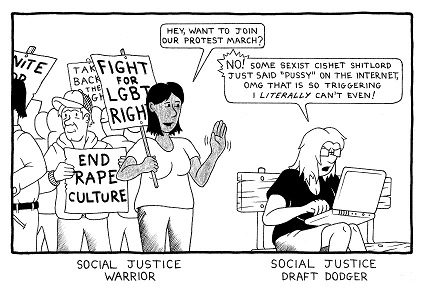
But you might say, gay liberation, strikes, those are real political actions, real causes, not frivolity like what I’m talking about, but that was far from the mainstream view back in 1984. So many socialists for so long saw homosexuality as a capitalist perversion, not as part of their struggle, not something that could be easily portrayed in terms of class struggle. And that’s why this bloody cartoon included in the post annoys me so much:

cartoon by RednBlackSalamander

Not just because it’s a lazy cheap shot and doesn’t understand that in 2015 it’s really hasn’t been possible for at least a decade to pretend that that online space is less important than offline spaces. No, it’s because I’m old enough to know that all the examples of worthy causes given here –take back the night, ending rape culture, lgbt rights — would have been ridiculed and dismissed as fauxtivism and middle class vanities not too long ago. It’s breathtakingly ignorant.

Now AW Hendry started his post by mocking the Sad Puppies, which is how I stumbled upon it, thanks to Mike Glyer’s sterling work rounding up Puppy related material. He used it as his example of how people waste time with online activism and throughout his piece the unspoken assumption is made that online doesn’t matter and economic considerations should be much more important than cultural fights like this. What this misses is that, even apart from the simple fact that quite a few of us now live our lives as much online as in the real world, online follows you home — ask Zoe Quinn or any other SWATting victim. What he also misses is that the struggle over the Hugos is more than just the misplaced vanity of a few rightwing culture warriors: as Kameron Hurley explained, the Hugos meant she got $13,000 more in her post-Hugo book advance.

Not the highest of stakes perhaps, but for your average struggling writer that is a large chunk of money. I also have the suspicion for at least some of the ringleaders, this kerfuffle is a way to help themselves to some of that sweet, sweet wingnut welfare. People like Tom Krautman or Dave Freer may seem dangerously unhinged to normal people, but they’d fit in well with Vox Day’s old haunt, Worldnet Daily. Voxy himself of course is trying to establish his vanity press as a serious rightwing proposition and arguably does all this for the publicity. Which means for him at least it’s not the winning that’s important, it’s keeping the fight going, the better to keep fleecing suckers.

Books read May

Late again as I keep forgetting to write these posts. Another disappointing month reading wise, only six books. I got nobody to blame but myself, having focused too much on other things than reading. This way I’ll not reach my goal of a hundred books read this year.

Bone Gap — Laura Ruby
I only read this to review it for my local science fiction bookstore, but I was glad I did so. A young adult fantasy novel that takes some very old fairy tales and shows what it looks like if the princess isn’t quite willingly taken away by the beautiful prince on the white horse…

The Riddle of the Labyrinth — Margalit Fox
The story of the decyphering of Linear B, the language found on clay tablets in the famous Mycean palace of Knossos and the three people who played key roles in it.

Great Powers and the Quest for Hegemony — Jeremy Black
Written twenty years after the first publication of Paul Kennedy’s 1988 The Rise and Fall of the Great Powers this is an appraisal of and correction to it, treating the same period

Sterrensplinters — Eddy C. Bertin
A career long retrospective collection of one of the best science fiction short fiction writers in the Dutch language.

Solar Flares — Andrew M. Butler
A reappreciation of the seventies in the context of science fiction, long shunted awkwardly inbetween the twin peaks of the New Wave and Cyberpunk. Slightly disappointing as it degraded into long recitations of book titles, movie plots undsoweiter. This needed a better structure.

Night’s Master — Tanith Lee
A reread sadly inspired by Tanith Lee’s death. Lush, decadent, erotically charged fantasy.

(not) Showcase Sunday: Jack Staff

cover of Jack Staff: Everything Used to Be Black and White


Jack Staff: Everything Used to Be Black and White
Paul Grist
Reprints Jack Staff V1 1-12
Get this for: somebody else’s nostalgia

A bit of a cheat this time, as I was getting a bit bored with Silver Age DC but didn’t want to skip another week. Hence this compromise. I’d gotten the first three volumes of Paul Grist’s retro nostalgic English superhero series at some con and had read bits and pieces of them, but not yet the first volume all the way through. This was a nice excuse to do so.

As I understand it, Jack Staff grew out of a proposal Paul Grist made to Marvel for an Union Jack miniseries, this being one of Marvel’s patriotic British superheroes created by Americans and therefore somewhat on the naff side. What works well for Captain America doesn’t quite work for British superheroes. So it’s a good thing it was rejected, which meant he didn’t have to adhere to American ideas about superheroes and could indulge in nostalgia for much more English sort of heroes.

Panel from Jack Staff #3

Because there is a sort of British superhero tradition, even apart from reworkings of American imports like Marvelman, a tradition coming out of the old IPC and Fleetway weekly comics anthologies of the sixties & seventies, full of weird not quite super, not quite heroes. This isn’t a nostalgia I share too much about, knowning about most of these comics only secondhand through well, projects like this. There have been a lot of British writers who have been indulging in this nostalgia, like Alan Moore in Captain Britain and Grant Morrison in Zenith, basically whenever they needed an army of superheroes to get slaughtered, and you pick up a lot of this by osmosis.

Half page introduction of Tom Tom from Jack Staff #1

So while the series is called Jack Staff and he is the nominal hero of it, quite a lot of it is actually devoted to all these lovingly done introductions of characters like Tom Tom the Robot Man (who is of course an expy of Robot Archie). Grist introduces a hell of a lot of characters, both expies like this, but also more original ones and every single one of them gets their own half or quarter page introductionary panel. This works well to give an old-fashioned feel to the strip, in effect dividing each issue as if was one of those old anthologies.

Becky Burdock, Vampire Reporter from Jack Staff #7

When it works well, it’s great, but it depends a lot on creating atmosphere and the average comics nerd’s ability to fill in the missing pieces themselves through decades of experience with this sort of retro continuity. Reading it all at once, instead of issue by issue makes for a disjoined experience. These aren’t so much stories, as sketches of stories. that’s always the risk with this sort of comic of course, when you’re trying to hint at an entire universe worth of back story, again relying on the average reader’s understanding of superhero cliches.
Becky Burdock, Vampire Reporter from Jack Staff #7

The funny thing about the series is also how incompetent and useless Jack Staff is. His secret identity is unmasked in the first issue, he gets knocked out more often than Green Lantern used to be and most of his cases are resolved by others. It’s a very English view of superheroes, of not very useful, not very dependable weirdos, even in an universe filled with strange beings and alien menaces.

Bramble & Son, Vampire Hunters in action from Jack Staff #7

What makes the series is Grist’s artwork, which is gloriously expressive, making full use of the possibilities of black and white. At times it’s Toth like in its use of shadows, but Grist also uses white backgrounds a lot to isolate his characters, especially in those half page introductions. Many artists would be afraid to leave so much empty, but Grist has the courage to do so when necessary. All in all this was a very enjoyable trip through somebody else’s nostalgia.