It’s never pleasant when puppies project

This really is a disgusting accusation from Brad Torgersen:

Mr. Sandifer, if you truly believe that a book like ANCILLARY JUSTICE or a story like “The Water That Falls On You From Nowhere” did not benefit from a tremendous groundswell of affirmative-action-mindedness, you’re not paying attention. Please phone me when you’re interesting in discussing diversity beyond a skin-deep level. Quote Larry Niven: there are minds which think as well as yours, just differently.

Especially when you remember the drek Torgersen democratically choose for his supporters to put on the Sad Puppy slate. Which turned out to mainly function as cover for the Rabid Puppy slate run by a serial failure to promote his buddy John C. Wright and his new vanity press.

But it’s a good example of the sort of rightwing projection the Pups are prone too and all too familiar for anybody who was around for the heyday of warblogging –remember that– or the 2008-now freakout after a black man got elected president. I’m not sure at this point if this is done deliberately, or whether it’s completely subconscious on Torgersen’s part to accuse his enemies of behaving like, well, himself. It’s coupled to that other rightwing trait of just refusing to believe people can like other things than you, in its purest form best seen whenever proper football (ie soccer) is making inroads in America again as some pundit pops a gear and start sputtering that surely nobody truly American can enjoy this and it’s all a liberal plot to undermine the moral fabric of the country?

Speaking of projection, here’s Sarah Hoyt showing some rare self knowledge:

We’ve seen the same effect over and over again with people who comment on blogs (clears throat) both cultural and political, and even historical and that, no matter how often they’re proven wrong, keep coming back and stating the same thing they said in different words, as though that would make it true. They seem incapable of processing challenges, doubts, or even factual disproof of their charges.

Or wait, my bad, she actually meant people like the commenters at File 770. Because after all it was they who put forward ridiculous conspiracy theories about why their favourite sf writers didn’t win Hugos, engaged in an organised ballot stuffing campaign, invent their own jargon of “glittery hoohas” (completely misused), Social Justice Warriors and “whole word readers” to sneer at anybody asking questions or noticing inconsistencies and seem incapable of evaluating any sort of science fiction in any way other than as political propaganda, right?

Sterrensplinters — Eddy C. Bertin

Cover of Sterrensplinters


Sterrensplinters
Eddy C. Bertin
222 pages
published in 2013

Eddy C. Bertin was an important author in my personal Golden Age of science fiction. A Flemish author, he was one of the few science fiction writers writing in Dutch back in the late seventies & eighties. Dutch language science fiction has never been particularly abundant and most that was published was not very good. Bertin was one of the few exceptions, an author who could’ve found an audience in English as well (and indeed, has had a couple of stories published in English). Still active, Bertin has written everything from hard science fiction to dark fantasy and horror, often mixing genres and with a tendency towards the Lovecraftian end of horror.

Sterrensplinters (Star Splinters) is a 2013 anthology collecting some of his best stories taken from his 1970s and 1980s collections. These are all long out of print, so a new collection of them is very welcome. The short introduction doesn’t tell much about why exactly these stories were chosen, or why the collection had to be divided into two parts: Membranen and Splinters, other than that the first set of stories takes place in a shared universe, while the remainder are standalone. That second set of stories feels as an afterthought, even if it includeds one of Bertin’s most famous stories.

Read more…

The Gemmell Awards shortlist is out

I’ve added the shortlist for the David Gemmell Awards to the 2014 noticable SFF novels list:

Legend Award for Best Fantasy Novel:

  • Half a King — Joe Abercrombie
  • Valour — John Gwynne
  • Prince of Fools — Mark Lawrence
  • Words of Radiance — Brandon Sanderson
  • The Broken Eye — Brent Weeks

Morningstar Award for Best Debut Fantasy Novel:

  • Traitor’s Blade — Sebastien de Castell
  • The Mirror Empire — Kameron Hurley
  • The Godless — Ben Peek
  • The Emperor’s Blades — Brian Staveley
  • The Age of Iron — by Angus Watson

Interesting to see that Joe Abercrombie, Kameron Hurley and Brian Staveley all made it on both the Locus and the Gemmell shortlists and no other so far and that this is the only overlap the Gemmell has with any of the other major awards. Both the Locus and the Gemmell are of course open awards that can be voted on through the interwebs. I had expected more critical appreciation of Hurley’s novel though.

Showcase Sunday: Bat Lash

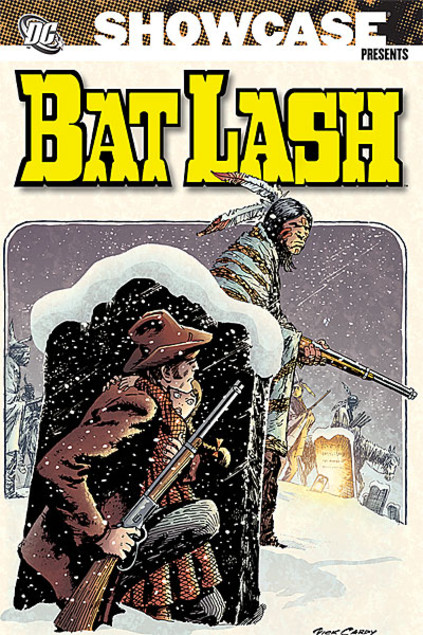
cover of Showcase Presents: Bat Lash


Showcase Presents: Bat Lash
Sergio Aragones, Nick Cardy, Denny O’Neil and friends
Reprints Showcase #76, Bat Lash #1-7, DC Special Series #16 & Jonah Hex #49, 51 & 52
Get this for: Nick Cardy art going from full on cartoonish to spaghetti western realist in two panels

Having now read through several of Showcase volumes of early sixties DC Silver Age series, I felt it was time for a break. Important as those series are, they do suffer from the fact that these were never meant to read through in one sitting, with many of the stories being variations on a theme, the same ones cropping up again and again. What I needed instead wasn’t yet another huge 500+ page wodge, but something slim and slightly more complex. The collected Bat Lash was perfect.

Bat Lash: lightning fast gunslinger

By 1968, when Bat Lash made his first appearance, in Showcase of course, comics was very different from where it was at the start of the sixties. The Silver Age revolution DC had unleashed had been taken up by Marvel with great enthusiasm and while DC might still be selling more comics than them, all the excitement was at Marvel. Unlike DC, Stan Lee and co had aimed their comics at a more adult readership, making both their heroes’ morals and stories slightly more complicated than the goody two shoes world of DC, not helped by the latter’s bureaucratic ways of working. By the end of the decade though DC was working hard to catch up with Marvel, Bat Lash being one of the results of this improvement drive.

Bat Lash the masher

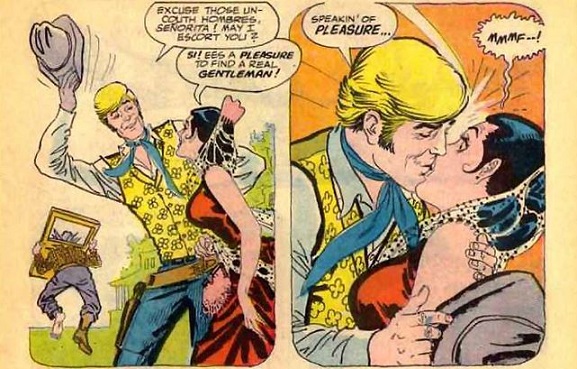
Bat Lash was a very different sort of western hero. A dandy and a scoundrel, he had a taste for the finer things in life, especially if those finer things were female and at times he might as well have been wearing a fedora instead of a stetson; he’s portrayed as a little bit too grab handey at times, though of course every woman he puts the moves on ends up liking it very much, except when they have their own nefarious designs. Bat Lash was the creation of an unlikely duo: Sergio Aragones, much better known for his humouristic, big footed work for Mad and Groo the Warrio and artist Nick Cardy, best known for his Aquaman and Teen Titans art, with Denny O’Neil helping with the scripting after his first appearance.

Nick Cardy shows his funny side

Most of the stories here follow the same pattern: open with Bat Lash in peril, only to saved at the last moment by the woman he got into trouble for, then riding out of whichever town he was in to get involved in some sort of adventure in which his avarice has to combat his well buried better nature. These then are still fairly formulaic stories, but much more interesting and with some continuity between them, with our hero crossing the border into Mexico in one issue and attempting to get out in the next.

Nick Cardy draws women very well

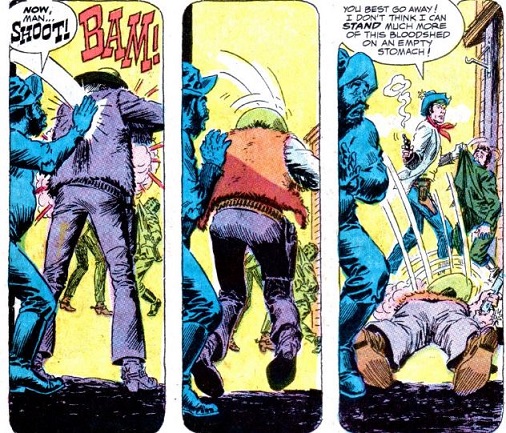
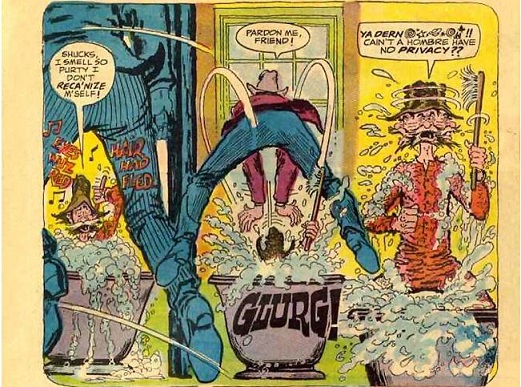
What really makes the original Bat Lash series is Nick Cardy’s artwork, some of the best he’s ever done. Just look at the Showcase cover above, originally done for issue two: that’s a brilliantly done scene, telling a story with one picture. Cardy has a real affinity for drawing the old west and is great at action scenes as in that first sequence showing Lash being ambushed and turning the tables on his ambusher. But he also does well with humour, which turns up a lot in these stories, as in the sequence where Bat Lash has to escape from his hotel by fleeing through some old-timer’s bath. It’s clearly the same artwork, just a bit more exaggerated. And of course Cardy also has his usual flair with drawing women, who have a heft and physicality to them that’s rare for that time, especially at DC. Plenty of artists that could draw pretty girls, but Cardy’s are real women. In black and white his artwork looks even better than when it’s coloured.

The brothers Lash meet, unknowingly

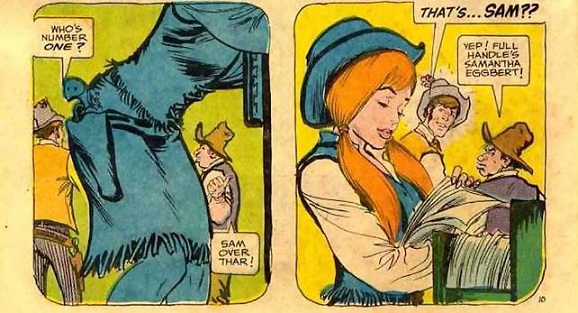
Sadly the original series only lasted seven issues, which is barely long enough to have gotten the sales figures for the first issue in. Since then he’d been wandering around the edges of DC’s western titles and this volumes includes some of his later appearances, which aren’t bad, but without Aragones or Cardy onboard, lack the charm of the original. A pity too that in that very last issue, after the previous one had featured his origin, Lash runs across a bounty hunter with gunslinging skills as good and perhaps even better as his own, out for his blood and who might just be his younger brother, a storyline that was ended just as it begun…

Your writer’s group would not be angry with this

Kate Paulk lays down her rules for Hugo worthy fiction:

Early immersion – I read a hell of a lot, and I find it very easy to become immersed in a piece. The earlier it drags me in, the better. If I don’t get the immersion, the interplay of the technical factors (prose quality, characterization, plotting, foreshadowing, etc.) isn’t handled well enough to do it. I’ve read pieces where I liked the premise and characters, but the craft wasn’t good enough to generate immersion. I’ve also read pieces that I hated but were well enough done to hold me despite that.

It goes on for a while like that, going through such controversial demands like “there is a plot” and “there are characters”, but it’s all a bit anodyne, a bit obvious, a bit dull and unchallenging. If that’s your standard for Hugo worthy science fiction, there’s a lot of it out there: it’s not exactly a high bar to clear. But there’s more:

The prose is invisible. This needs some explanation: the prose needs to be polished enough and reflective enough of the content and pacing that it helps maintain reader immersion instead of having clunky phrasing that throws a reader out of the story. The only really viable exceptions I’ve come across are in shorter works where the prose can sometimes serve as a character in itself.

That’s the sort of bollocks you hear a lot of science fiction readers talk about, that they want prose that’s transparent, “doesn’t get in the way of the story”, doesn’t demand any attention paid, doesn’t challenge. There’s of course a huge inferiority complex running through parts of science fiction, resulting in the dismissal of everything that smacks of the literary and difficult. That’s what you see here. It’s not bad persé, it’s just a bit unambitious.

And to be honest, the Hugos too often have been that already. There are plenty of middle of the road novels that have been nominated and won it. Do we really need more of that, or do we rather have something a bit more challenging? Certainly the Puppy nominees aren’t the answers: by all reports they mostly fail even Paulk’s rather low standards.

(Title courtesy of Gabriel F. in comments over at File 770.)