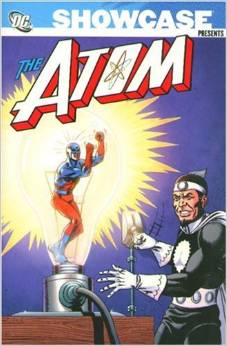
Showcase Presents: The Atom, Volume 1
Gardner Fox, Gil Kane, Murphy Anderson and friends
Reprints Showcase #34-36, The Atom #1-17
Get this for: Gorgeous Gil Kane art and more inventive than usual Gardner Fox scripts
Though it isn’t quite true that the sixties renaissance at Marvel was due to the work of three men: Jack Kirby, Steve Ditko and Stan Lee, it is more true than false, in contradiction to DC. There the whole Silver Age revolution took place while the company as a whole went on with business as usual. The Batman and Superman titles would largely stay out of it until the mid-sixties and there wasn’t an equivalent to that core of Lee, Kirby and Ditko driving everything. Therefore there was much less of a house style to DC’s superhero titles, as we can see if we compare Carmine Infantine’s work on The Flash with Gil Kane’s work here, on The Atom. Both in their own way are emblemic of DC’s Silver Age, but even when both are inked by Murphy Anderson, you couldn’t mistake the one for the other.
Like the Flash, the Atom got his tryout in Showcase, which by the time he got his spot, had perfected its formula: three sequential issues, followed by another three if needed, or in the case of the Atom, directly into his own magazine. As with The Flash, most issues of The Atom had two stories, with the second often dedicated to the Atom’s adventures in time thanks to professor Hyatt’s time pool, introduced in issue three, which also saw the debut of Chronos the Time Thief. Of course, like the Flash, the Atom was a reworking of an existing DC superhero, in this case just a bruiser whose small stature and his girlfriend mocking him for it set him on a path to fight crime — in the Golden Age this was actually one of the more complicated origins.
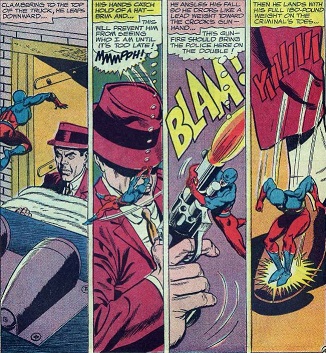
Sixties Atom was much more interesting of course, based in a science fictional origin. A piece of white dwarf star matter had fallen to earth near Ivy Town, where scientist Ray Palmer (named after Amazing Stories editor Raymond A. Palmer) found it and experimented with it. Palmer was attempting to find a reliable way to shrink down objects for reasons and thought the white dwarf fragment could help. In the end it turned out he could use it to shrink himself down with, but nothing was stable. So enter the Atom, the world’s tiniest crime fighter. Having not just the ability to shrink, but also to regulate his weight, moving from feather light to his “full 180 pounds weight” while six inch heigh, means the Atom can move about quickly while giving him a concentrated punch when needed. It also means Gil Kane gets to do a lot of great action scenes, utilising his skills to the fullest. His Atom is constantly in motion, hopping, punching, using the environment to reach his opponents and knock them out.
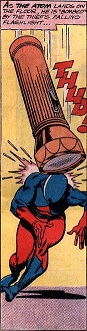
Talking about getting knocked out, that’s something the Atom himself does a lot too, almost as much as Hal Jordan is over in Green Lantern. Almost every story when the writer feels the need to drag a fight out or slightly complicate matters, something accidently falls on the Atom’s head, or some crook flails wildly and just manages to hit him, or something else happens that makes it all slightly less one sided. Though hilariously dumb when taken out of context, it does make sense in the sort of fights he gets into, with thugs flying everywhere and crashing into furniture as the Atom yanks their legs out from under them. Nevertheless it’s a miracle he never suffered a concussion; he should’ve been as punch drunk as an ex-NFL player by now. But it’s perhaps only when reading so many of these stories one after the other that formulas like this become noticable. These are after all still stories meant to be discarded, with little attention paid from issue to issue to continuity; it also must’ve helped that The Atom appeared bimonthly. You wonder if the original readers noticed these things or not…
As said, there’s little in the way of continuity in these stories, bar the occasionally reappearance of certain villains or crooks. Like Barry Allen in The Flash, Ray Palmer shows up complete with a girlfriend and like Linda West, she’s a professional woman, working as a criminal lawyer, not wanting to marry until she’s proven herself as a lawyer. A hint of feminism there? Of course, in the Comics Code world of Silver Age DC, she’s the sort of criminal lawyer who only defends the innocent, usually her friends, so you wonder how busy she is…. But it is interesting to see how many of DC’s early Silver Age heroes had working girlfriends: Flash, the Atom, Green Lantern and of course Hawkman and Hawkgirl. A far cry from the childish antics of the Lois Lane/Superman “relationship”.
Gardner Fox was of course a veteran comics and pulp writer already when he wrote The Atom and what I like about his scripts is that he often bases them on some piece of scientific or historical or even legal knowledge, which is then dutifully footnoted, only for it to get all crazy as only a silver Age DC comic can. All done seriously, but in one story based on how lactic acid builds up in muscles, you have the crook ironing the Atom to give him precognosis because apparantly that buildup gives off “ato-energy” which in turn caused precognosis!
To be honest, in the end you rarely read these comics for the story, but rather for the great Gil Kane art, which comes out very well in black and white indeed.

