In an alternate timeline, if WWF wrestling had had slightly more coverage in the Netherlands in the mid-eighties, rather than being banished to the post-midnight slot on Superchannel/Sky Channel, I would’ve become a wrestling nerd rather than a comix nerd. This video gives a great example of the appeal of wrestling when, as everybody knows, it isn’t real. Starring some people you may recognise.
Long Live the Queen — HA!

Kim Nguyen plays Long Live the Queen
Hanako Games’ Long Live the Queen is a princess story all about facets and demanding respect. You play as Princess Elodie, who must replace her late mother as queen by the end of the year. It’s a princess power fantasy where you learn all about Elodie’s world so that she may navigate politics both at home and abroad and survive attempts on her life. It’s a brutal game, as you learn how to progress by failing and/or dying repeatedly. It’s maddening for perfectionists.
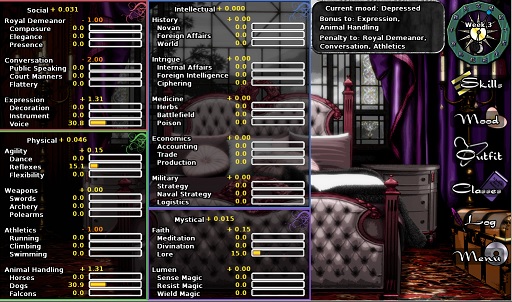
Long Live the Queen is one of those deceptively simple spreadsheet simulator games where the appeal is that it is really, horribly, unfairly difficult. Basically the only decisions you can take is what classes to send Elodie to, how she spends her weekend to help change her mood to get bonuses in her classes and hope you can take the right decisions during the cut scenes, which is when all the action happens. Some of the crisis events are triggered, some are random, some unavoidable but all you can only prepare for either by accident or because you’ve played it before and died. (Unless you cheated and had the wiki open next to it.)

Not a game with much of a visual glamour going on, so if that’s your bag, this is not for you. At best you get scenes like this, with princess Elodie looking at you depressed, angry or happy depending on her exact mood. All the real interest is in beating the story, which has set you up for failure. Having played it for a couple of hours, I can say it’s really frustrating to be blindsided by something you have recovery of; it needs an entirely different mindset to play than the sort of game I normally play, where there’s always room to correct a mistake you make. Here, you die and have to restart.

So instead you have to find out the perfect combination of skill training and luck to make it through the crisises that hound you and hope the game has mercy on you. But it probably won’t.
Resident Evil redux

Unlike myself, Mr Moth has played and is a fan of the original Resident Evil games the movies are based on. Therefore he’s considerably more hacked off at them than I was, though I can certainly agree with much of his criticism:
3) Paul WS Anderson really believes the Umbrella Corporation is staggeringly incompetent.
Umbrella manage to wipe out nearly every human in existence but to what end? They’re a business and the undead are not a target market. By the fifth film it’s clear that the Red Queen is intent on destroying humanity. The problem is that humanity is well on its way to total extinction by the time of, well, Extinction. Las Vegas is a ruin, buried by the Nevada desert in just five years. There’s no coming back from that, but still Umbrella hold board meetings and employ receptionists (exactly how were they recruiting their staff? “Are you a zombie?” “No.” “Welcome to Umbrella.”). Their long-term plan made no sense, and it’s worth noting that in the games, humanity is in much better nick.
But that’s ok, because they were never going to benefit from it, anyway. Every single one of their developments got away from them in one way or another. The Red Queen goes rogue and kills everyone. The Nemesis turns goodie. The super-secret exit to their bioweapons lab is besieged by thousands of zombies, kept at bay by the thinnest of chainlink fences. The airtight lab they store their highly infectious weaponised virus in has aircon vents that link directly to the offices. If their underwater base loses power, all their soldiers go to sleep during the power cut. They leave hundreds of clones lying around of their most powerful enemy.
The Resident Evil movies really only make sense as spectacles, especially after the first one, which I still think was a rather good suspense horror movie even if there were plot holes there you could drive a zombie horde through. The overall story arc doesn’t make much sense and Umbrella has to be the most incompetent, pointlessly evil corporation in the world.
And yet, having watched all five movies over the last two months, these are still entertaining movies that have the redeeming feature of starring strong, female characters who aren’t undermined by their male costars, hold their own without becoming the usual bad girl cliche. It can be so much worse, as a look at the Underworld series, that other naughties action horror with female lead franchise, shows.
What can the harvest hope for, if not for the care of the Reaper Man?
The news is no less shitty for being expected. Terry Pratchett, long suffering from early onset Alzheimers, has died. I’d been worrying about it ever since he pulled out of the Discworld con last year. I’ve been crying ever since I heard the news, coming in from an after work dinner with co-workers.
It’s hard to underestimate the impact he has had on my life, through his books and his fandom. The humour came first of course, shining through even the idiosynchronatic Dutch translation; the deep humanity came later. And then, in 1997 pTerry came to the Netherlands for a book signing in Rotterdam and I came into contact with alt.fan.pratchett fandom, people who are still friends almost twenty years later. There was Usenet and meetups and irc and Clarecraft Discworld Events and Discworld Cons.
And then there was Sandra.
We met on lspace IRC in spring 2000, mutually annoying each other (in what turned out to be a flirty way), then getting to talking each evening on the phone, then she came over just after Christmas 2000 and that was that. We spent the next two years travelling to and from each other’s homes, until in 2003 she moved in with me. Cue seven years of bliss, or at least domestic comfort, all thanks to Terry Pratchett.
But that’s not the best thing Terry Pratchett did for Sandra and me. The best thing he did for her was to help her die at a time of her own choosing. It was watching his documentary when she was in the middle of a two year battle with failing kidneys and the side effects of receiving a transplant. Talking it over afterwards she admitted that she had been thinking of wanting to die herself, of thinking that there would be a point at which she felt her life would no longer be worth living, that she had to give up the battle.
In the end, she of course did. She had been afraid that if and when she died, it would’ve been in pain and fear, not at a time and place of her own choosing. Terry Pratchett’s documentary gave her the strength and conviction to do put an end to a struggle no longer worth fighting, when she still had the ability to do so with dignity and on her own terms.
That was the greatest gift he could’ve given her and me, but I’ve never found the words to thank him for it.
“a covert kind of feminist SF”
In ada, “a journal of gender, new media & technology”, Lucy Baker looks at how Lois McMaster Bujold treats the birthing process in her Vorkosigan series and how it echoes real world feminist concerns:
Lois McMaster Bujold’s science fiction (SF) relies on the symbiotic relationship between the technological and the social. This is often illustrated by the tension between the scientific and medicalized process of reproduction (via uterine replicators, cloning, and genetic modification) and the primal, ‘natural’ process. Varied levels of technological advancement and associated societal changes across the myriad planets within her SF universe allow Bujold to structure this tension as an emotional and social process as much as a medical or obstetrical one, while maintaining a respect for the choices, risks, and vulnerabilities involved in becoming pregnant.
[…]
Bujold’s SF work highlights and integrates women’s experiences into the narrative. It is this examination and ultimately hopeful yet practical approach that makes Bujold’s work feminist – it is “Invention…stories and role models and possibilities, that prepare us to leap barriers and scale heights no one has reached before, that prepare us to change the world.” (Gomoll 6).
I only found this because it showed up in my referers one day, linking to my post arguing that Bujold writes hard science fiction. It’s further proof that despite her and the Vorkosigan series massive popularity, she’s still underestimated as a serious and important science fiction author. Partially it must be because the series is published by Baen Books, often somewhat unfairly dismissed as a publisher of cookie cutter mil-sf and other pulp and at first glance it’s easy to confuse the Vorkosigan books as something like the Honor Harrington series: lightweight entertainment.
That her gender also plays a part I’ll take as a given, though I note that hasn’t stopped her from winning an impressive number of Hugo and Nebula awards.
But what may also play a role is perhaps that Bujold is actually not obvious enough with her writing; as Baker argues, she writes “a covert kind of feminist SF”, nowhere near as overtly political as a Joanna Russ or even a Nicola Griffith. That the setting is the familiar sort of semi-feudal, aristocratic stellar empire helps hide this too, as the revolution the uterine replicator brings to Barrayar on the surface looks just like modernisation, not anything really revolutionary. In the same way the uterine replicator itself doesn’t look like hard science fiction because Bujold focuses too little attention to the technological side of things, but rather more on the social impact of it as filtrered through the point of view of her aristocratic protagonists.
(You could even make an argument that the overall story of the Vorkosigan series is showing the start of a bourgeois revolution, as progressive members of the old aristocracy make common cause with the up and coming rich merchants to remake the feudal system in their favour…)
And of course perhaps the most important reason why Bujold is underestimated is that she’s so very readable; you rarely have to struggle with reading her novels and we still tend to think difficulty equals genius.