Sugar, Sugar — Serge Baeken

how Sugar got his name

One of the best comics published last year was Serge Baeken’s Sugar, a slice of life comic about the life of a cat and the family he’s adopted into. Cat comics are always problematic because they so easily dive into sentimentality; it’s so easy just to lose yourself in cute anecdotes. Baeken’s work on the other hand has a bite to it. Partially because he recognises the essential truth of having cats, that you have to get used to their death, you share your life with them for, if you’re lucky, ten-fifteen years and then have to get used to their absence.

But more than that, it’s the art that keeps it from being sentimental, in its formalism. Baeken keeps the same six by four panel grid throughout the book, but within these panels experiments with layout in a way you don’t see a lot in other comics, certainly not so consistently. So in the early page shown above, you basically have a big overview picture of the street and block of flats the family lives in, intercut in panels, with the narrative set on top of it. It’s hard to know how to read it at first, your eye drawn down the page following the line of the building first, then back up to the first text balloon. Or perhaps down the road in the middle of the picture?

Sugar learns to talk

Baeken uses a lot of, if I understand McCloud’s Understanding Comics correctly, “aspect to aspect” transitions between panels, where different aspects of one idea are shown, rather than the passage of time. Here used like a training montage in a movie to show Sugar learning how to “talk” with his humans. I like the way in which the people are drawn slightly more “realistic”, with more lines to their faces than the cats, sleek and stylised.

Sugar in action

The consistent six by four grid is also great at showing action, with Sugar breaking through the panel borders, background orientation shifting with his own. There’s a touch of Toth, of Hugo Pratt in Baeken’s use of black and white, of shadow. These are pictures you can keep looking at for hours.
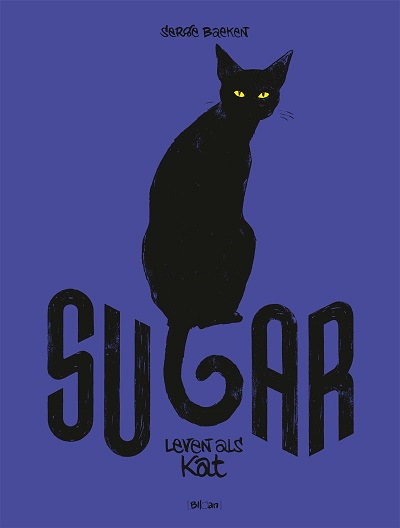
Sugar cover

As Wim Lockefeer laments at the Forbidden Planet blog, Sugar hasn’t been translated into English yet, but it wouldn’t need much translation. If you’re even slightly comfortable with French or Dutch, pick this up at your favourite comic store.

The Black Cat teaches judo (3)

The Black Cat teaches judo tricks from Black Cat 8

Somebody has gotten worried about children imitating these “lessons”, considering the warnings to “use caution as you may injure your partner”. The Black Cat isn’t noticably softer on dames than she is on her male sparring partners. Great expression on her opponent’s face in the last panel.

All her Children Fought


Proof you can tell a science fiction story with only three actors and one, not entirely convincing special effect. Based on the story by Tobias Buckell, who has the story of how it came to be up on his blog. It’s an excellent example of how much you can convey with just a bit of subtle incluing, by working within genre expectations. I can’t be the only one to watch this and be reminded of Ender’s Game, can I?

Some comments: I wonder if the choice of accents for the three actors was deliberate or just a coincidence, but it works in contrasting the boy and his minder with the main character. I’m not sure the premisse of the movie is valid, the reason why it’s young boys/children being sent up there rather than adults, but it makes emotional sense.

A week of short short stories reviews

So I made the decision to read through this list of 98 well received short SF stories from last year, as originally posted to MetaFilter, reading roughly three stories a day. The first week of posts is now up:

  • Introduction and list of stories
  • Day One: stories by Charlie Jane Anders, Eleanor Arnason and Dale Bailey
  • Day Two: Jessica Barber and two by Elizabeth Bear.
  • Day Three and Four: Helena Bell, Holly Black, Aliette de Bodard, Richard Butner, Richard Bowes & Chaz Brenchley.
  • Day Five: Siobhan Carroll, Dario Ciriello and C. S. E. Cooney.
  • Day Six: Julio Cortázar, Tom Crosshill and Amanda C. Davis
  • Day Seven: Amal El-Mohtar, Ruthanna Emrys and K. M. Ferebee.

It’s been interesting reading these stories this way, usually done on my tablet lying on the couch with a cat on my lap. Even if a given story isn’t too my liking, it’s easy enough to push through to a better one. I don’t read enough short stories normally and this is a good challenge to get me to read more.

Resident Evil: Afterlife

The infection hits Tokyo

If the Resident Evil movie series is good at anything, it’s at providing great looking images like this, set pieces that sacrifice logic for looks. Here we supposedly have patient zero infecting Tokyo with the T-virus, the first zombie to hit Japanese shores, but you would expect that after the destruction of Raccoon City and the subsequent spread of zombies over North America, Japan would be slightly more prepared for a similar outbreak, or that Umbrella would come clean about it. But no.

Alices attacking Umbrella

At the end of the last movie Alice promised Umbrella she’s visit them in Tokyo and she’d bring some friends. This is them. Alices and clones attack, loads of mooks die, not least from friendly fire as head baddie Wexler is not choosy in who he kills. It all ends with everybody from Umbrella and all the clones dead and Alice free to persue her quest for Arcadia.

That is a lot of the walking dead attacking that prison

Which turns out to be some sort of honeytrap, as she finds a lot of planes but no people, with the exception of a brainwashed Claire Redfield. They set off by plane along America’s west coast and come across a prison, surrounded by thousands of zombies, inhabited by a motly crew of survivors, most of whom won’t make it to the end of the movie.

you got to look good even after the zombie apocalypse

What struck me this time is how well groomed all these survivors are; Alice and Claire in full make up and pretty boy over there has kept his beard neatly trimmed. The Resident Evil movies always had a sense of style, but by now style has definately won out over substance. This is btw roughly were I first came in with the franchise, one late night after the football had finished. Back then I hadn’t realised how disjointed this movie was, one sequence stitched to another, or how much it was making up on the fly.

Knock knock

Case in point. This fucker. Suddenly there’s a supersized zombie king to make things interesting, a supernatural creature not seen in any of the other movies. This is something the movies have done before, when regular zombies are no longer enough, but it feels like cheating. Here it does what the run of the mill zombies couldn’t and break down the prison walls, functioning as catalyst to trigger our heroes frantic escape.

Surprise, surprise

They escape to the Arcadia, which Alice and co had learned was actually a ship sailing past the west coast, picking up survivors. It is of course a trap and of course it’s Wesker, who died in the first twenty minutes of the movie, who’s the mastermind, having infected himself with a new strain of the virus, keeping at bay with anti-serum and willpower. Cue massive boss fight including both the Redfields, Claire’s brother Chris having been introduced in the prison; a bit late, considering he’s once again an important character from the videogames not given his due in the movie series.

Jill Valentine working for Umbrella

A happy ending? Of course not. Umbrella, for all its incompetence in actually keeping a world worthy to rule over, are very good at having plots within plots and just as everybody is freed and the Arcadia is ready to become a haven for non-infected humans, up pop their gunships again. And who should lead the Umbrella forces but Jill Valentine, proving that a turn to evil always comes with a worsening taste in clothing, as she has her tits out and wears a not very comfortable looking leotard/fishnet combo.