Books read January

That’s the first month of 2015 done and dusted. Eleven books read, ten more reviewed over at the booklog. Which puts me on track for reading a hundred plus books this year, which would be nice. Four fantasy novels, three science fiction, two history books and one disappointing book on steampunk.

A Natural History of Dragons — Marie Brennan
The first in a series about a natural explorer obsessed by dragons in a mock-Georgian fantasy world. Excellently done.

Half Life — SL Huang
The sequel to Zero Sum Game, in which math savant Cas Russell learns how to fake friendship like a normal human being.

Everybody Was Kung Fu Fighting — Vijay Prashad
Excellent overview of the history of intersectionality between the South Asian and Black experiences, largely in the context of US history.

A Wizard Abroad — Diane Duane
The YA wizards series goes to Ireland, the country its author also moved to. Coincidence? Luckily not at all as Oirish as you may expect from an American author dabbling in Celtic myths.

The Golem and the Djinni — Helene Wecker
At the American Book Center they compared this to Jonathan Strange and Mr Norrell and I can see why. They share the same sensibility and willingness to let the story breathe.

The Rise of Cities in North-West Europe — Adriaan Verhulst
A bit of a misnomer as it only looks at roughly fifteen cities in the southern Netherlands between the Somme and the Meuse. Somewhat more worthy than I’d expected.

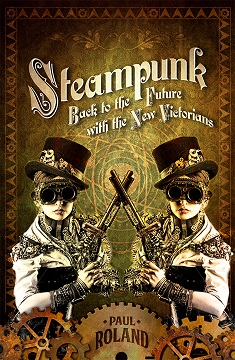
Steampunk — Paul Roland
A disappointing overview of the steampunk subculture.

Pandora’s Planet — Christopher Anvil
Light hearted semi-libertarian fun about humans outsmarting alien invaders — written from the point of view of the invaders.

The Lion Game — James H. Schmitz
Fifteen year old psionic wonderkind Telzey Amberdon outsmarts a hidden invasion of the Hub. Fun adventure science fiction.

Spies of the Balkans — Alan Furst
Another of Furst’s usually quite depressing spy thrillers set just before and during World War II, this one has what you might call a happy ending.

Wolfhound Century — Peter Higgins
Epic fantasy set in a sort of steampunk fantasy Soviet Russia.
Steampunk — Paul Roland

Cover of Steampunk


Steampunk
Paul Roland
191 pages including index
published in 2014

If I felt more nasty Reginald Pikedevant’s excellent cri de coeur against steampunk fakery would be my whole review. I spotted Steampunk: Back to the Future with the New Victorians in the library among the new books and thought “great, just the sort of field guide I need to come to grips with this newfangled steampunk nonsense”. Sadly though this turned out to be just a shallow cash in which told me little I didn’t know written in an irritating manner that had my hackles up halfway through the first chapter.

Read more…

Pandora’s Planet — Christopher Anvil

Cover of Pandora's Planet


Pandora’s Planet
Christopher Anvil
192 pages
published in 1972 (original in 1956)

Libertarianism has a well deserved bad reputation in science fiction, largely because so many writers who profess to be adherents also are godawful people who write jack off fantasies about how freedom requires there jackbooted thugs putting their boot in somebody else’s face, whether it’s Heinlein’s repeated wish to kill off all the lawyers or Kratman resurrecting the Waffen SS to deal with an alien invasion. But once upon a time there was a gentler, more humane sort of libertarianism, one that still catered to the prejudices of Analog notorious editor John Campbell Jr, but that hadn’t quite lost its humanity. H. Beam Piper was its best known representative, but there were others, like Christopher Anvil.

Anvil is one of those writers I only ever had heard about, but had never read simply because I’d never seen any of his work for sale, new or secondhand. He was never translated in Dutch as far as I know, one of those minor Analog writers who’d been reasonably popular in the sixties and seventies but was passed by when the genre moved on. From what I gather he specialised in stories in which clever humans put one over militaristic aliens and Pandora’s Planet is in that mold, gently cocking a snoot at authority in general in the process. It’s gentle and not very humourous satire, but much better than the modern libertarian habit of genociding every alien race that looks at Earth funny.

Read more…

The Black Cat teaches judo

The Black Cat teaches judo tricks from Black Cat 7

Decades before Felica Hardy poured herself into a slinky furred cat suit, stunt woman and movie star Linda Turner strut the comics pages in bathing suit, buccaneer boots and opera mask as the Black Cat. First appearing in Pocket Comics #1, she was a headliner in Speed Comics before she got her own series in 1946, which ran a respectable sixtyfive issues, though she had to deal with the usual genre switches as superhero comics stopped selling.

Unlike a lot of other golden age comics, the Black Cat had actually a decent line up of second features. Usually there were two Black Cat stories, the obligatory two pages text story (needed to keep up second class mail privileges), with the rest filled up by the usual boring “humour” one pagers as well as some interesting secondary strips. Simon and Kirby had The Duke of Broadway and The Vagabond Prince, there was Invisible Scarlet O’Neil, one of the first superheroines and others like His Honor and the Red Demon, about a judge turned superhero.

And then there were the judo pages. Starting from issue 7, each issue has two pages of judo tricks in which the Black Cat tells her readers how to get away from and subdue any ruffians, ably illustrated by her main artist, the underrated Lee Elias. So I thought, why not make these a regular feature?